

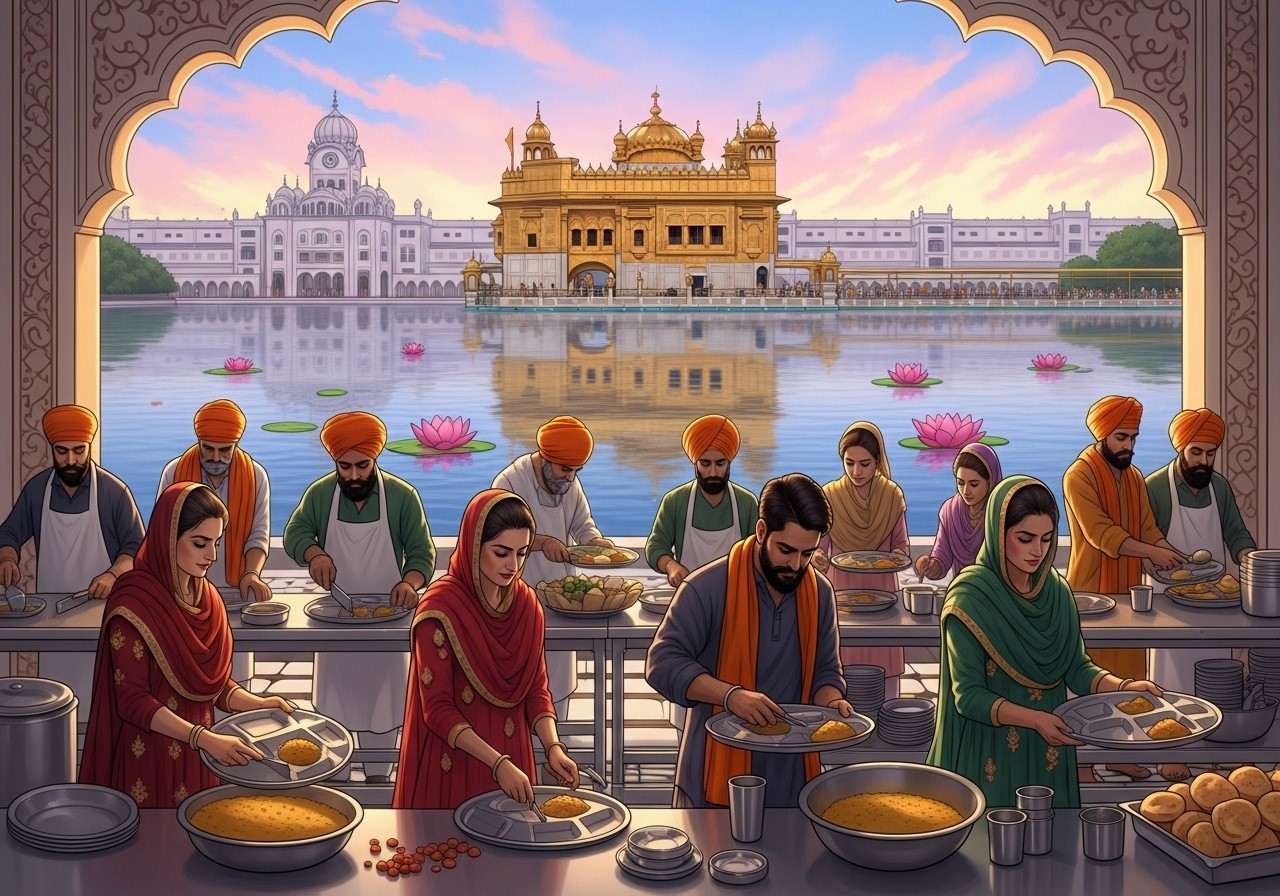
When you step into the Golden Temple (Harmandir Sahib) in Amritsar, the first thing that touches your soul isn’t just the gleaming gold or the holy Sarovar; it is the overwhelming sense of humanity. Here, the kitchen never sleeps. Known worldwide as the largest community kitchen, the Langar at Harmandir Sahib is a living testament to the Sikh values of equality, unity, and selfless love. Whether you are a king or a commoner, everyone sits together in pangat (rows) on the floor to share a meal, breaking down the barriers of caste, creed, and status.
For us in India, food is not just sustenance; it is Prasad—a divine blessing. The Langar serves as both a spiritual and community hub, welcoming millions of pilgrims with open arms and warm plates, showcasing the true essence of Indian hospitality.
The Roots of a Sacred Tradition
To truly appreciate this marvel, we must look back to the 15th century. The concept of Langar was introduced by Guru Nanak Dev Ji, the founder of Sikhism, who believed that “truth is the highest virtue, but higher still is truthful living.” He wanted to create a society where no one slept hungry and where people served one another without ego. This tradition was further strengthened by the successive Gurus.
While Guru Nanak Dev Ji planted the seed, it was nurtured by others. For instance, the third Guru formalized the institution of Langar, insisting that anyone wishing to meet him must first eat in the community kitchen. You can read more about Guru Amar Das Ji and the legacy of equality to understand how deep these roots go. Later, when Guru Arjan Dev Ji built Harmandir Sahib in 1604, it became the beating heart of this tradition. The core principles of ‘Seva’ (selfless service) and ‘Sarbat da Bhala’ (welfare of all) continue to guide the operations today, just as Guru Ram Das Ji’s teachings continue to inspire the community.
A Miracle of Logistics: Operations and Scale
It is hard to fathom the sheer scale of the operation until you see it with your own eyes. The Langar at Harmandir Sahib operates 24 hours a day, 365 days a year. It is estimated that the kitchen serves between 50,000 to 100,000 people daily. On festivals like Vaisakhi or Gurpurab, this number can easily swell to over 200,000 devotees.
How is this possible? It is the power of the community. The kitchen is run by approximately 500 employees, but the real energy comes from the countless volunteers, or Sevadars. You will see grandmothers peeling vegetables alongside young college students, and CEOs washing dishes next to farmers. To handle the rush, the kitchen utilizes massive cooking vessels and modern technology, including an automatic roti-making machine capable of churning out 25,000 rotis per hour during peak times.
- Sustainability and Care: The management is increasingly conscious of the environment. The Shiromani Gurdwara Parbandhak Committee (SGPC) has taken a commendable step to adopt organic farming for the Langar ingredients, ensuring the food is not only spiritually pure but physically healthy.
- Energy Efficiency: Blending tradition with modernity, the operation incorporates sustainable practices like using solar energy and recycling water, setting an example for large-scale kitchens globally.
The Menu: Simple, Satvik, and Soulful
The food served in the Langar is simple, vegetarian, and incredibly nutritious. The standard menu usually consists of piping hot Dal (lentils), Rice, Sabzi (mixed vegetables), Roti (bread), and Kheer (rice pudding). Following Sikh dietary customs and to ensure the food is suitable for visitors of all faiths, the meals are prepared without garlic or onions.
If you have a special place in your heart for sacred offerings, you might be interested in our collection of Holy Food and Prasad items available at Poojn.in, which celebrates the sanctity of divine bhog.
The cooking techniques focus on hygiene and community involvement. However, the most anticipated offering is the Karah Prasad—a rich, sacred pudding made of wheat flour, sugar, and generous amounts of desi ghee. It is received with cupped hands as a sign of humility.
How Poojn.in Helps You Bring the Divinity Home
While we at Poojn.in do not organize travel or tours to the Golden Temple, we understand that the spirit of Amritsar lives in the hearts of devotees everywhere. We act as a bridge, bringing the authentic cultural and spiritual essence of India to your doorstep. Our online store is dedicated to providing high-quality goods that help you maintain your rituals and traditions, wherever you are.
Essentials for Your Home Rituals
The spirit of feeding others, similar to the Langar, is also found in the Vedic tradition of Brahman Bhojan or Annadaan. To support your personal acts of charity and worship, we offer:
- Traditional Puja Thalis: Explore our range of Puja Thalis which are essential for serving food during rituals, ensuring that your offering is presented with the utmost respect and tradition.
- Brass Utensils and Incense: We provide authentic brass utensils for traditional cooking and serving, alongside premium incense sticks that create a fragrant, sacred atmosphere during your meal preparation and prayers.
Connecting with Sikh Heritage
For those who wish to deepen their understanding of the sacred spaces of Sikhism, we have curated a selection of items that resonate with the teachings of the Gurus.
- Books and Prayer Mats: Our store offers a collection of books on Sikh history and philosophy to help you learn about the Gurudwaras. We also provide comfortable prayer mats (Aasan) to ensure your meditation and prayer sessions are peaceful.
- Religious Texts and Attire: To help you connect with the scriptures, we offer Sikh religious texts and traditional clothing suitable for visiting Gurudwaras or for your daily prayers at home.
Note: Poojn.in is an online store for cultural goods. We do not provide VIP darshan, travel packages, or guide services for temples.
For more information or to shop our range of cultural goods, contact us at 03369029784 or WhatsApp 9476142738.
Impact on Culture and Society
The Langar at Harmandir Sahib is more than just a free meal; it is a lesson in humanity. It provides food security for the needy while teaching the privileged the value of humility. By sitting on the same floor, eating the same food, the distinctions of the outside world vanish. It serves as a global model for community kitchens, proving that when people come together with a pure heart, no one needs to go hungry. Visitors often leave with tears of gratitude, not just for the food, but for the overwhelming love with which it is served.
Common Questions About the Golden Temple Langar
What exactly is the Langar at Harmandir Sahib?
It is the world’s largest free community kitchen located inside the Golden Temple complex. It welcomes everyone, regardless of religion or background, to sit and eat together, fostering unity.
Is there a cost to eat there?
No, the meals are completely free. The Langar is supported entirely by donations (Dasvandh) from devotees and the selfless service of volunteers.
What kind of food is served?
The menu is strictly vegetarian and typically includes wholesome staples like Roti, Dal, Rice, Vegetables, and Kheer. The food is simple, hygienic, and deeply satisfying.
Can I volunteer at the Langar?
Absolutely. This is known as ‘Seva’. You do not need any prior permission; you can simply walk in and ask to help with chopping vegetables, serving water, or washing dishes. It is considered a great privilege.
When is the best time to visit for Langar?
The kitchen operates 24/7, so you can partake in the Langar at any time. However, it is most crowded during meal times (lunch and dinner) and on religious festivals.
A Final Thought
Harmandir Sahib’s Langar stands as a timeless beacon of hope and unity. It reflects the core Sikh values of compassion and service. It reminds us that while we may pray in different ways, hunger is the same for everyone, and so is the need for love. By welcoming every individual with open arms, it bridges gaps and builds a sense of community that the world desperately needs today.