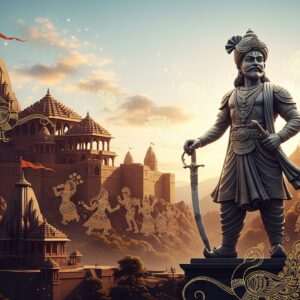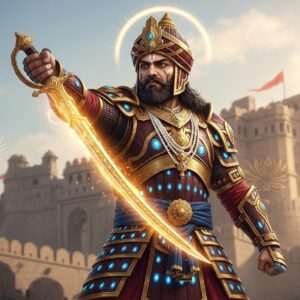


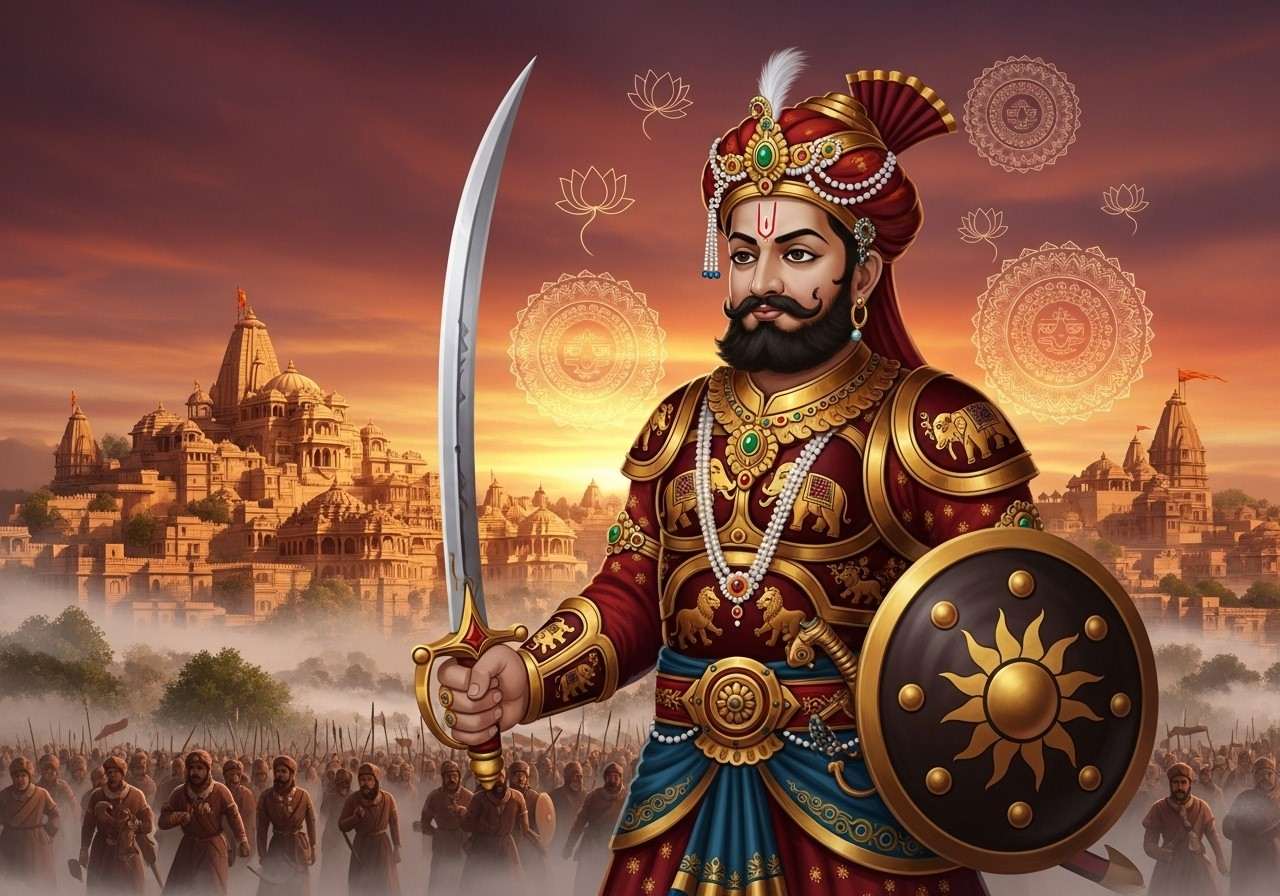
The history of our motherland is filled with tales of kings who fought for land, but very few fought for the soul of the nation. Bappa Rawal is one such legendary figure. His story is not just about the clash of swords; it is about the rise of a civilization, the defense of Dharma, and the establishment of the glorious Mewar Kingdom. For us Indians, remembering Bappa Rawal is like revisiting the roots of our own resilience. Let us journey back to the 8th century and understand the life of this great Hindua Suraj (Sun of the Hindus).
The Rise of a Warrior: Historical Background
Born as Kalabhoja, Bappa Rawal grew up in a time when the Indian subcontinent was facing severe threats from foreign invaders. Belonging to the esteemed Guhila Rajput dynasty, he carried the blood of ancestors who valued honor above life. The 8th century CE was a turbulent period, and the region of Mewar needed a savior. It is impossible to discuss this era without understanding the deep significance of the Mewar Kingdom, which later became the cradle of Indian resistance and pride.
The terms ‘Rajput’ and ‘Chittor’ became synonymous with bravery during his time. Rajputs were the custodians of culture, and Chittor was not just a fort, but a symbol of unshakeable power. Bappa Rawal’s upbringing in the wild hills of the Aravallis prepared him for a destiny that would reshape the map of India.
Battles that Saved a Civilization
Bappa Rawal’s military career was nothing short of miraculous. His battles were not merely for territory; they were for the protection of our culture and traditions.
The Iron Wall Against Arab Invasions
One of his greatest contributions was repelling the Arab invasions that had swept through Sindh. Leading a coalition of Indian rulers in the Battle of Rajasthan, Bappa Rawal inflicted a crushing defeat on the invaders. History tells us that he stopped the advance of Muhammad Bin Qasim, a feat that protected the heartland of India from being overrun. Some historical accounts even suggest that Bappa didn’t just stop them; he pursued the retreating armies through Saurashtra, pushing them back to the western banks of the Sindhu River.
Victory at Mandovar
The tales of his courage are legendary. In the battle of Mandovar, Rajasthan, it is said that Bappa Rawal led a small force of just 6,000 soldiers against an enemy army ten times that size. Through superior strategy and the fierce spirit of his men, he achieved a decisive victory. This proved that in war, it is not just numbers that count, but the fire in the heart of the warrior.
Expanding the Horizons
Bappa Rawal was not content with just defense. He expanded his kingdom aggressively, making vassals of distant lands like Kandahar, Khorasan, and parts of Iran. He marched as far as Ghazni, defeated the local ruler Salim, and established his influence before returning home. This expansion ensured that the frontiers of India remained secure for a long time.
Establishing the Kingdom of Mewar
While battles are won with swords, kingdoms are built with vision. In 728 CE, Bappa Rawal formally established the Mewar Kingdom. The crowning jewel of his conquest was the capture of the strategic Chittor Fort from the Mori rulers (some sources suggest he took it back from Arabs who had defeated the Moris) between 734-753 CE. He made Chittor the capital, a move that would define Rajput history for centuries.
He was a master diplomat as well. Understanding that unity is strength, he formed alliances with regional powers like the Pratihara king Nagabhata I. Just as we see in the history of other great Indian powers, such as the Gahadavala Dynasty, alliances were crucial for survival and prosperity.
Because of his contributions, he was bestowed with titles that still evoke respect: Raj Guru (preceptor of princes) and Chakravarti (Universal Lord). He laid the foundation for a lineage that would later produce heroes like Maharana Pratap.
Connecting with Our Roots Through Poojn.in
Reading about such glorious history often sparks a desire to connect with our own traditions. At poojn.in, we understand that culture is not just in books, but in the rituals we perform daily. Just as the Rajputs worshipped Goddess Shakti for strength before battle, many of us continue these traditions today. If you are looking for authentic ritual items, such as the Rakta Jaba Alta used in auspicious Devi pujas, our online store is your one-stop destination. We are India’s biggest cultural goods store, dedicated to bringing you genuine products that honor your faith. Visit poojn.in to bring a piece of tradition into your home.
Legacy and Cultural Influence
Bappa Rawal did not just leave behind a kingdom; he left a legacy of valor and kinship solidarity. He showed that a ruler must be a guardian of his people’s faith and way of life. The temples he supported and the forts he strengthened are standing testaments to his vision. His life reminds us that a warrior also has a personal and spiritual side, much like the lesser-known stories of later warriors, such as Chimaji Appa’s family life, which show the human aspect behind the sword.
Common Questions About Bappa Rawal
Understanding the Founder of Mewar
Many people are curious about who Bappa Rawal really was. Simply put, he was the visionary warrior king who founded the Mewar dynasty in Rajasthan in the 8th century, celebrated for his unmatched valor against foreign invaders.
The Significance of His Empire
When we ask what his empire is known for, the answer lies in its military might and cultural preservation. He turned Mewar into a stronghold of resistance and prosperity in northwestern India, setting a standard for future Rajput generations.
The Impact of His Battles
It is often asked how his battles shaped the kingdom. His victories, particularly against the Arabs and at Chittor, did not just expand his borders; they secured the region’s political autonomy. By defeating Muhammad Bin Qasim, he ensured the safety of the Indian interior.
Lessons from His Leadership
What can we learn from him today? Bappa Rawal teaches us the importance of strategic alliances, the power of a united front, and the duty to protect one’s culture. His leadership was a blend of aggression in battle and wisdom in governance.
At Poojn.in, we salute the spirit of Indian heritage. While we do not offer travel packages or VIP temple darshan, we are proud to serve you by providing the finest cultural and ritual goods online. Let us help you keep the flame of tradition alive in your home.