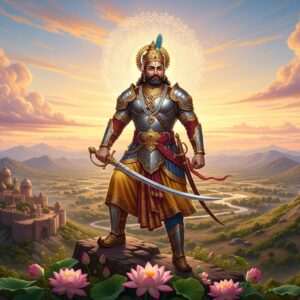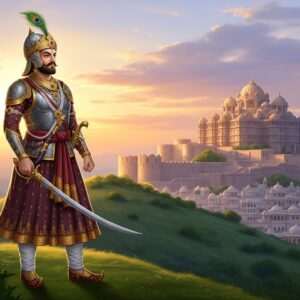


When we speak of Indian history, few chapters evoke as much goosebumps as the saga of Mewar. Located in the heart of Rajasthan, this region is not just a piece of land; it is a testament to unshakeable resolve, sacrifice, and honor. The story of the Mewar dynasty, spanning over 1400 years, is a glowing example of how our ancestors stood like a protective wall against foreign invasions. From the founding strength of Bappa Rawal to the legendary defiance of Maharana Pratap, this lineage defines the true Rajput spirit.
For us Indians, understanding this history is like reconnecting with our roots. It reminds us that our culture has survived because brave souls fought to protect it. Let us take a journey through time to understand the socio-political climate of that era and appreciate the legacy that makes us proud today.
Bappa Rawal: The Architect of Mewar’s Sovereignty (713 AD – 753 CE)
The story begins with a young boy named Kalbhoj, born in 713 AD, who would later be known to the world as Bappa Rawal. His early life was steep in tragedy and struggle; his father, Rawal Mahendra, along with other male family members, fell in a fierce battle against the Bheels of Idar. However, destiny had greater plans for him.
Raised by his mother with the protective support of loyal Bheel attendants, Bappa Rawal learned the intricate skills of military warfare and survival from the very communities that once opposed his kin. This upbringing instilled in him a deep connection with the land and its people.
In 734 AD, at the young age of 21, he displayed immense valor by defeating Man Mori, the ruler of Chittor, and conquering the historic Chittor Fort. This victory marked the true beginning of the Mewar Kingdom‘s dominance. But his contributions went beyond local conquests. Bappa Rawal was a visionary who understood the threat of foreign invaders. He is credited with leading an anti-Arab confederacy, alongside the Gurjara-Pratihara ruler Nagabhata I, successfully repelling Arab invasions in the 8th century.
Before he abdicated the throne in 753 CE to pursue a spiritual path, he had established a legacy so potent that he is even said to have built the city of Rawalpindi as a military base. His reign laid the spiritual and political foundation that would sustain the dynasty for centuries.
The Golden Lineage: Guardians of Culture
Following Bappa Rawal, the Guhila Rajput dynasty continued to flourish. The rulers who followed didn’t just fight wars; they were patrons of art, architecture, and Dharma. They understood that a kingdom is defined by its culture. During times of external threats and internal strife, the dynasty used strategic matrimonial alliances and shrewd diplomacy to keep the saffron flag flying high.
The period between the 8th and 16th centuries saw Mewar evolving into a distinct entity. Trade routes flourished, and the unique Mewari identity—a blend of martial pride and deep religious devotion—was cemented. It is this very devotion to culture that we try to keep alive in our modern homes today.
At Poojn.in, we understand the importance of keeping these traditions alive. While we cannot fight battles like our ancestors, we can honor them by maintaining the sanctity of our daily rituals. Explore our collection of authentic cultural goods that help you stay connected to your roots.
Maharana Pratap: The Icon of Resistance (1540-1597)
Centuries later, the values planted by Bappa Rawal blossomed in the form of Maharana Pratap Singh I. Born on May 9, 1540, to Udai Singh II and Jaiwanta Bai, he belonged to the illustrious Sisodia clan. He ascended the throne as the 13th ruler of Mewar in 1572, at a time when the Mughal Empire, under Akbar, was swallowing kingdoms across India.
Maharana Pratap’s life was a constant refusal to compromise on self-respect (Swabhiman). The pivotal moment came during the Battle of Haldighati on June 18, 1576. Here, Pratap’s forces clashed with a massive Mughal army led by Man Singh I of Amber. Despite being outnumbered, the battle was fierce. Although the Mughals claimed the field, they failed to capture the Maharana or crush his spirit.
- Guerrilla Warfare Tactics: Following Haldighati, Maharana Pratap retreated into the rugged Aravalli hills. He used the terrain to his advantage, employing guerrilla tactics that frustrated the Mughal forces for years, preventing them from establishing total control over Mewar.
- Unbroken Spirit: Unlike many contemporaries who surrendered for comfort, Pratap chose a life of hardship in the forests rather than bowing down. This sacrifice turned him into a deity of patriotism and freedom in Indian folklore.
Sadly, this beacon of bravery passed away due to injuries from a hunting accident at Chavand on January 19, 1597, at the age of 56. However, his legacy remains immortal.
Bridging the Era: From Bappa to Pratap
When we look at the timeline from Bappa Rawal to Maharana Pratap, we see a beautiful thread of continuity. Bappa Rawal created the kingdom and secured it against early invaders; Maharana Pratap defended that very sovereignty against a powerful empire centuries later. Both rulers were heavily influenced by their mothers and the support of local tribes (Bheels), proving that true leadership in India has always been inclusive.
If you are keen on understanding how these royal families interconnect, including other significant dynasties, it is fascinating to look at the broader picture of Indian royal history.
For those interested in the deep roots of Indian history, Poojn.in offers insightful content on various dynasties. You can read more about historical connections, such as the Surasena Kings or the vast Vardhana Dynasty, to see how different royal houses shaped the India we know today.
Keeping the Tradition Alive in Your Home
The history of Mewar is not just for textbooks; it is a reminder of the sanctity of our traditions. Today, we don’t need swords to protect our culture; we need dedication to our values. Whether it is lighting a lamp in the evening or performing a small puja, every act is a tribute to our ancestors who fought to preserve this way of life.
To help you maintain this spiritual atmosphere in your home, Poojn.in brings you premium quality ritual items. We specialize in goods that are essential for your daily worship, ensuring you get the best without leaving your home.
Our Offerings Include:
– Traditional Puja Thalis: beautifully crafted to add grace to your rituals.
– Pure Incense Sticks: to create a calming, divine aura in your prayer room.
– Brass Deities: Authentic idols for your home temple.
Visit www.poojn.in today. For personalized assistance, you can call us at 03369029784 or chat with us on WhatsApp at 9476142738.
Common Queries About Mewar’s Lineage
Who is considered the true founder of the Mewar Kingdom?
Most historians and cultural experts regard Bappa Rawal as the true founder. Born as Kalbhoj, he established the kingdom in 728 CE and later conquered the Chittor Fort in 734 AD, setting the stage for the dynasty’s dominance.
How are Bappa Rawal and Maharana Pratap related?
They are connected through blood and lineage. Bappa Rawal was the founding ancestor of the Guhila dynasty, which later evolved into the Sisodia clan, to which Maharana Pratap belonged. Pratap was a direct descendant, carrying forward the same torch of independence lit by Bappa Rawal.
What was the significance of the Battle of Haldighati?
Fought on June 18, 1576, this battle is a symbol of resistance. Although Maharana Pratap’s army was outnumbered by Akbar’s forces (led by Man Singh I), the battle demonstrated that the Rajputs would not submit easily. It marked the beginning of Pratap’s legendary guerrilla warfare in the Aravallis.
Did Bappa Rawal really fight the Arabs?
Yes, historical records suggest that Bappa Rawal played a crucial role in the 8th century. He was part of a strategic anti-Arab confederacy and is credited with repelling invasions, thereby protecting the Indian subcontinent from early foreign domination.
Where can I find authentic items to honor my cultural traditions?
For those who value authenticity, Poojn.in is your trusted partner. We provide a curated selection of cultural and ritual goods, delivered right to your doorstep, so you can focus on your devotion.