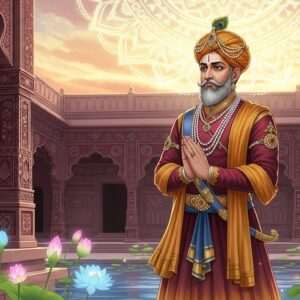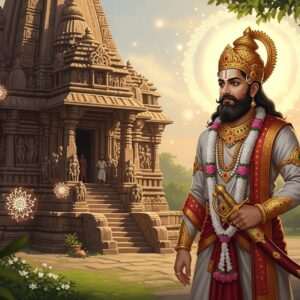


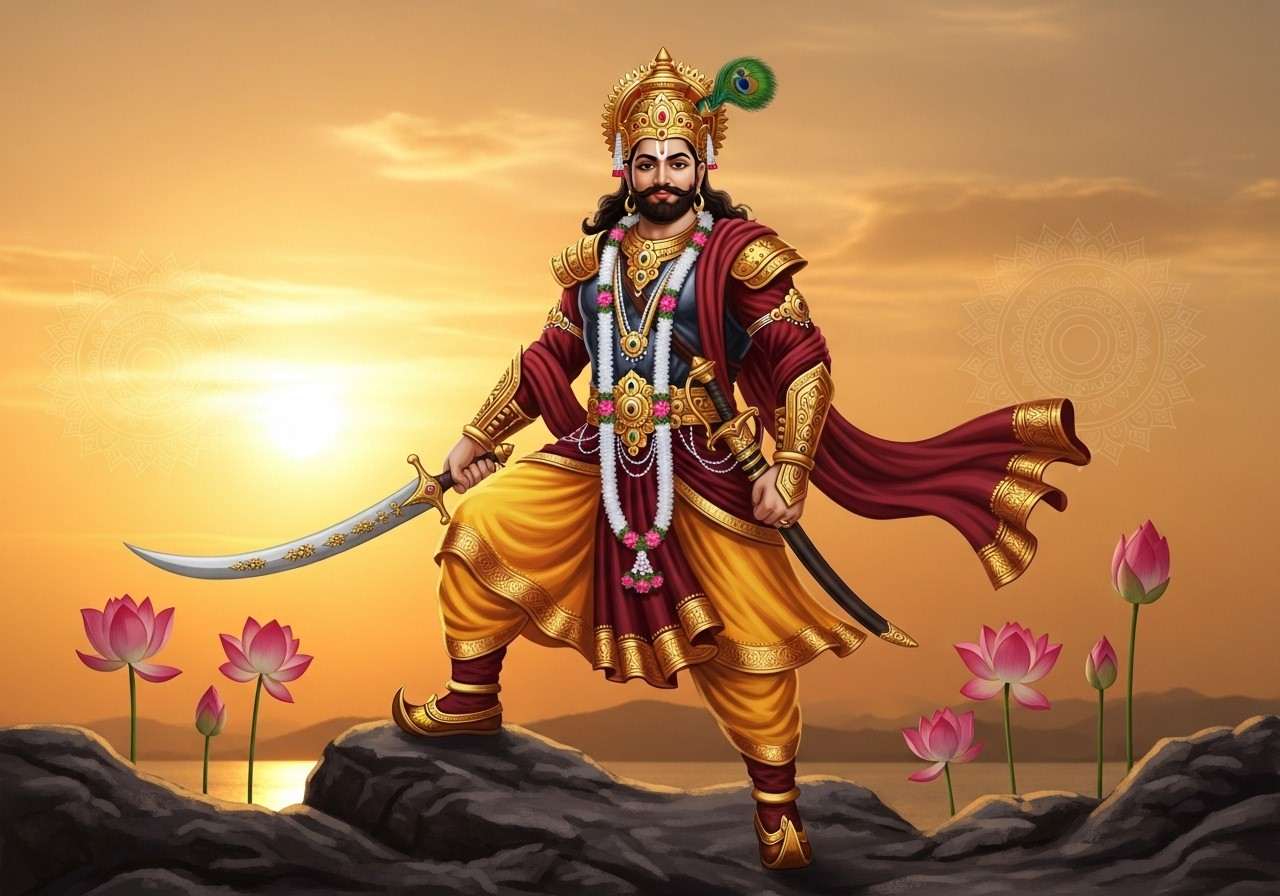
In the vast and vibrant tapestry of Indian history, few names resonate with as much valor and reverence as Bappa Rawal. Often celebrated not just as a king but as a savior of Dharma, he stands as a colossal figure in the 8th century. For us Indians, history is not merely dates and facts; it is a living memory of our ancestors’ sacrifices. Bappa Rawal, also known by the name Kalbhoja, was the illustrious founder of the Mewar Kingdom, establishing a legacy of resistance and honor that would define the Rajput spirit for centuries to come.
Ruling during a tumultuous era, he is credited with shielding the motherland from foreign invasions. Today, we take a journey back in time to explore the life of this mighty ruler, the myths surrounding his 1280 kg sword, his towering physical stature, and the divine blessings of Eklingji that guided his path.
The Historical Rise of a Warrior King (728 CE)
The 8th century was a period of significant transition and challenge for India. It was during this time that Bappa Rawal rose to prominence, etching his name in the annals of time. Historical records and the Ekalinga Mahatmya suggest that he established the Mewar Kingdom around 728 CE. He was not born onto a golden throne; rather, his early life was marked by struggle and destiny. Following the death of his father, Nagaditya, in a battle against the Bhils of Idar, young Bappa was raised in the safety of Nagda by a Brahmin mother, disguised as a caretaker of cows.
His lineage traces back to the Guhila Rajput dynasty, but it was his personal valor that unified the clans. He is celebrated for repelling Arab invasions from the north-west, securing the borders of India. In fact, his influence was so profound that it is said he established a military post that eventually grew into the city of Rawalpindi (now in Pakistan), named in his honor. For those interested in how ancient warriors defended their lands, understanding the history of regional conflicts is vital, much like the deep history found in Parshuram Kund mythology and history.
Divine Legends: The Blessings of Harit Rashi
In India, power is often seen as a result of devotion (Bhakti). The legend of Bappa Rawal is incomplete without mentioning the sage Harit Rashi. It was this great sage who recognized the royal potential in the young cowherd and initiated him into the Shaivite order. The sage’s blessings were instrumental in Bappa attaining kingship. As a mark of eternal gratitude and devotion, Bappa Rawal constructed the magnificent Eklingji Temple at Nagda.
Unlike other monarchs who ruled as supreme owners of the land, Bappa Rawal set a unique precedent. He ruled as a Diwan (prime minister) or servant of Lord Shiva, considering Eklingji to be the true King of Mewar. This tradition of humility and service was upheld by his descendants for generations. Legends also speak of his expansive family life, suggesting he married numerous women, with some accounts claiming 100 queens, signifying political alliances across regions.
The Myth of the 1280 Kg Sword and Towering Stature
When we sit with our elders, the stories of Bappa Rawal’s physical strength often sound superhuman, filling our hearts with awe. Folklore describes him as a giant among men, standing nearly 9 feet tall. To match this incredible frame, it is said he wore a dhoti measuring 35 hands and a royal dupatta of 16 hands. However, the most captivating aspect of this legend is his weapon.
Oral traditions passionately claim that Bappa Rawal wielded a massive sword weighing 1280 kg (roughly 35-40 Man in traditional weights). While modern historians view these numbers as metaphors for his unstoppable power and the “heavy hand” he dealt to enemies, these stories highlight the warrior ethos of Rajasthan. His strength was not just physical but moral, allowing him to conquer the Chittor Fort from the Mori tribe and lay the foundation of a dynasty that would never bow down. If you are fascinated by the legacy of legendary blades, you might enjoy reading our comparison on Khanda vs Katana: Iconic Sword Comparison.
Bring a Piece of Valor to Your Home
At Poojn.in, we understand that honoring our ancestors is about keeping their memory alive in our daily lives. While we cannot offer the legendary heavy swords of the past, we provide authentic, culturally rooted ritual items that symbolize that same protective energy. For devotees and collectors who wish to keep a symbol of strength in their prayer room or home, we have curated special items.
Please note that we specialize only in cultural goods and do not offer travel packages or temple tours.
-
Brass Tir Kathi (14 Inch)
This exquisite brass piece captures the essence of traditional weaponry in a ritual format. Measuring 14 inches, it is perfect for your home shrine, representing the protective power of the Trishul and the warrior spirit of ancient India. -
Brass Tir Kathi (18 Inch)
For those seeking a more commanding presence in their spiritual space, this 18-inch version offers a grander tribute to our heritage. It is crafted with attention to detail, ensuring that the sanctity and aesthetic of Indian rituals are maintained.
For any assistance with these cultural treasures, please feel free to reach out to us at 03369029784 or send a message on WhatsApp at 9476142738.
Common Curiosities About Bappa Rawal
We know that reading about such a larger-than-life figure sparks many questions in the minds of our readers. Here, we address some of the most common topics discussed by history enthusiasts and devotees alike.
Many people frequently ask about the authenticity of the sword’s weight. While the figure of 1280 kg is widely popular in folklore and bardic tales (Charan Sahitya), it is largely considered a symbolic representation of his immense strength and the heavy burden of leadership he carried. No human could wield such weight in combat, but the legend effectively conveys that his might was unparalleled.
Another common topic of interest is his connection to Lord Shiva. Readers often want to know why he is called a “Sevak.” Bappa Rawal did not view himself as the ultimate authority; he believed he was merely managing the land on behalf of Eklingji. This is why the rulers of Mewar never formally sat on the throne inside the Eklingji temple, sitting on the floor instead to show respect to the true King, Lord Shiva. This devotion is somewhat similar to the deep spiritual connections found in other regions, such as the legends explored in Rajasthan’s Parshuram Temples.
Finally, there is often curiosity regarding his burial and final days. Historical discrepancies exist, with some saying he abdicated the throne around 753 CE or 764 CE to become an ascetic. Legends even suggest a miraculous end where his body turned into flowers, allowing both his Hindu and Muslim subjects (due to his extensive conquests and marriages) to honor him in their own ways, reflecting his vast influence across the subcontinent.
A Legacy Etched in Stone
The impact of Bappa Rawal is not just in books but visible across Rajasthan. A majestic statue of Bappa Rawal stands in Mewar, and another can be found within the Eklingji Temple complex, where he is depicted with clasped hands facing Nandi, the holy bull. Furthermore, the Shri Bappa Rawal Temple in Mathatha serves as a beacon of his enduring glory.
Bappa Rawal was more than a ruler; he was the architect of a legacy that prioritized Dharma, independence, and valor. His story reminds us that true strength lies in the service of the divine and the protection of one’s culture. At poojn.in, we are honored to share these stories that define who we are. Explore our collection today to bring a piece of this rich tradition into your home.