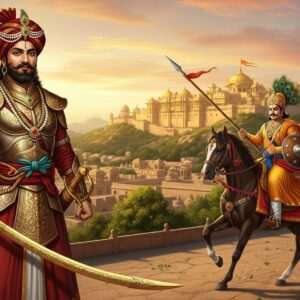


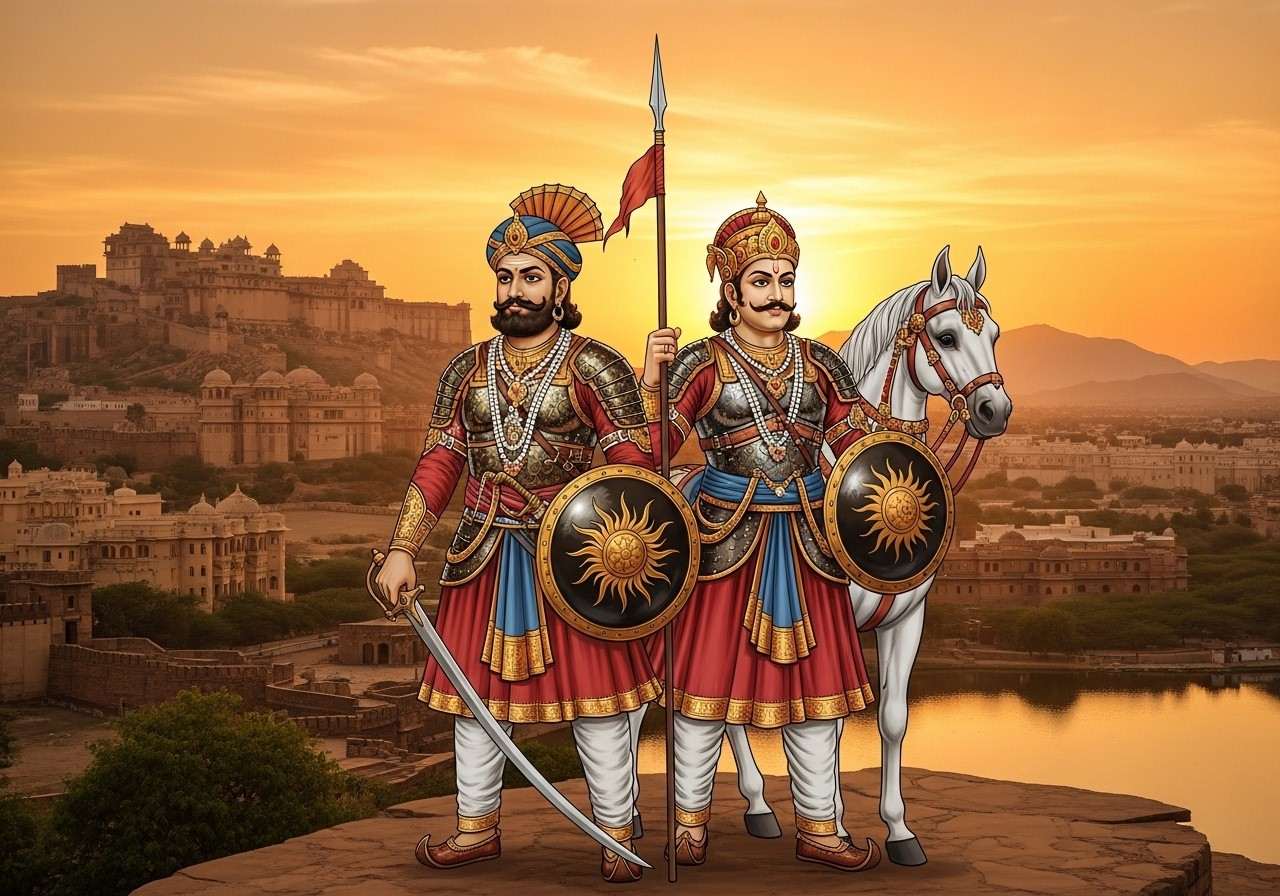
Namaste and welcome to Poojn.in. When we speak of bravery in India, one region stands tall, echoing tales of sacrifice and unshakeable resolve—the Mewar Kingdom. This is not just history; it is the heartbeat of Rajputana. From the early days of Bappa Rawal to the fierce defiance of Maharana Pratap, the rulers of this dynasty have left a mark that time cannot erase. At Poojn.in, we cherish these stories that shape our identity, bringing you closer to the roots of our glorious culture.
The Origins: A Legacy Carved in Stone (530 AD – 734 AD)
The story of the Mewar Dynasty, often referred to as the Udaipur State, is ancient and profound. While the kingdom’s foundations were laid around 530 AD, the true lineage traces back to the Guhila rulers. It is believed that the dynasty’s origins go back to Guhil (Guhaditya) around 569 AD. However, the man who truly etched the name of Mewar into the annals of history was the legendary Bappa Rawal.
In 734 CE, Bappa Rawal achieved a monumental victory by seizing the mighty Chittorgarh fort from the local Mori chieftains. This was not just a conquest; it was the birth of a powerhouse that would defend India’s western frontiers for centuries. For a deeper understanding of how this powerful state evolved, you can read our detailed guide on Mewar Kingdom: A History of Its Rise and Fall.
Bappa Rawal: The Shield of India
Bappa Rawal was more than a king; he was a guardian of the faith and the land. In the early medieval period, when India faced the threat of Arab incursions, it was Bappa Rawal who stood like a wall. History records his successful campaigns against Arab invaders, including the formidable General Junaid. He did not just defend his territory; he drove the invaders back beyond the western borders of Rajputana.
-
Military Genius: Bappa Rawal’s strategies were ahead of his time. He united various clans and created a formidable force that ensured Mewar’s sovereignty, eventually allowing it to emerge as an independent state in the early 10th century.
His ability to foresee threats allowed Mewar to survive while neighboring powers struggled against the expansion of the Delhi Sultanate. -
Spiritual Foundation: The rulers of Mewar always ruled as custodians (Diwans) of Lord Eklingji (Shiva). Bappa Rawal’s patronage of temples established a tradition where governance and spirituality went hand in hand.
This spiritual dedication is why the people of Mewar remained resilient even in the darkest times, believing their true ruler was the Divine himself.
The Shift to the Sisodia Dynasty
History is never static. Over the centuries, the original Guhilot clan made way for their kin, the Sisodia clan. This transition in the 14th century marked a new era of resilience. A pivotal moment came in 1326, when the valiant Rana Hammir, also known as Maharana Hammir Singh, recaptured Chittorgarh from the Tughluq forces. He solidified the Sisodia branch, ensuring the saffron flag flew high once again. To understand the geography and symbols of this era, do explore our article on Mewar Legacy Explored: Capital, Map, and Flag Guide.
Maharana Pratap: The Icon of Defiance
Centuries later, the dynasty produced a warrior whose name is synonymous with freedom—Maharana Pratap. By the time he ascended the throne, the political landscape had changed drastically. The Mughal Emperor Akbar had conquered Chittorgarh in 1568, and the capital had shifted. Yet, the spirit of Bappa Rawal lived on in Pratap.
Maharana Pratap refused to bow down. While other kingdoms became vassals, he chose the hard life of the forests over a life of luxury in servitude. His legendary battle at Haldighati is a testament to his courage. Though the Mughals held the territories for about 150 years, they could never conquer the soul of Mewar. The rulers proudly carried the title of “Maharana”, distinguishing themselves as supreme warriors and protectors.
Culture, Architecture, and Spirituality
The Mewar Dynasty did not just build an empire of swords; they built an empire of art and devotion. The region is dotted with majestic forts, palaces, and temples that reflect the grandeur of Rajput architecture. From the towering Victory Tower (Vijay Stambha) to the serene lakes of Udaipur, their contribution to Indian heritage is immense.
This deep connection to art and the divine is what makes their history so enchanting. You can learn more about their artistic contributions in our feature on Mewar’s Cultural Influence: Architecture, Art, and Spirituality. For those who wish to bring a touch of that spiritual purity into their own homes, we recommend trying the premium range of Moksh Agarbatti, available at our store, which captures the essence of temple devotion.
Bring the Royal Heritage Home with Poojn.in
We at Poojn.in understand that reading about history often sparks a desire to connect with it tangibly. As India’s premier destination for cultural goods, we are here to support your journey of discovery.
Whether you are looking for Rajputana-inspired artifacts that reflect the grandeur of the Maharana, or books that detail the factual history of the Mewar Dynasty, our online store has a curated collection waiting for you. Our goal is to make these cultural treasures accessible to every Indian household.
-
Authentic Collection: We offer items that are deeply rooted in tradition. From ritual items to home decor that speaks of Indian heritage, our products are selected with care.
Explore our range to find pieces that resonate with the values of courage and devotion found in Mewar’s history. -
Hassle-Free Shopping: You do not need to travel far to find authentic cultural goods. Poojn.in brings the market to your doorstep with a secure and easy online shopping experience.
If you have any questions about our products, our team is always ready to help you with the warmth of Indian hospitality.
Please note: Poojn.in is strictly an online store for cultural goods. We do not offer travel packages, guide services, or VIP darshan bookings for any temples.
Understanding the Mewar Dynasty: Common Questions
Our customers and readers often have many questions about this fascinating era of Indian history. We have gathered some of the most common topics to help clarify the glorious past of Mewar.
The Founder and His Origins
Many people ask us about the true founder of the dynasty. It was indeed Bappa Rawal who established the kingdom’s prominence in the 8th century, specifically around 734 CE, by taking Chittorgarh. However, the lineage traces back even further to Guhaditya in the 6th century. Bappa Rawal is revered not just as a king, but as the one who stopped the Arab invasions, securing the land for future generations.
The Connection Between Bappa Rawal and Maharana Pratap
Another frequent query is regarding the relationship between the founder and the legendary Maharana Pratap. They are connected by blood and spirit. Maharana Pratap was a direct descendant of Bappa Rawal. Both rulers shared the same DNA of defiance—Bappa Rawal against the Arabs and Maharana Pratap against the Mughals. They are the two pillars that bookend the rise and the resilient peak of the Mewar Dynasty.
The Legacy and Family Tree
The family tree of Mewar is vast, transitioning from the Guhilot clan to the Sisodia clan under Rana Hammir. Each ruler, including Bappa Rawal’s son and successors like Khuman, played a vital role. They maintained the kingdom’s independence until 1947, covering regions that include present-day Udaipur, Bhilwara, and Chittorgarh. Their legacy is not just in the battles won, but in the preservation of Hindu culture and Rajput values against all odds.
We hope this journey through the history of Mewar has inspired you. To keep this spirit alive in your daily life, visit Poojn.in and explore our wide range of cultural and ritual products.