

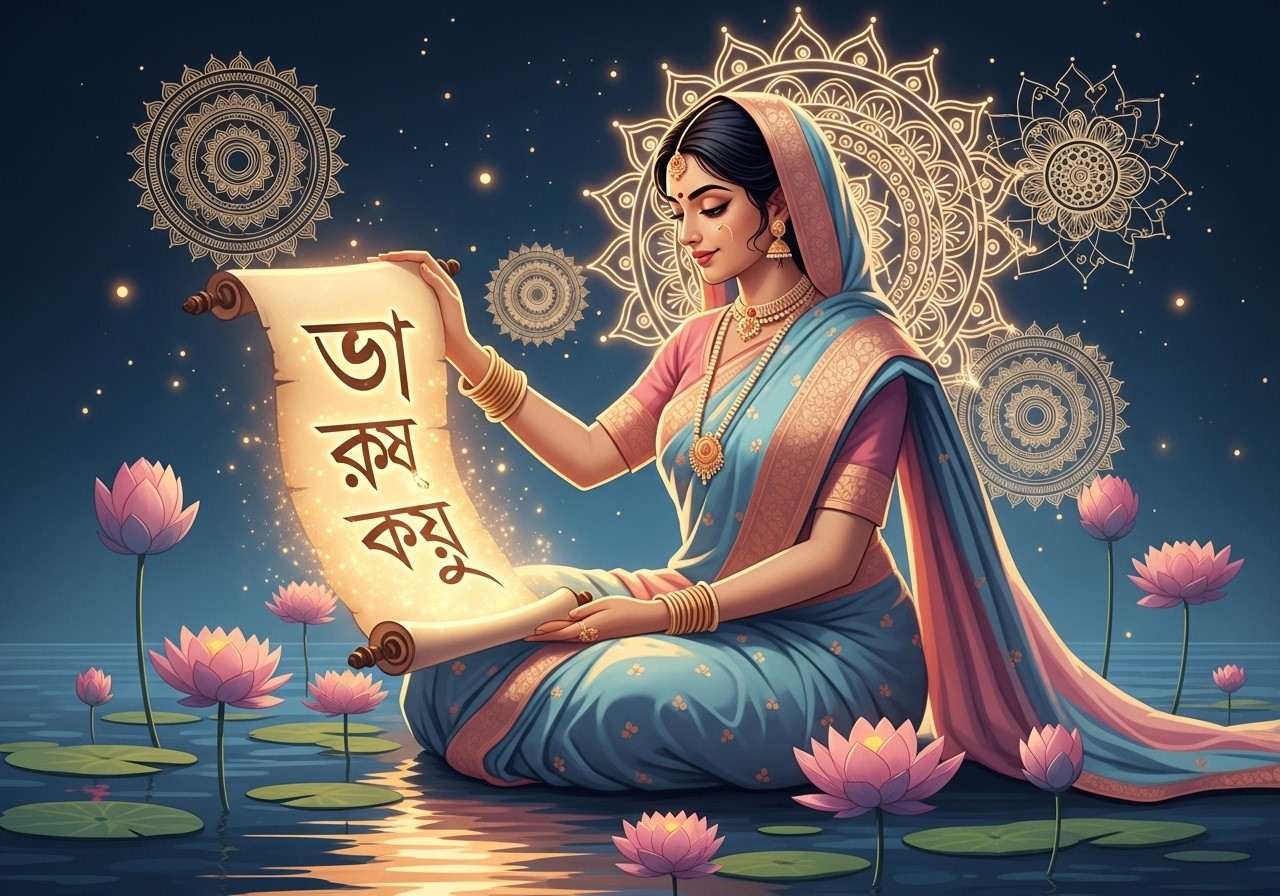
The Bangla script is far more than a mere collection of letters; it represents the very soul of a rich, timeless heritage. For those of us with roots in Bengal, this script forms the heartbeat of our daily lives, our faith, and our traditions. Let us discover together how understanding the Bengali writing system acts as a beautiful bridge, helping us reconnect with our identity and preserving our cultural roots for generations to come.
Understanding the Beauty of the Bangla Script
Exploring the Structure of the Letters
At its core, the Bengali alphabet comprises 50 basic letters, gracefully divided into vowels and consonants. As you look closely, you will notice its beautifully rounded, cursive shapes, bound together by a prominent horizontal line at the top, lovingly called the ‘matra’. The vowels, traditionally known as ‘swarabarna’, alongside the consonants, or ‘banjanbarna’, form the very foundation of this linguistic marvel. Over centuries of history, this script has blossomed, deeply influenced by significant historical milestones and spiritual movements, ultimately evolving into an incredibly distinctive and meaningful writing system.
Representing Bengali Alphabets in English: A Guide to Romanization
Bridging Scripts Through Romanization
Transcribing Bangla into English is a delicate art known as Romanization, blending the sounds of our ancestors into the familiar Latin script. Because English does not naturally accommodate every unique Bengali phonetic nuance, scholars and linguists have designed various Romanization frameworks. These thoughtful systems strive to mirror the authentic sounds of our mother tongue through English characters as accurately as possible.
Vowels (Swarabarna)
- অ (ô or o): This primary vowel often sounds like ‘on’ or ‘own’, depending on its placement in a word. It serves as the foundational breath of the Bengali phonetic system and gracefully flows through our daily speech.
- আ (a): Pronounced softly like the ‘a’ in ‘art’, this vowel brings an open, melodious tone to words. It is widely used in countless beautiful names and spiritual terms across our rich culture.
- ই (i): This letter sounds exactly like the ‘ee’ in ‘cheese’, bringing a sharp, sweet inflection to our vocabulary. It is an essential component when expressing endearment or forming common verbs in Bangla.
- ঈ (i): Sharing the identical pronunciation as its shorter counterpart, this long vowel carries a similar ‘ee’ sound. Historically, it was held longer in speech, though modern conversational usage often blends it seamlessly.
- উ (u): You will pronounce this vowel much like the ‘oo’ in ‘hoop’, providing a deep, rounded sound to the syllable. It frequently appears in traditional words denoting pure emotion, divine action, and the beauty of nature.
- ঊ (u): Echoing the exact same pronunciation as the shorter ‘উ’, this long vowel also delivers a beautiful ‘oo’ sound. In traditional texts and ancient scriptures, recognizing its distinct visual presence is highly valued by scholars.
- এ (e or ae): Depending on the structure of the word, it can playfully sound like the ‘e’ in ‘egg’ or the ‘a’ in ‘ape’. This phonetic versatility makes it one of the most vibrant and frequently used vowels in everyday Bengali.
- ঐ (oi): This visually unique character is actually a beautiful phonetic blend of the sounds ‘ও’ and ‘ই’. It produces a rich, rolling ‘oi’ sound, famously heard in words referring to unity and divine cultural traditions.
- ও (o): Pronounced distinctly and clearly like the ‘o’ in ‘own’, this vowel gives a firm, comforting roundness to spoken words. It is deeply embedded in both our casual household greetings and our formal poetic recitations.
- ঔ (ou): Acting as a seamless and elegant blend of ‘ও’ and ‘উ’, this powerful vowel creates a robust ‘ou’ sound. While it appears somewhat less frequently today, it is absolutely crucial for specific heritage words and classical vocabulary.
Consonants (Banjanbarna)
- ক (ka): This foundational letter sounds just like the ‘k’ in ‘kite’, forming the very beginning of the entire consonant chart. It is arguably one of the most recognized and heavily utilized letters in the Bengali language.
- খ (kha): Produced by coupling the raw sound of ‘k’ and ‘h’, this beautifully aspirated consonant sounds like ‘kh’. It requires a gentle burst of air from the throat, giving incredible depth to the spoken word.
- গ (ga): Pronounced warmly and clearly as the ‘g’ in ‘gun’, this soft consonant provides a very grounding, earthy tone. It features prominently in common words related to family bonds, village life, and spiritual hymns.
- ঘ (gha): This is a powerful, coupled sound merging the softness of ‘g’ and ‘h’ to form a robust ‘gh’. The slight vibration in the throat it demands is highly characteristic of many classical Indo-Aryan languages.
- ঙ (ṅa): Resembling the nasal ‘ng’ sound found seamlessly in the English word ‘sing’, this letter adds a distinct resonance. It usually pairs intimately with other consonants to create beautifully complex conjuncts in written Bengali.
- চ (ca): This character sounds crisp and direct, much like the ‘ch’ in ‘chair’, and confidently starts the palatal group of consonants. It is lively and energetic, often used perfectly in words describing sudden movement or sight.
- ছ (cha): Acting as the slightly aspirated sibling to the previous letter, it sounds very similar to a hard ‘chh’. The extra breath required to speak it perfectly captures the emotionally expressive nature of spoken Bangla.
- জ (ja): Pronounced smoothly like the ‘j’ in ‘jug’, this particular consonant is incredibly soft and highly versatile. You will lovingly find it in words celebrating joyous birth, everyday life, and many of our cherished cultural festivals.
- ঝ (jha): This is a deep, naval sound produced while the tongue touches the upper part of the mouth cavity. It carries a heavy, almost windy tone often found in descriptive words portraying heavy storms or intense emotions.
- ঞ (ña): Sounding much like the soft ‘gn’ in ‘gnome’, it specifically requires a slight upward movement of the tongue. Though rarely used standing on its own today, it remains utterly vital for forming traditional compound letters.
- ট (ṭa): This letter sounds sharply like the ‘t’ in ‘top’, providing a quick, retroflex tap against the hard palate. It is distinct and crisp, separating it entirely from the softer dental sounds found later in the alphabet.
- ঠ (ṭha): Known traditionally as the harder, aspirated version of ‘ṭa’, it carries a forceful, deliberate breath behind the ‘t’ sound. Mastering this specific letter helps non-native speakers truly capture the authentic, raw village dialects of Bengal.
- ড (ḍa): Pronounced much like the deep ‘d’ in ‘dark’, this letter provides a solid, rhythmic beat to the spoken language. It frequently appears in common words related to nature, rhythmic sounds, and solid physical objects.
- ঢ (ḍha): This beautiful letter features a coupled sound of ‘d’ and ‘h’, naturally creating a resonant ‘dh’. It is incredibly famous for its association with the ‘Dhak’, our traditional grand drum played joyously during Durga Puja.
- ণ (ṇa): This is a highly unique nasal sound produced when the tongue touches a bit away from the teeth. It holds a special place in grammatical purity, especially appearing in words derived directly from ancient Sanskrit roots.
- ত (ta): Offering a soft, deeply Indian dental sound of ‘t’, it is pronounced exactly as we say it in the word “Bharat”. This gentle, soothing letter is the foundational cornerstone of many respectful terms and high philosophical concepts.
- থ (tha): Sounding gracefully like the ‘th’ in ‘thermo’, this aspirated dental consonant is breathed out very softly. It effortlessly lends a poetic and calming quality to words dealing with stillness, mythology, and sacred places.
- দ (da): Pronounced softly and seamlessly like the ‘th’ in ‘the’, it is a gentle dental sound deeply embedded in our daily speech. It naturally forms the root of countless words expressing sheer compassion, giving, and divine blessings.
- ধ (dha): This powerful sound is produced by lovingly coupling a soft ‘d’ and ‘h’, resulting in a breathy ‘dh’. It is a deeply revered letter, starting numerous words directly linked to Indian spirituality, wealth, and righteous duty.
- ন (na): Sounding exactly like the ‘n’ in ‘man’, this simple dental nasal is incredibly common and highly functional. It seamlessly binds sentences together, acting as a structural pillar for almost all everyday Bangla communication.
- প (pa): Pronounced clearly and playfully as the ‘p’ in ‘push’, this bilabial consonant starts words with a gentle pop. It is beautifully seen in countless words expressing utmost purity, religious devotion, and the natural elements around us.
- ফ (pha) to হ (ha): The remaining letters—ফ, ব, ভ, ম, য, র, ল, শ, ষ, স, and হ—map quite comfortably to their respective English equivalents. Learning these specific consonants is often a breeze for those already familiar with basic English phonetics, gracefully completing our beautiful alphabet.
Implicit Vowels and Translation Tools
In our beloved Bangla script, the primary vowel “a” implicitly follows most consonants, quietly breathing life into the spoken word unless another vowel overrides it or a ‘hasanta’ beautifully halts the sound altogether. When it comes to more advanced and scholarly transliteration, esteemed frameworks like the National Library at Kolkata romanization or the ISO 15919 standard lovingly employ diacritic marks to maintain absolute phonetic purity. Today, an incredible array of digital tools and mobile applications are readily available to gently guide learners, making authentic Bengali-to-English translation more globally accessible than ever before.
From Letters to Words: The Joy of Building Vocabulary
Forming Words and Expanding Your Conversational Skills
Watching individual Bengali letters gently merge to form meaningful words is a truly magical and rewarding experience. Take, for instance, the combination of letters forming ‘বই’ (boi), which beautifully translates to ‘book’—a traditional vessel of knowledge. By understanding these root formations, you naturally expand your cultural vocabulary and deeply enrich your everyday communication skills with loved ones. Engaging in exercises where you weave letters into words is a heartwarming way to internalize the language and confidently participate in our vibrant cultural expressions.
The Deep Cultural Significance of the Bangla Alphabet
Preserving Our Parampara Through the Script
The Bengali script is completely intertwined with our cultural pride, prominently echoing through our legendary literature, soulful music, and intricate art forms. The immortal works of Gurudev Rabindranath Tagore, among countless others, draw their timeless emotional depth from the sheer richness of this very language. Furthermore, this alphabet is deeply rooted in our sacred rituals and family ceremonies, acting as a vital thread in preserving our beautiful heritage. When we celebrate joyous occasions like Pohela Boishakh, embracing the script gives us a profound, intimate glimpse into the true essence of Bengali parampara.
Accessible Resources for Your Learning Journey
Heartwarming Aids to Master the Language
For those eager to embrace this cultural journey, an abundance of resources waits to guide you through the Bengali alphabet and its Romanized English translations. Modern digital platforms and interactive apps offer engaging daily lessons, while beautifully bound traditional books provide deep, structured wisdom you can hold in your hands. Joining local or online community forums helps you connect with native speakers who gladly share their warmth and conversational tips. Enrolling in specialized cultural workshops completely immerses you in the script, wrapping your learning experience in true, welcoming Indian hospitality.
How Poojn.in Can Support Your Cultural Exploration
Embarking on the path to learning the Bangla script is a deeply fulfilling spiritual and cultural endeavor that connects you back to your roots. At Poojn.in, we are incredibly honored to provide authentic cultural goods that beautifully complement your educational journey. Our thoughtfully curated online store features an exquisite array of traditional items designed to keep you strongly connected to the majestic traditions of Bengal.
- Books and Educational Material: We proudly offer a selection of culturally rich literature that directly aids in your understanding of Indian heritage. These authentic texts are wonderfully curated to inspire and support your lifelong commitment to mastering the Bengali script.
- Traditional Writing Tools: Discover the nostalgic charm of our classic writing instruments and beautifully crafted authentic notebooks available exclusively on Poojn.in. Writing down your newly learned alphabets with these traditional tools transforms a simple lesson into a deeply meaningful, spiritual experience.
We at Poojn.in remain fully devoted to delivering premium, authentic products that lovingly honor your devotion to lifelong learning and cultural preservation. You can deeply enjoy the peace of mind that comes with shopping online, as we safely and respectfully deliver these cherished items right to your doorstep. For any heartfelt guidance or queries regarding our cultural collections, please feel free to reach out to us warmly at 03369029784 or conveniently drop us a message on WhatsApp at 9476142738.
Embracing the Beautiful Journey Ahead
As we conclude this heartfelt guide, it beautifully highlights how grasping the Bengali alphabet through English translation unlocks a mesmerizing world of rich literature, deep emotion, and unbroken tradition. Romanization gracefully bridges the gap, allowing those accustomed to English to step comfortably and confidently into the warm embrace of Bangla phonetics. Whether you are exploring this path for personal spiritual growth, reconnecting with your ancestral roots, or simply admiring the breathtaking elegance of Bengali heritage, every single sound you learn draws you closer to home.
Today’s modern tools perfectly blend with our traditional wisdom, making this learning journey incredibly accessible for families everywhere. We encourage you to walk this path with a patient, loving, and curious heart, fully aware that you are keeping a magnificent Indian tradition vibrantly alive. Let the melodious, sweet sounds of Bangla fill your home and your heart with boundless joy and pride.
Frequently Asked Questions
How many distinct letters make up the Bengali writing system?
The traditional and revered Bangla script is built upon a solid foundation of 50 basic letters. This comprehensive, beautiful set inclusively features both the essential vowels and the highly expressive consonants.
What is the primary purpose of this elegant alphabet?
It is the glorious, living medium used to write the Bengali language, which is spoken from the heart by millions across India, specifically in West Bengal, Tripura, and neighboring regions. It serves as the sacred vessel for our grand literature, daily prayers, and heartfelt family conversations.
Can we directly translate these letters into the English script?
Absolutely, through a thoughtful linguistic process known as Romanization, these native letters can be systematically converted to English characters. However, one must always remain respectful of the cultural context, as subtle pronunciations may lovingly shift depending on the specific word being spoken.
What is the best way to master this script alongside vocabulary?
A wonderful, culturally immersive approach is to begin with the basic letters and lovingly pair them with simple, everyday household words. Consistent, patient practice will dramatically enhance both your visual recognition and your authentic spoken pronunciation over time.
Does the structure of Bangla resemble the English alphabet?
The two writing systems are quite uniquely distinct from one another in almost every way. They differ wonderfully in their fluid visual strokes, their complex phonetic depth, and their deeply rooted historical Indian origins.
Where might one find a reliable guide for English transliteration?
You can easily uncover highly trustworthy guides through dedicated cultural language books, enriching online heritage forums, and specific educational platforms warmly tailored for Indian language enthusiasts.
Why is taking the time to learn this script so historically vital?
Immersing yourself in the script is absolutely essential for authentic communication and serves as a master key to unlocking India’s majestic Bengali literature. It is also deeply rewarding and necessary if you wish to actively participate in local cultural festivities and sacred spiritual ceremonies.
Is it possible to use these authentic letters in our daily digital conversations?
Yes, thankfully, the global integration of Unicode has made it incredibly easy for the diaspora and locals alike. You can joyfully type, read, and proudly share the Bengali script across almost all modern digital devices and social platforms today.