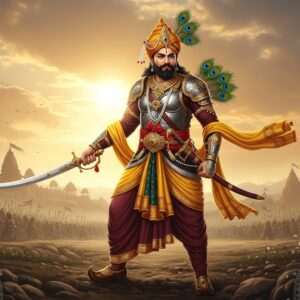


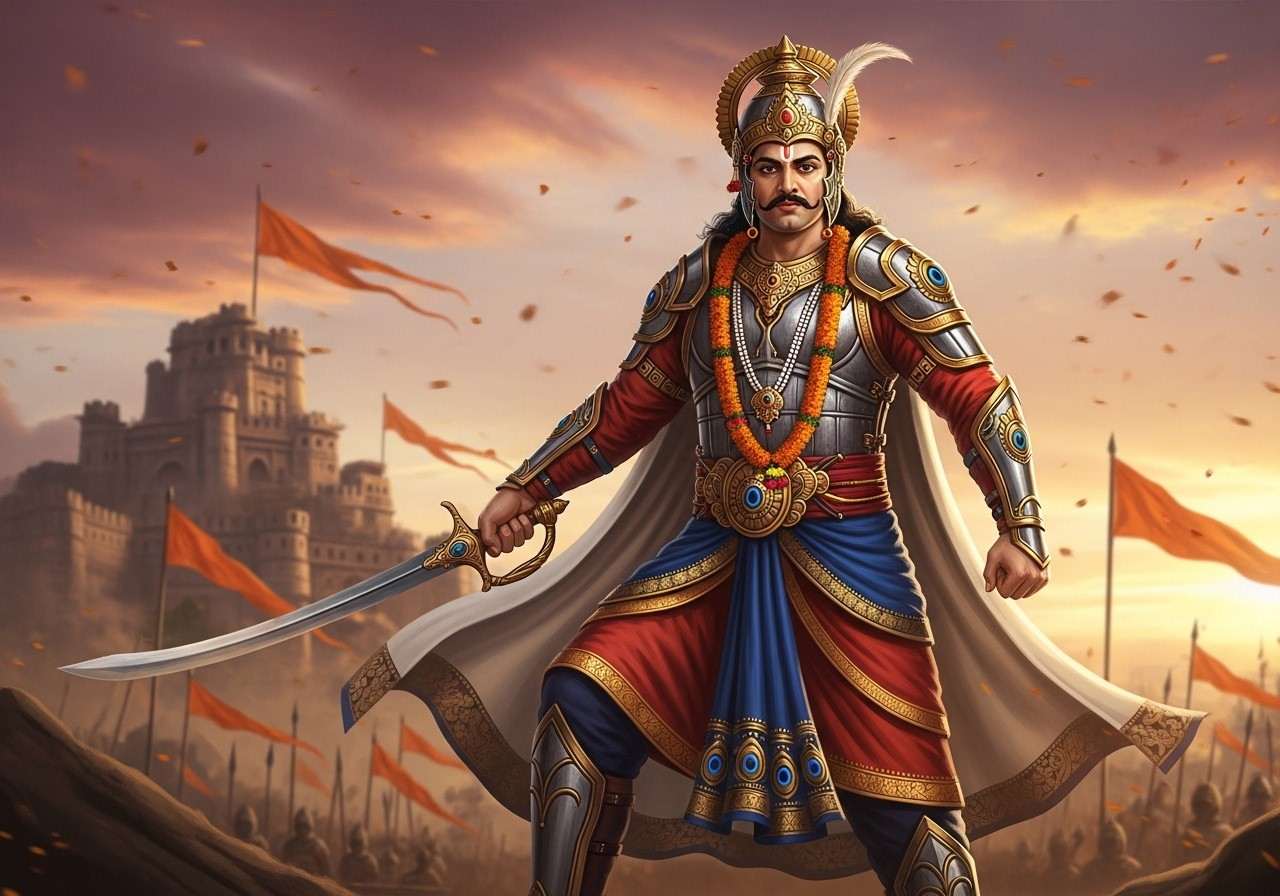
Namaste and welcome to poojn.in, the heart of India’s cultural and spiritual needs. Today, we invite you to step back in time, into the rugged and majestic lands of Rajasthan. India is a nation built on the sacrifices of heroes, and few shine as brightly as Bappa Rawal. He was not just a king; he was a guardian of Dharma, a strategic genius, and the founding father of the legendary Mewar dynasty. For us at poojn.in, honoring such ancestral heritage is part of our mission to keep our traditions alive.
Let us immerse ourselves in the fascinating saga of Bappa Rawal—a story woven with threads of bravery, devotion to Lord Shiva, and unwavering leadership.
The Early Days: Origins of a Legend (7th Century – 734 CE)
The story begins in the early 8th century, a period of great turbulence. Born around 713 CE as Prince Kalbhoj, Bappa Rawal belonged to the esteemed Guhila Rajput clan. However, his childhood was far from the comforts of a palace. Tragedy struck early when his father, Maharawal Sital Deoji (also known as Rawal Mahendra II), was killed by Arab invaders. This event set the stage for a life defined by resilience.
To protect the young prince, he was raised in secrecy. History tells us he was brought up by a Brahmin lady, absorbing the values of wisdom and righteousness. Simultaneously, he was nurtured by loyal Bhil attendants, the indigenous warriors of the region. It was here, amidst the forests and hills, that he learned the art of warfare and survival. This unique blend of Brahminical wisdom and tribal warfare skills molded his character, preparing him for the destiny that awaited him.
The Rise of the Lion of Mewar (734 CE)
The year 734 CE marked a turning point in Indian history. At a time when foreign invaders were knocking on India’s doors, Bappa Rawal displayed extraordinary military genius. He led his army to a decisive victory against the Arabs in the famous Battle of Nagda. This was not just a defense of territory; it was a defense of culture and faith.
Following this victory, his ambition turned toward the fortified city of Chittor. He defeated Maan Mori, a ruler of the Maurya dynasty, and seized the majestic Chittor Fort. This conquest was significant as it marked the end of Mauryan influence in that specific region—a lineage that traces back to the great Chandragupta Maurya, whose life and legacy defined an earlier era of Indian governance. With Chittor under his command, Bappa Rawal established the Mewar dynasty and was crowned the King of Mewar.
The Golden Reign and Spiritual Devotion (734-753 CE)
From 734 to 753 CE, Bappa Rawal’s reign was a golden era of expansion and consolidation. He did not just rule; he fortified. His administrative reforms transformed Mewar into a well-organized kingdom. He understood that a king’s strength lies in his alliances, and he successfully forged strong ties with neighboring kingdoms to create a united front against external threats.
However, Bappa Rawal was as much a devotee as he was a warrior. He was a staunch worshiper of Eklingji (Lord Shiva), whom he regarded as the true ruler of Mewar, considering himself merely a Diwan (Prime Minister) serving the Lord. This deep spiritual connection is a testament to the values we cherish at poojn.in—where duty and devotion go hand in hand.
The Mystery of His Final Years (753 CE – 810 CE)
Like many great figures in ancient history, such as those discussed in the historical timeline of Surdas, Bappa Rawal’s final years are shrouded in mystery and varying accounts. The transition from king to ascetic is a powerful narrative in his life.
- The Path of Renunciation (753 CE): Many historical sources suggest that around 753 CE, Bappa Rawal chose a spiritual path. He abdicated the throne to devote himself entirely to the worship of Shiva. This act of renunciation highlights the Indian ideal that spiritual liberation is the ultimate goal of life, surpassing even royal power.
- Conflicting Dates of Death: The timeline of his passing varies. Some records state he died in 753 CE at Eklingji immediately after abdication. Others suggest he lived a long life as an ascetic, passing away around 810 CE. There is also a mention of a victory against King Kukuteshwar in 755 CE, implying he remained active either militarily or spiritually for longer than some records suggest.
For those interested in how complex historical timelines work, you might find our article on the Lohara Dynasty timeline fascinating, as it helps explain how historians piece together these ancient puzzles.
Connecting with Heritage: How Poojn.in Brings History Home
Understanding the life of Bappa Rawal is about more than just dates; it is about feeling the connection to our ancestors. At poojn.in, we believe that bringing authentic ritual items into your home is a way to keep this energy alive. We do not offer travel packages or VIP temple darshans, but we do provide the tools you need for your own spiritual practice.
If you wish to connect with the ancient traditions that Bappa Rawal championed, consider our collection of authentic ritual goods:
- Historical Significance of Bhoj Patra: In ancient times, before paper was common, mantras and yantras were written on the bark of the Himalayan Birch tree. To bring this ancient energy into your puja room, you can explore our authentic Bhoj Patra (Original Himalayan). It is perfect for writing sacred mantras just as the sages did in the era of the Guhila dynasty.
- Ritual Statues and Decor: Our store offers high-quality murtis that reflect the artistry and devotion of traditional India. Placing these in your home serves as a daily reminder of the values of valor and bhakti that Bappa Rawal stood for.
- Traditional Worship Essentials: From pure ghee wicks to brass diyas, we ensure that every item you purchase from poojn.in resonates with purity and tradition.
For any assistance in choosing the right cultural items for your home, please contact us at 03369029784 or WhatsApp us at 9476142738. We are here to serve your spiritual needs.
Common Questions About Bappa Rawal’s Legacy
When was Bappa Rawal born and what was his childhood like?
Bappa Rawal was born around 713 CE. His birth name was Prince Kalbhoj. His early life was difficult and dramatic; after his father, the King of Mewar, was killed by Arab invaders, Bappa Rawal was raised in hiding by a Brahmin woman and loyal Bhil attendants who taught him the skills of warfare.
What are the major military achievements of Bappa Rawal?
His most significant achievement was the Battle of Nagda in 734 CE, where he defeated the Arab invaders. Following this, he captured the Chittor Fort from the Mauryan ruler Maan Mori, officially establishing the Mewar dynasty and crowning himself King.
When did Bappa Rawal die or abdicate the throne?
The timeline can be complex. Most sources agree he abdicated the throne around 753 CE to follow a spiritual path devoted to Lord Shiva. While some believe he died shortly after in 753 CE or 760 CE, other historical accounts suggest he lived as an ascetic until 810 CE.
Why is Bappa Rawal important to Indian culture?
He is revered not just as a king but as a protector of Dharma. By stopping the Arab invasion, he safeguarded the cultural and religious fabric of the region. His devotion to Eklingji set a precedent for the Mewar kings who followed, styling themselves as custodians rather than owners of the land.
Bappa Rawal’s life teaches us that true strength comes from a balance of physical power and spiritual humility. At poojn.in, we are proud to share these stories and provide you with the cultural goods that help you celebrate our rich Indian heritage every day.