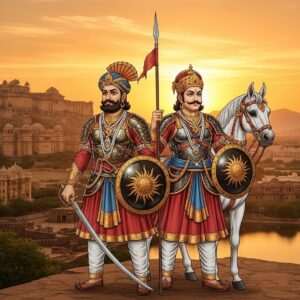



In the grand tapestry of Indian history, few names shine with as much brilliance as Bappa Rawal. A figure of immense valor and spiritual depth, he was not just a king but a guardian of our culture. His story is one of resilience, rising from the tragic loss of his father to becoming the founder of a dynasty that would protect Dharma for centuries. Today, we take a journey back in time to understand how his influence stretched all the way from the lakes of Mewar to the strategic frontiers of Rawalpindi.
At Poojn.in, we believe that understanding our roots helps us celebrate our traditions with more devotion. As India’s premier online store for cultural and ritual goods, we are dedicated to bringing the essence of this heritage into your homes through authentic puja samagri and spiritual idols.
The Rise of a Legend: Origins and Divine Blessings
The story of Bappa Rawal, born as Kalbhoj in 713 AD, reads like a divine script. Belonging to the illustrious Guhila Rajput clan, his early life was marked by adversity. After his father, Maharawal Sital Deoji, was martyred fighting Arab invaders, young Bappa was raised in the safety of the Aravalli hills by a compassionate Brahmin mother. This upbringing instilled in him a deep respect for both the scripture and the sword.
His destiny was shaped under the guidance of Harit Rishi, a revered sage of the Mewar region. It is said that through the sage’s blessings and his own devotion to Lord Shiva (Eklingji), Bappa secured the divine right to rule. By 734 AD, at the youthful age of 21, his prowess was undeniable. He defeated Man Mori to conquer the impregnable Chittor Fort, laying the foundation for one of the most powerful empires in Indian history.
The Great Expansion: From the Heart of Rajasthan to Rawalpindi
Bappa Rawal’s vision went far beyond local governance; he understood the need for a fortified India. His reign, which the Ekalinga Mahatmya cites as starting around 728 CE, was defined by a proactive military strategy. He did not just defend; he pushed the boundaries.
Historical records indicate that he played a pivotal role in the Battle of Rajasthan, where he led a coalition to inflict a crushing defeat on the invading Arab forces. But he didn’t stop there. To ensure the safety of the motherland, he chased the invaders deep into the west, past Ghazni and up to Iran. To secure the frontiers, he established a critical military base in a region that came to be known as Rawalpindi (derived from Rawal), which remains a testament to his reach even today.
Just as Bappa Rawal secured the frontiers, other dynasties also played crucial roles in shaping our history. You might find the history of the Karkota Empire fascinating, as they too were instrumental in the geopolitical landscape of the north. similarly, the Gahadavala Dynasty later rose to prominence, continuing the tradition of strong governance.
A Legacy of Protection and Spirituality
The impact of Bappa Rawal was so profound that it is said the Arabs did not dare attack India for nearly 400 years following his campaigns. He was the progenitor of a lineage that would later produce heroes like Rana Sanga and Maharana Pratap. His life teaches us that true strength comes from a balance of physical power and spiritual submission. In 753 AD, after establishing a vast empire, he abdicated his throne to walk the spiritual path, surrendering himself completely to the devotion of Lord Shiva.
Celebrating such potent history often reminds us of the rituals that honor strength and divinity. In many traditions, the color red signifies this power (Shakti). If you are performing rituals dedicated to the divine feminine or seeking traditional items, you might want to explore our authentic Rakta Jaba Alta, perfect for auspicious occasions and traditional adornment.
Furthermore, understanding the flow of history helps us appreciate different eras. For instance, the Chaulukya Dynasty and Kumarapala’s legacy offer another perspective on how dharma and kingship intertwined in Western India, much like in Mewar.
Connecting with Our Heritage
While we cannot travel back in time to witness Bappa Rawal’s court, we can keep the spirit of his devotion alive in our daily lives. Whether it is through daily prayers or reading about our ancestors, staying connected to our roots is vital.
Please note: While we love sharing the rich history of our land, Poojn.in is exclusively an online store for cultural and ritual goods. We do not organize historical tours, travel packages to Chittor, or VIP darshan services. Our mission is to provide you with the best puja samagri delivered to your doorstep.
Common Questions About Bappa Rawal’s Empire
Curiosity regarding the extent of Bappa Rawal’s Kingdom
Many history enthusiasts often ask how far Bappa Rawal’s influence actually reached. It is a matter of great pride that his empire stretched from the spiritual heartland of Mewar in present-day Rajasthan all the way to Rawalpindi in modern-day Pakistan. This vast expanse was not just political but a strategic shield for India’s culture.
The connection between the ruler and Rawalpindi
There is often confusion about why a city so far north is named after a Mewar king. The city of Rawalpindi was originally established as a military garrison or base by Bappa Rawal to guard the North-West Frontier against invasions. His lasting impact on the region’s socio-economic fabric is embedded in the very name of the city.
Visualizing the Empire without modern maps
Scholars and students frequently look for maps of this era. While ancient cartography is different from modern standards, historians reconstruct his empire based on archaeological evidence and manuscripts like the Ekalinga Mahatmya. These records highlight key trade routes and military outposts that connected the Indian plains to the Iranian plateau.
The significance of his reign for modern India
Why do we remember him today? Bappa Rawal is celebrated not just as a conqueror but as a symbol of Hindu resistance. By defeating the Arabs in the Battle of Rajasthan (734 AD) and securing the borders, he ensured that Indian culture, philosophy, and religion could thrive undisturbed for centuries. His legacy is the freedom we cherish and the traditions we follow.
At Poojn.in, we salute the spirit of such ancestors. To bring a piece of this sacred tradition into your home, browse our collection of authentic ritual items today.