


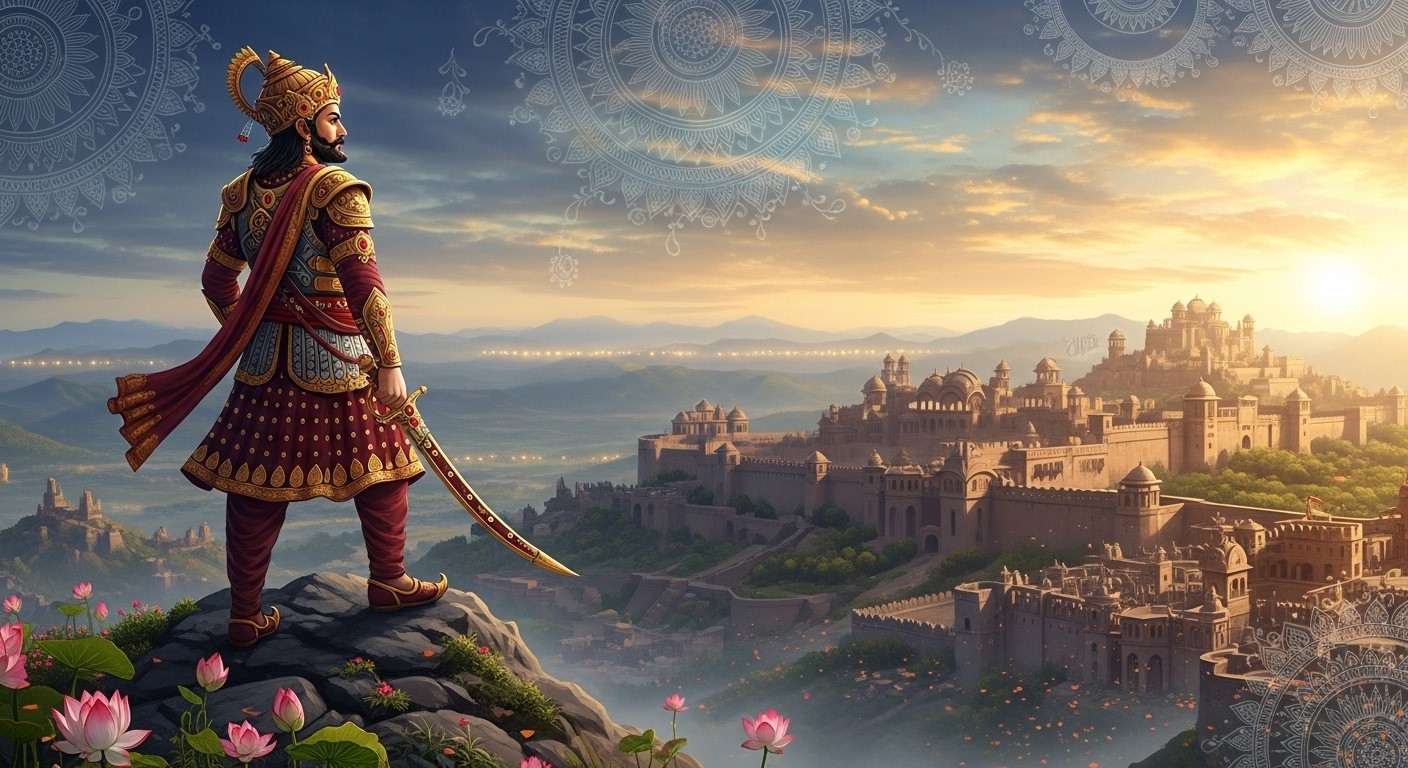
Every corner of our beloved Bharatbhumi is steeped in tales of extraordinary courage and deep-rooted spirituality. Among these golden chapters, the magnificent legacy of Bappa Rawal stands as a towering beacon of resilience and faith. Originally known by his birth name Kalabhoja, this remarkable 8th-century king from the illustrious Guhila Rajput dynasty is traditionally honored as the true architect of Mewar’s enduring power. His era was not just about territorial expansion; it was a profound movement that beautifully shaped the cultural and political landscape of Rajasthan, laying the foundation for a formidable empire that continues to inspire our generations today.
The Spectacular Rise and Consolidation of Mewar
The journey of this great king is a testament to strategic brilliance and divine grace. Bappa Rawal is credited with capturing the formidable Chittor Fort around 734 CE. By defeating the Mori ruler, Man Mori, he successfully established unshakeable Guhila dominance over the region of Mewar. This historic victory was crucial, as it consolidated power amid rival clans scattered across the rugged and beautiful Aravalli hills. The socio-political conditions of the time required a leader of immense strength, and his ability to form strategic alliances with neighboring tribes facilitated a rise to prominence that would forever alter the course of our history.
Establishing a Divine Regency: The Blessings of Eklingji
What truly sets our Indian rulers apart is their unwavering devotion to the divine, a sentiment deeply embedded in our culture. Upon securing control of Chittor, Bappa Rawal declared Eklingji, a magnificent manifestation of Lord Shiva, as the true and supreme ruler of Mewar. He ruled merely as a humble servant or Diwan of the deity, establishing a beautiful tradition of divine regency that Mewar’s rulers honored for centuries. Showcasing his immense devotion to Shaivism, he built the original Eklingji temple around 734 CE near Nagda. This sacred space became the spiritual heartbeat of the empire, beautifully reflecting the era’s artistic sensibilities and deep-rooted religious faith.
Embrace the Divine Aura in Your Own Home
When we reflect upon such profound devotion to Lord Shiva, it naturally awakens a heartfelt desire to cultivate a similar spiritual atmosphere within our own homes. At poojn.in, India’s biggest cultural goods and services store, we deeply understand your longing for authentic, high-quality spiritual items. While you immerse yourself in the rich heritage of our ancestors, you can seamlessly bring a piece of that sacred tradition into your daily life. Our online store is dedicated to offering products that honor our rituals with absolute purity.
- Traditional Puja Kits for Daily Worship: Recreate the divine atmosphere of ancient temples right in your personal prayer room. Our thoughtfully curated kits contain everything you need to perform daily rituals with utmost devotion and purity, ensuring your family stays connected to our beautiful roots.
- Exquisite Statues and Sacred Idols: Bring home beautifully crafted deities that reflect the rich artistic heritage of our magnificent culture. These sacred idols serve as a constant, comforting reminder of the divine presence, reflecting the deep-rooted faith that guided our great ancestors.
- Premium Incense Sticks and Natural Dhoop: Fill your living space with the calming and uplifting fragrances that have been used in traditional Indian worship for centuries. The soothing aroma will transport you to a state of meditative peace, perfectly reminiscent of the grand aartis of yesteryears.
For more information or to easily place an order, please visit our online store. We are always here to assist you; feel free to contact us at 03369029784 or reach out conveniently via WhatsApp at 9476142738.
The Formidable Shield: Defending the Motherland Against Arab Invasions
Beyond his spiritual devotion, Bappa Rawal’s reputation as a formidable warrior was forged in the fires of immense conflict. After the Arab conquest of Sindh in 711 CE, our beloved motherland faced severe external threats. Understanding the crucial need for unity, he formed powerful strategic alliances with neighboring Hindu rulers, including Nagabhata I of the Gurjara-Pratihara dynasty and Jaysimha Varman of the Rashtrakuta Empire. Around 725 CE, he united smaller states like Ajmer and Jaisalmer, creating an unstoppable Hindu coalition against Muhammad bin Qasim.
His tactical genius and intimate knowledge of the local topography allowed him to brilliantly outmaneuver the enemy’s cavalry, pursuing Qasim’s forces all the way back to Baluchistan. Later, when Junaid Al Marri launched raids into Rajasthan, Malwa, and Gujarat, the king of Mewar allied with Jai Bhatt of Gujarat and Nagabhata I. Together, their army ambushed Junaid’s forces in the Aravalli hills, delivering a crushing defeat that drove the invaders far beyond Khurasan, ensuring the safety of our lands.
The Enduring Cultural Legacy of the Hindua Suraj
The reign of this visionary leader marked a phenomenal turning point in our history. His unyielding resistance against foreign invaders successfully protected India’s northwest frontier, rightfully earning him the glorious title of “Hindua Suraj” (The Sun of the Hindus). His far-reaching influence is truly awe-inspiring; historical accounts even suggest that the city of Rawalpindi in present-day Pakistan bears his name. To symbolize his authority and absolute devotion, he issued beautifully minted gold coins featuring a Shivling, leaving an indelible mark on our cultural and economic heritage. He fostered social stability and economic growth, inspiring future generations to uphold the values of valor, unity, and unwavering faith.
Seamlessly Answering Your Curiosities About Mewar’s Greatest Founder
Who exactly was this legendary monarch of Rajasthan?
He was an awe-inspiring king and the foundational pillar of the Mewar dynasty. Born as Kalabhoja, he is celebrated for his immense courage, unshakeable devotion to Lord Shiva, and strategic brilliance in protecting and expanding his prosperous empire.
What specific regions were under his sovereign control?
His expansive and well-protected domain proudly covered significant portions of present-day Rajasthan and parts of Gujarat. This strategic presence successfully secured essential trade routes and strongly fortified the North-Western frontiers of our country.
How did he manage to expand and protect his kingdom so effectively?
He achieved this monumental task through highly strategic conquests, forming crucial alliances with neighboring Hindu rulers, and displaying exceptional, fearless leadership on the battlefield, especially against foreign invaders.
Why is his empire considered so historically important for us today?
His reign is of paramount historical importance because it laid the bedrock for the Mewar kingdom, a lineage that played an incredibly crucial role in preserving Indian independence, culture, and Dharma during turbulent times.
Is it possible to view a map of this glorious historical empire?
Absolutely, historical maps provided by scholars and historians beautifully visualize the impressive extent of his empire. They highlight the strategic locations of his forts, administrative hubs, and the natural geographical defenses that safeguarded his kingdom.
What was his most significant contribution to Indian history?
His most profound contribution lies in successfully halting the early Arab incursions into the Indian subcontinent. By driving back formidable commanders, he fiercely protected our rich heritage and ensured the survival of our cultural practices.
How did his incredible leadership influence the later rulers of Rajasthan?
His military strategies and the beautiful tradition of ruling as a divine regent for Eklingji profoundly influenced generations of later rulers. He set a golden standard for ethical, courageous, and culturally rooted leadership that defined Rajputana pride.
What valuable life lessons can we learn from his grand conquests?
His life beautifully teaches us the timeless importance of strategic foresight, fearless leadership, and the unmatched power of unity. It reminds us that deeply rooted faith and strong alliances are the essential building blocks for creating a lasting, prosperous legacy.