


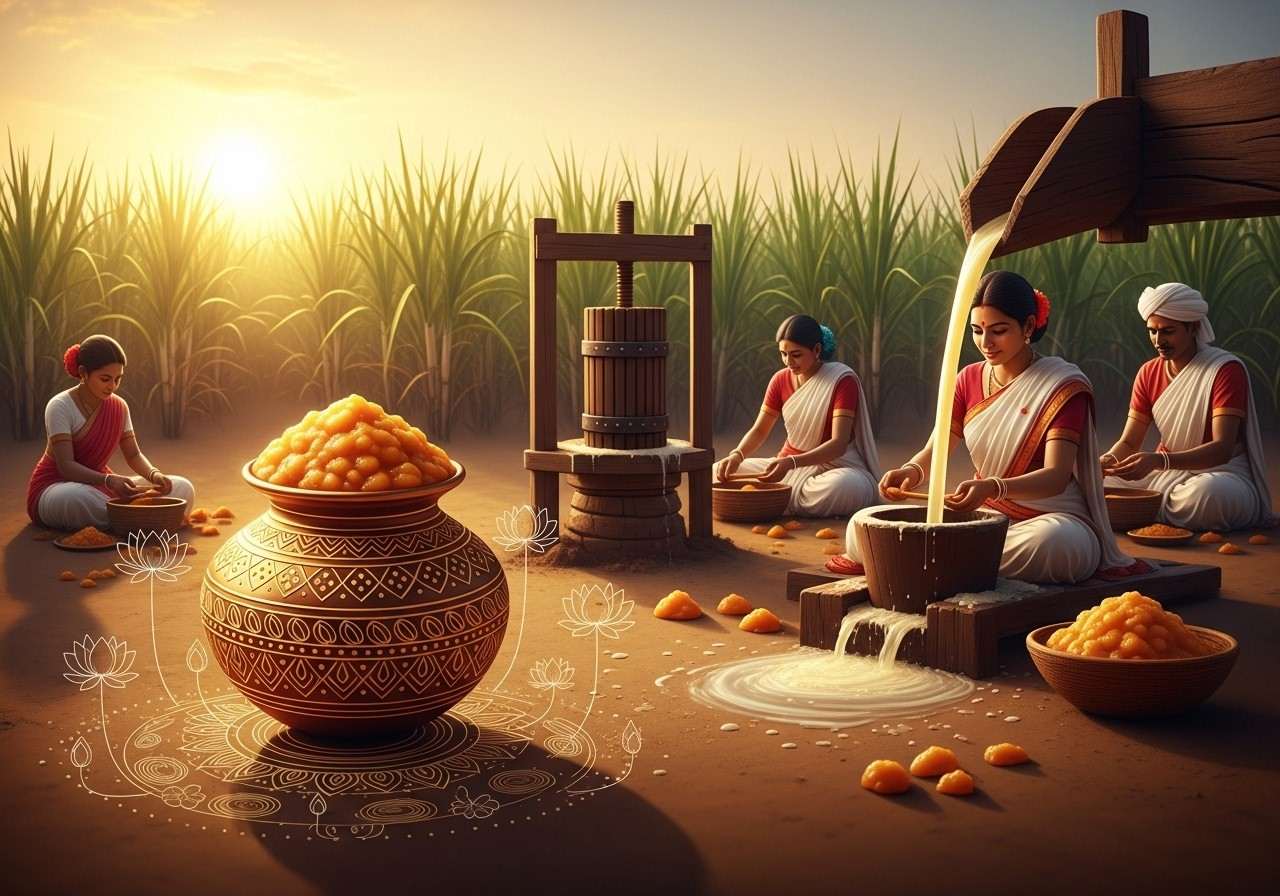
In every Indian household, the jar of Gur (Jaggery) holds a place of reverence, often sitting right next to the salt and turmeric. It is not merely a sweetener; it is a symbol of our heritage, warmth, and traditional well-being. Derived from the humble sugarcane, this golden delight transforms from a sturdy stalk into a nutrient-rich staple that sweetens our festivals and heals our bodies. Understanding the journey of how sugarcane becomes this cherished ingredient gives us a deeper appreciation for the authentic rituals we hold dear. At poojn.in, we understand that for the modern Indian family, purity and tradition go hand in hand.
The Traditional Jaggery (Gur) Making Process
The creation of authentic Gur is a labor of love, a process passed down through generations of skilled artisans. It is a fascinating transformation that requires patience, precision, and a deep understanding of nature’s chemistry.
1. Extraction of Sugarcane Juice
The journey begins in the fields with the harvest of mature sugarcane stalks. To ensure the finest quality, farmers select stalks with the optimal sweetness levels. These stalks are then crushed to release their precious liquid. While modern facilities use power-driven machines, many traditional setups still rely on the charm of bullock-driven crushers, preserving the old-world authenticity of the process.
2. Collection and Clarification
Once the juice is collected in large vessels, it must be purified. This step is critical for health and taste. The raw juice is filtered to remove suspended matter, but true clarification goes deeper. Artisans use specific agents to remove impurities like salts and fibers.
Traditionally, organic clarificants like Bendi (ladies’ finger plant extract), Sulkali, and Doela are used, while inorganic options like lime help adjust the pH balance. This meticulous cleaning ensures that the final product is safe and pure.
3. Concentration by Boiling
The clarified juice is then transferred to massive iron pans placed over furnaces. In a beautiful cycle of sustainability, the dried wood pulp (bagasse) from the crushed sugarcane is often used as fuel to fire these furnaces. The juice is boiled until it thickens into a rich, golden syrup.
The artisan must watch for the “striking point”—the specific temperature where the syrup is ready. This varies by the type of Gur desired: 118°C for solid blocks, 106°C for liquid jaggery, and 120°C for granular forms. It is a test of skill and timing.
4. Cooling and Solidifying
Finally, the concentrated syrup is poured into cooling trays or molds. As the thick, amber liquid cools, it is either pounded to create granules or left to set into the familiar solid blocks we buy. Once completely cooled and solidified, it is ready to sweeten our teas, desserts, and lives.
How to Make Fresh Sugarcane Juice at Home
Nothing beats the refreshing taste of fresh sugarcane juice, especially during the scorching Indian summer. While street vendors are a common sight, making it at home ensures hygiene and freshness.
Start by sourcing fresh sugarcane stalks; the fresher the stalk, the sweeter the juice. You will need a specialized juicer, as standard kitchen mixers often cannot handle the tough fibers. Clean the stalks thoroughly to remove any dirt or grit. As you extract the juice, you can enhance the flavor by adding a touch of ginger, mint, or a squeeze of lime. This not only improves the taste but aids digestion. Always store the juice in a cool place if not consuming it immediately to preserve its natural goodness.
Understanding Traditional Sugarcane Byproducts: Molasses
The process of boiling sugarcane juice yields more than just solid jaggery. One of the most valuable byproducts is molasses. This thick, dark syrup is rich in nutrients that are often stripped away in refined sugar processing.
Produced during the boiling stage, molasses captures a high concentration of minerals. It serves as a potent natural sweetener and health supplement, known to boost energy levels swiftly. Across different regions of India, molasses is used in various traditional recipes, adding a distinct, robust flavor to sweets. For the health-conscious consumer, it offers a mineral-rich alternative to empty calories.
Cultural Significance and Ritual Use of Jaggery
In our culture, no auspicious beginning is complete without something sweet, and often, that sweet is Gur. It symbolizes prosperity, happiness, and a warm welcome. In many Indian homes, it is customary to offer a piece of jaggery and water to guests arriving from the sun, a practice rooted in Ayurveda to cool the body.
Jaggery is also central to our festivals. From the Pongal dishes of the South to the Til-Gud of Makar Sankranti in the North and West, it binds the country in a thread of sweetness. It is a common offering (Prasad) in religious ceremonies, representing our gratitude to the divine. For urban families, using authentic Gur is a way to stay connected to these roots.
Health Benefits of Jaggery (Gur)
Our ancestors championed Jaggery long before it became a “superfood.” Unlike refined sugar, which provides empty calories, Jaggery is packed with essential vitamins and minerals.
- Digestive Health: Consuming a small piece of Gur after meals is a time-tested habit to kickstart digestion and prevent acidity.
- Iron-Rich: It is an excellent source of iron, making it highly beneficial for managing anemia and boosting energy levels, particularly for women.
- Immunity Booster: Rich in antioxidants, Jaggery helps in detoxifying the liver and cleansing the body, which in turn supports a robust immune system.
- Respiratory Relief: It is traditionally believed to clear the respiratory tract and is often consumed during winters to ward off colds and coughs.
How Poojn.in Supports Your Cultural Needs
At Poojn.in, we are dedicated to bringing the essence of true India to your doorstep. We know that for your rituals and kitchen, you need products that are pure and spiritually resonant. While we specialize in a vast array of cultural goods, we ensure that everything we offer meets the highest standards of tradition.
- Pure Jaggery Blocks: We source pure, chemical-free jaggery blocks derived from the finest sugarcane. These are perfect for your daily cooking or for making sacred offerings (Naivedya) during poojas.
- Traditional Utensils: The vessel matters as much as the ingredient. Explore our collection of brass and copper utensils, which are ideal for storing water or preparing traditional sweet dishes, maintaining the sattvic quality of your food.
- Sugarcane Juice Extractor: For those who wish to embrace the DIY spirit, we offer high-quality manual juice extractors suitable for home use. These allow you to extract fresh juice hygienically right in your kitchen.
For any assistance with your orders or to know more about our cultural collection, please feel free to reach out. You can contact us at 03369029784 or chat with us on WhatsApp at 9476142738. Experience the joy of tradition with the convenience of modern shopping at Poojn.in.
Embracing Tradition with Modern Convenience
Jaggery is more than just an ingredient; it is a connection to our soil and our ancestors. Whether it is the intricate science of boiling juice to the perfect 118 degrees or the simple act of sharing a piece of Gur with a loved one, these traditions ground us. By choosing authentic products and understanding their origins, we keep our heritage alive. Poojn.in is proud to be your partner in this journey, bridging the gap between ancient wisdom and your modern lifestyle.
Frequently Asked Questions About Jaggery & Juice
What defines the traditional process of making jaggery?
The traditional method is a careful art involving the extraction of sugarcane juice, followed by clarification using natural agents like lime or herbal extracts. The juice is then boiled in large pans until it reaches a specific temperature—around 118°C for solid blocks—before being cooled and molded. It is a chemical-free process that retains natural nutrients.
Is it difficult to make fresh sugarcane juice at home?
Not at all, provided you have the right tools. You simply need to clean the sugarcane stalks thoroughly and use a juicer designed for fibrous stalks. Once extracted, strain the liquid to remove pulp. You can enjoy it immediately, perhaps with a dash of ginger or lemon for added zest.
Apart from Jaggery, what else comes from sugarcane?
Sugarcane processing yields several byproducts. Molasses is a nutrient-dense, dark syrup left after crystallization, often used in baking or as a health supplement. Bagasse, the fibrous residue, is traditionally used as an eco-friendly fuel to fire the jaggery furnaces.
Why do health experts prefer Jaggery over refined sugar?
The preference lies in the nutrient profile. Jaggery is less processed and retains vital minerals like iron, magnesium, and potassium, which are stripped away in white sugar. This makes it a healthier, more wholesome option for sweetening your food.
Can Jaggery be a direct substitute for sugar in all recipes?
Yes, Jaggery serves as an excellent natural substitute. It imparts a rich, caramel-like depth to dishes. However, because it has a distinct color and moisture content, you might need to slightly adjust the quantity or expectations regarding the final texture of your dish.
What are the benefits of drinking fresh sugarcane juice?
Fresh sugarcane juice is a powerhouse of energy. It is loaded with antioxidants and electrolytes, making it a natural hydrator. It aids in liver function, helps digestion, and provides an instant energy boost without the crash associated with artificial energy drinks.