

In every Indian household, especially as the winter chill sets in, there is a familiar and comforting jar sitting on the kitchen shelf. It holds not just a sweetener, but a piece of our heritage—Jaggery, or as we fondly call it, Gur. This golden delight is far more than just a substitute for sugar; it is an emotion, a symbol of purity, and a staple in our rituals and daily diet. From the ‘Gud ki Chai’ that warms our mornings to the tiny piece offered as ‘Prasad’ to the deities, Jaggery is deeply woven into the fabric of the Indian subcontinent.
Let us take a journey back to the roots, quite literally, to understand the intricate art of Jaggery production. This is a craft that has been passed down through generations, preserving the natural goodness that modern refined sugar often lacks. Historically, our ancestors revered Gur not only for its rich taste but for its immense health benefits, using it as a digestive aid and an energy booster for farmers working under the sun.
Transforming Sugarcane to Jaggery: An Artisanal Craft
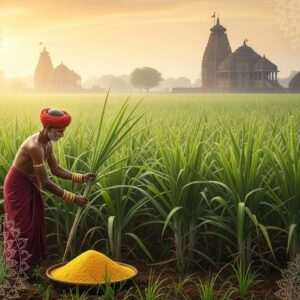
The creation of authentic Gur is a labor of love that begins in the verdant fields of rural India. It is a process that demands patience, skill, and a deep respect for nature. Unlike the industrial processing of white sugar, making Jaggery is a traditional craft that retains the soul of the sugarcane.
According to traditional wisdom and modern understanding, the process unfolds in four distinct stages:
-
Extraction of Juice
The journey commences with the harvesting of mature sugarcane or palm sap. In the rustic crushing units often found near the fields, the sturdy stalks are crushed to extract every drop of fresh, sweet juice. This raw liquid, vibrant and full of life, serves as the foundation for the entire process. -
Clarification and Purification
Once extracted, the juice must be cleansed. It is filtered to remove physical impurities like field dirt and sand. In true organic production, no harsh chemicals are used; instead, natural agents (often vegetable based like wild okra stems) are introduced to reduce acidity and bring impurities to the surface, ensuring the final product remains Satvik and pure. -
Concentration by Boiling
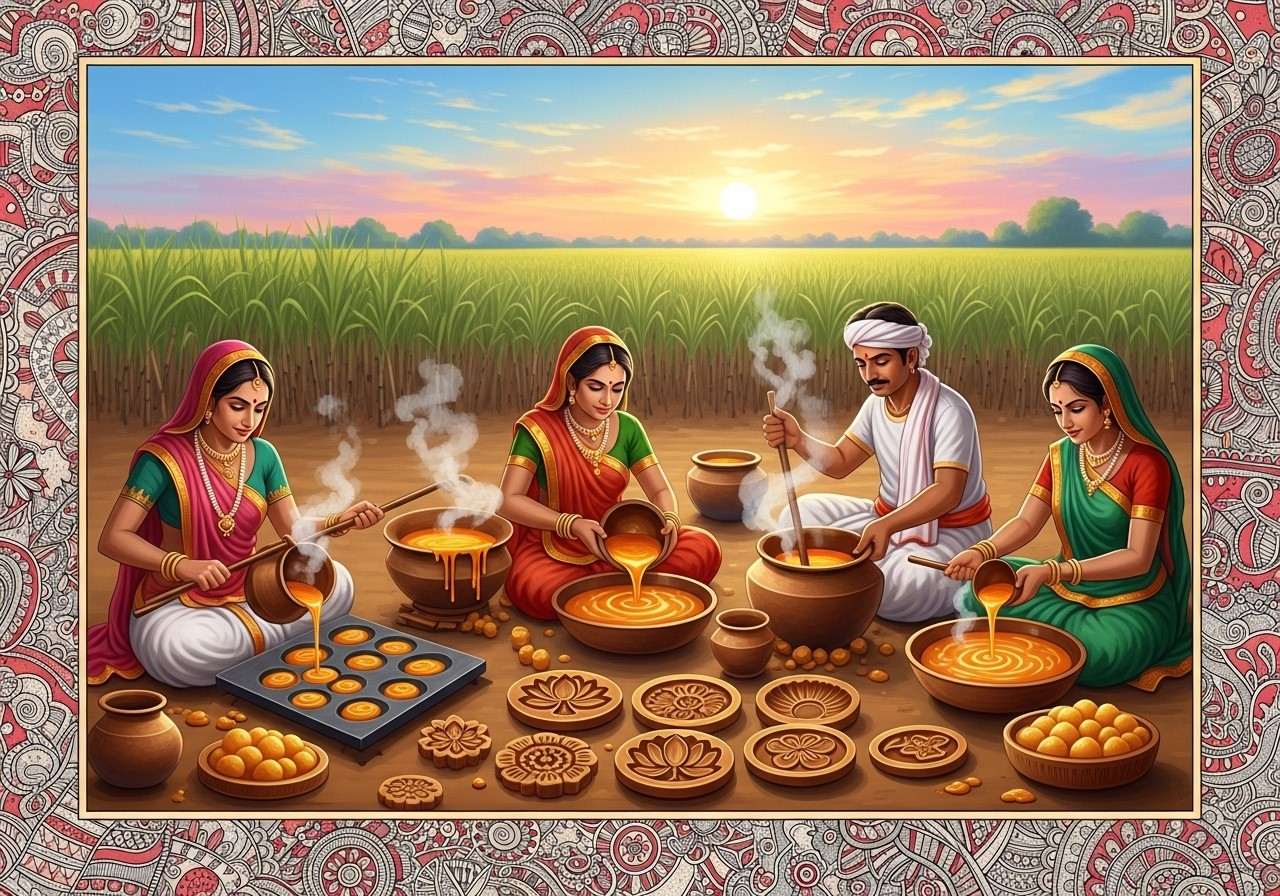
The clarified juice is then poured into massive, shallow iron pans known as ‘kadhai’. It is boiled over a slow fire, often fueled by the dried crushed cane itself. As the juice simmers and thickens into a dense, golden syrup, skilled artisans constantly perform skimming to remove any remaining impurities rising to the top, ensuring a clean texture. -
Cooling and Solidifying
This is the final, crucial step where liquid turns to solid gold. The concentrated syrup is poured into wooden or metal molds to cool down. As it sets, it solidifies into the familiar blocks (bheli) we see in markets. Alternatively, it can be cooled and pounded to create granular powder or shakkar, ready to sweeten our desserts.
Interestingly, the visual appeal of Gur tells a story of its making. The color can range from a light golden yellow to a deep, dark brown. A darker color often signifies that the Jaggery was not over-clarified, meaning it has retained a higher concentration of the sugarcane juice’s original nutrients and minerals.
Discovering Sugarcane Gur: More Than Just Sweetness
Sugarcane Gur is often cherished for its robust flavor profile. Because it retains the rich molasses content, it has a depth of flavor that is earthy and complex, unlike the one-dimensional sweetness of white sugar. In Indian cuisine, it is a versatile hero—balancing the spice in a Gujarati Dal, binding the sesame seeds in a Makar Sankranti Laddu, or simply melting on top of a hot Makki ki Roti.
Culturally, it is a sign of good omens. We start new ventures by eating curd and jaggery, and we exchange it to symbolize prosperity and goodwill. The production process itself is sustainable; nothing goes to waste, and it supports the livelihoods of local farmers (Kisan) who keep these traditions alive.
Palm Jaggery vs. Sugarcane Jaggery: A Sweet Comparison
While Sugarcane Gur is widely popular, Palm Jaggery holds a special place, particularly in Eastern and Southern India. Derived from the sap of palm trees, it is often darker and possesses a unique, almost smoky caramel flavor.
From a health perspective, Palm Jaggery is often lauded for having a lower glycemic index and a higher mineral content compared to its sugarcane counterpart. The choice between the two often boils down to regional availability and family tradition—whether you prefer the sharp sweetness of sugarcane or the mellow richness of palm. Both, however, are gifts of nature that respect the environment.
How Poojn.in Helps You Celebrate Tradition
At Poojn.in, we understand that maintaining traditions requires the right tools and an authentic atmosphere. While we celebrate the art of making Gur, we also provide the essential cultural goods that accompany its use in your home and rituals.
-
Traditional Utensils for Serving
We offer a curated selection of copper and brass utensils, which are traditionally considered the best vessels for serving sacred food items. These durable metals not only look elegant but are believed to enhance the positive vibrations of the offerings made during your daily puja. -
Authentic Ritual Items
For those who value tradition, Poojn.in provides a variety of items perfect for rituals where Jaggery is used as an offering. Our cultural goods help you preserve these ancient practices with ease, delivering the essence of India right to your doorstep.
Explore our extensive collection today at Poojn.in to find the perfect cultural accompaniments for your home. For any inquiries or assistance, feel free to contact us at 03369029784 or WhatsApp us at 9476142738.
Embracing Tradition and Sweetness
Jaggery making is more than a mechanical process; it is a celebration of our connection to the earth. From the swaying stalks in the field to the sweet block in your hand, every step echoes a legacy of dedication. It connects us to our roots, reminding us of the simple, wholesome purity that Indian culture cherishes.
Whether you choose the golden sugarcane variant or the dark, nutrient-rich palm jaggery, you are choosing a lifestyle that values health over convenience and tradition over industrialization. With the ease of modern online shopping, bringing these cultural elements into your life has never been easier. Let us honor our rituals and enrich our recipes with this natural sweetness.
Common Questions About Jaggery (Gur) Making
How is sugarcane actually converted into Jaggery?
The process is a beautiful cycle of nature. First, the sugarcane stalks are crushed to extract their juice. This juice is then boiled in large pans until it thickens into a dense, golden syrup. Finally, the syrup is poured into molds to cool down and solidify into the blocks we use at home.
What exactly is Sugarcane Gur?
Sugarcane Gur is simply the traditional, unrefined sugar obtained from sugarcane juice. It is the most common form of Jaggery found in Indian households and is a staple ingredient in everything from winter sweets to daily tea.
Is there a big difference between Palm Jaggery and Sugarcane Jaggery?
Yes, there is a distinct difference. Palm Jaggery comes from the sap of palm trees and usually has a darker color and a richer, more complex taste. Sugarcane Jaggery is lighter and sweeter. Palm jaggery is often preferred for its lower glycemic index and higher mineral content.
Can I make Jaggery at home?
While the concept is simple, making Jaggery requires specific equipment like a crusher for extraction and a very large pan for boiling the juice for hours. It is generally an artisanal process best left to skilled farmers, but the result is always worth the effort.
Why do elders prefer Jaggery over white sugar?
Our elders value Jaggery because it retains the natural nutrients of the plant, unlike refined sugar which loses almost everything during processing. Jaggery is rich in iron and minerals, making it a healthier, more wholesome choice for the family.