

Namaste and welcome to a journey back in time. When we speak of ancient India, our minds often drift to the Mauryas or the Guptas. However, there is a fascinating chapter that often goes unnoticed—the era of the Indo-Parthian Kingdom under the mighty ruler Gondophares. This dynasty, deep-rooted in the northwestern frontiers, played a pivotal role in shaping the cultural and political landscape of our subcontinent.
At Poojn.in, we believe that understanding our past enriches our present traditions. While we don’t offer history tours, we are passionate about bringing the essence of our heritage into your homes through our curated collection of ritual items. Let us explore the rise, glory, and legacy of this unique kingdom that bridged the gap between Indian, Persian, and Greek cultures.
The Rise of the Suren Kingdom
The story begins around 19 CE. Gondophares, who was originally the governor of Drangiana (historically known as Sakastan), took a bold step. He declared independence from the Parthian Empire, establishing what scholars often call the Suren Kingdom. This wasn’t just a rebellion; it was the birth of a new power.
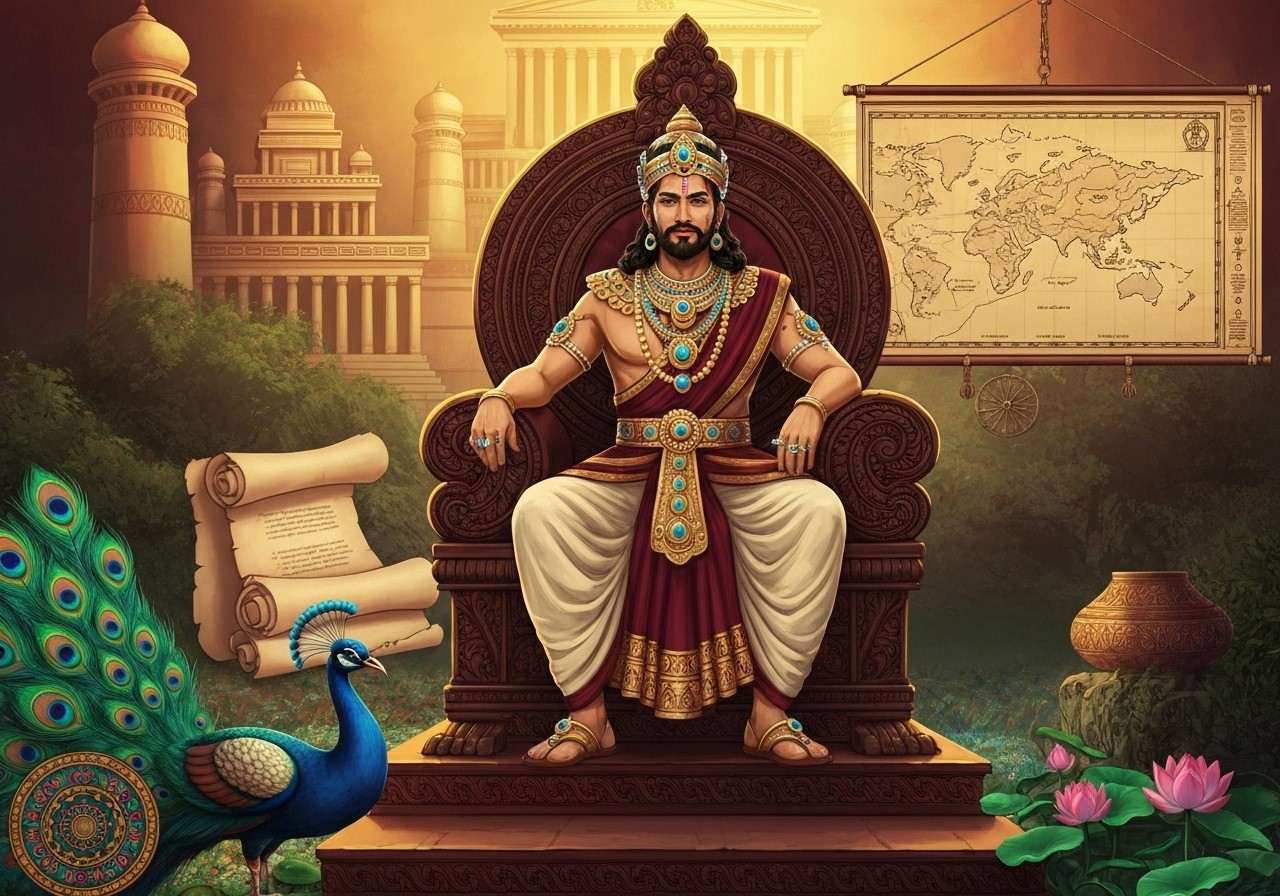
Gondophares was a visionary strategist. He expanded his territory by conquering lands previously held by the Indo-Scythians and Indo-Greeks. His domain was vast, covering Arachosia, Seistan, Sindh, Punjab, and the Kabul Valley. By around 40 CE, the empire was at its peak, and Gondophares rightfully took the title of “King of Kings.”
To understand the grandeur of such ancient expansions, one might look at other great powers of the subcontinent. For instance, the rise and significance of the Magadha Kingdom offers a similar tale of consolidation and power, though in a different region of our vast land.
Administration and the Loose Framework of Power
Unlike the centralized empires we often read about, Gondophares adopted a unique administrative style. His empire functioned as a loose framework where smaller local dynasts and satraps maintained their positions. In exchange, they recognized Gondophares and his successors as their supreme leaders. This strategy allowed for stability in a region known for its complex tribal dynamics.
This region, particularly Punjab and the northwest, has always been significant in our epics and history, much like the territories described in the history and geography of the Pandava Kingdom. The continuity of these lands as centers of power highlights their strategic importance throughout the ages.
Cultural Syncretism: A Blend of Faith and Art
One of the most beautiful aspects of the Indo-Parthian rule was its cultural tolerance and syncretism. The rulers likely practiced a blend of Zoroastrianism and Buddhism, respecting the spiritual diversity of their subjects.
- Architectural Marvels: The Indo-Parthians are credited with constructing the famous Takht-i-Bahi, an ancient Buddhist monastery in Mardan (modern-day Pakistan). Today, this stands as a UNESCO World Heritage Site, a testament to their patronage of spirituality.
- Coinage and Economy: The coins from this era are fascinating. They display a mix of Parthian, Greco-Bactrian, and local Indian influences. Gondophares standardized minting to facilitate trade along the Silk Road, boosting the economy.
Just as these ancient rulers valued the tangible representation of their culture through coins and architecture, we at Poojn.in value the tangible items that keep our traditions alive today.
If you are looking to bring a piece of tradition into your home, explore our range of culturally significant items here. We offer authentic goods that resonate with the spirit of Indian heritage.
The Decline and Legacy
History tells us that no empire lasts forever. After the death of Gondophares I, the kingdom began to fragment. The Kushans, another formidable power, began to encroach upon Indo-Parthian territories in the latter half of the 1st century CE.
The final blow came much later. The Sasanian Empire eventually conquered Sakastan around 224/5 CE, marking the end of the Indo-Parthian political dominance. For a deeper understanding of the powers that succeeded them, you might find our article on the legacy of the Kushano-Sasanians incredibly insightful.
A Note on the Legend of St. Thomas
There is a popular Christian tradition that associates Gondophares with the Apostle Thomas. While this story is deeply cherished by many, it is important to note that historians have found no contemporary archaeological evidence to firmly support this meeting. However, the very existence of such legends speaks to the fame Gondophares held in the ancient world.
Frequently Asked Questions About the Indo-Parthian Kingdom
We often receive queries from history enthusiasts wanting to know more about this era. Here, we address some common curiosities to help clear the mist around this ancient dynasty.
Who exactly was Gondophares and when did he rule?
Gondophares was the founder of the Indo-Parthian Kingdom. He was originally a governor of Drangiana who declared independence. His reign started around 19 CE, and the dynasty he established lasted until approximately 226 CE.
What areas did the kingdom cover?
At its peak, the kingdom was quite vast. It encompassed parts of eastern Iran, various regions of Afghanistan, and the northwestern parts of the Indian subcontinent, including most of modern-day Pakistan and parts of northwestern India.
What is the connection between Gondophares and Buddhism?
The Indo-Parthian rulers were patrons of architecture and religion. They are known for building the Takht-i-Bahi, a stunning Buddhist monastery. This indicates a strong Buddhist influence in the region, alongside Zoroastrian practices.
Did the Indo-Parthians issue their own money?
Yes, they did. Their coinage is very famous among historians because it shows a blend of cultures. The coins reflected Parthian, Greek, and Indian styles, proving that the kingdom was a melting pot of different traditions.
Why is this kingdom sometimes called the Suren Kingdom?
Scholars often refer to it as the Suren Kingdom because Gondophares and his successors were likely members of the House of Suren, one of the noble families of Parthia.
Bring History Home with Poojn.in
The legacy of Gondophares reminds us of a time when culture, trade, and spirituality flourished side by side. At Poojn.in, we strive to keep the flame of Indian tradition burning bright. Whether you need items for your daily puja or special cultural artifacts, we are here to serve you.
Please remember, Poojn.in is strictly an online store for cultural goods. We do not provide travel packages, VIP darshan services, or tour guidance. Our sole focus is to provide you with the best cultural goods and ritual items delivered to your doorstep.
For any inquiries about our products, please feel free to contact us at 03369029784 or reach out via WhatsApp at 9476142738.