

Music in our country is rarely just for entertainment; for many of us, it is a path to the divine. When we talk about melodies that touch the soul, the tradition of Qawwali stands tall, echoing through the corridors of time. At the heart of this mesmerizing tradition stands a towering figure, Ustad Fateh Ali Khan Jullundhri (1901–1964). As we explore his life, we aren’t just looking at a musician; we are uncovering a rich tapestry of history, spirituality, and the Sufi Chishti Order.
For those of us who grew up listening to the legendary Nusrat Fateh Ali Khan, it is vital to look back at the man who shaped him—his father, Fateh Ali Khan. His story is one of immense discipline, deep spirituality, and a voice that could move mountains. Just as we cherish our family traditions, exploring his journey helps us understand the roots of the music that defines our culture today.
A Lineage of Devotion: The Qawwal Bacchon Gharana
Fateh Ali Khan was not an accidental artist; he was the torchbearer of a legacy that spanned over 600 years. He belonged to the illustrious Qawwal Bacchon gharana, a lineage celebrated for maintaining an unbroken tradition of Qawwali music. Much like the revered musical traditions of the Maihar Gharana, Fateh Ali Khan’s family history is steeped in discipline and devotion. This deep connection to the past allowed him to channel centuries of spiritual energy into every performance.
His training began at home, under the watchful eye of his father, Maula Bakhsh Khan. It wasn’t just about singing; it was about mastering the art of sound. Fateh Ali Khan was a virtuoso who mastered traditional Indian instruments like the sitar, sarod, and vichitraveena. Interestingly, he also mastered the violin, showcasing a rare ability to blend Eastern and Western sounds. His repertoire was vast, including thousands of verses in Punjabi, Urdu, Arabic, and Persian, allowing him to connect with diverse audiences across the subcontinent.
The Architects of Qawwali: Fateh Ali Khan, Mubarak Ali Khan & Party
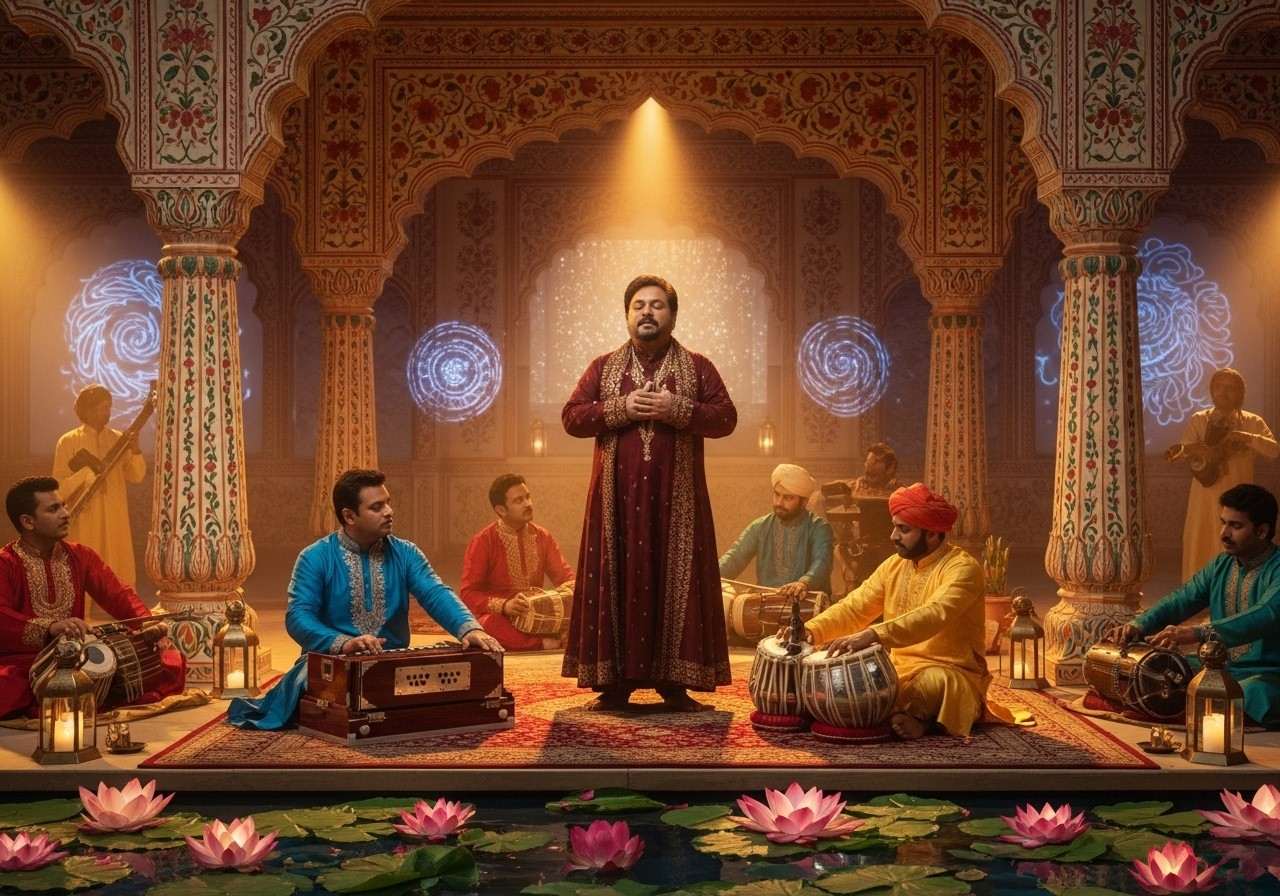
In the world of classical music, collaboration is key. Fateh Ali Khan led his family’s ensemble, famously known as Fateh Ali Khan, Mubarak Ali Khan & Party. His brother, Mubarak Ali Khan, was his partner in this spiritual journey, sharing both singing duties and the harmonium. Together, they were considered the foremost exponents of Qawwali in their era. Their partnership reminds us of the deep bonds found in musical families, similar to the Pandit sons’ tradition of lineage and legacy, where art is a sacred duty passed down through bloodlines.
One of their most significant contributions was bringing the poetry of Allama Muhammad Iqbal to the masses. Through their powerful renditions, they popularized Iqbal’s philosophical verses, earning praise from the poet himself. This fusion of high poetry and soulful music helped elevate Qawwali from local shrines to national stages.
Bring the Essence of Tradition to Your Home with Poojn.in
At Poojn.in, we understand that culture is not just something you read about; it is something you experience. If the soulful description of Qawwali has inspired you to reconnect with your roots, we are here to help you set the right atmosphere. We are India’s biggest cultural goods store, dedicated to keeping our traditions alive.
- Authentic Musical Instruments for Devotion:
Whether you are a beginner or a connoisseur, our collection includes high-quality harmoniums and tablas. These instruments are perfect for those evening riyaaz sessions or family gatherings where music becomes the medium of prayer. - Premium Incense and Aromatherapy:
Create the ambiance of a Sufi shrine right in your living room with our specially curated incense sticks and dhoop. The fragrance is designed to calm the mind and elevate the spirit, making it perfect for listening to devotional music legacies in peace. - Traditional Ethnic Wear:
Immerse yourself fully in the cultural experience by exploring our range of ethnic wear. Wearing traditional attire like a kurta while engaging in spiritual activities adds a layer of respect and authenticity to your practice.
Explore our wide range of culturally significant items today. For inquiries, you can reach us at 03369029784 or message us on WhatsApp at 9476142738.
Understanding the Spirit of Qawwali
Qawwali is often misunderstood as just a genre of music, but for us, it is a spiritual journey known as ‘Sama’. It is a medium for communal worship and spiritual connection. A typical performance is a dynamic interplay between the lead singer, the chorus, and the rhythmic clapping that mimics the heartbeat of the devotee. The themes revolve around divine love, separation, and the ultimate reunion with the Creator.
Listeners often describe the experience as cathartic. When the tempo builds and the voices soar, it creates a trance-like state where the listener forgets their worldly worries. Fateh Ali Khan was a master of this improvisation, knowing exactly when to let the music flow freely and when to rein it in, ensuring the sanctity of the tradition remained intact.
A Legacy That Lives On
The impact of Fateh Ali Khan extends far beyond his lifetime. In 1960, his immense contribution to the arts was recognized when he received the prestigious Pride of Performance Award. However, his greatest legacy is perhaps his son, the world-renowned Nusrat Fateh Ali Khan, and his grandson, Rahat Fateh Ali Khan. They took the foundation laid by Fateh Ali Khan and introduced Qawwali to the global stage.
Today, when we listen to Qawwali on digital platforms or attend live concerts, we are witnessing the fruits of Fateh Ali Khan’s labor. He preserved the authenticity of the classical ragas while making the music accessible, ensuring that this beautiful art form did not fade away into history.
Common Questions About Fateh Ali Khan and Qawwali
Who was Fateh Ali Khan and why is he important?
Fateh Ali Khan Jullundhri was a legendary classical singer and Qawwal who laid the groundwork for modern Qawwali. As the father of Nusrat Fateh Ali Khan and a master of the Qawwal Bacchon gharana, he is revered for blending classical music expertise with Sufi devotion, influencing generations of musicians.
What instruments are used in traditional Qawwali?
Traditional Qawwali relies heavily on the harmonium and tabla, along with the rhythmic clapping of the chorus. Fateh Ali Khan was unique because he also mastered string instruments like the sitar and sarod, enriching the musical texture of his performances.
How can I start appreciating Qawwali music?
The best way to start is by listening to the classics with an open heart. Focus on the emotion in the voice rather than just the lyrics. To enhance the experience, create a peaceful environment at home—perhaps with some soothing incense from Poojn.in—and let the music take you on a spiritual journey.
What is the connection between Fateh Ali Khan and Allama Iqbal?
Fateh Ali Khan and his brother Mubarak Ali Khan were instrumental in popularizing the poetry of Allama Muhammad Iqbal. They set his philosophical verses to music, making complex spiritual ideas accessible to the common man, a feat for which Iqbal himself expressed deep gratitude.