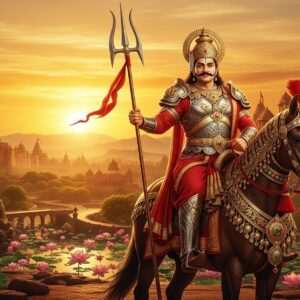


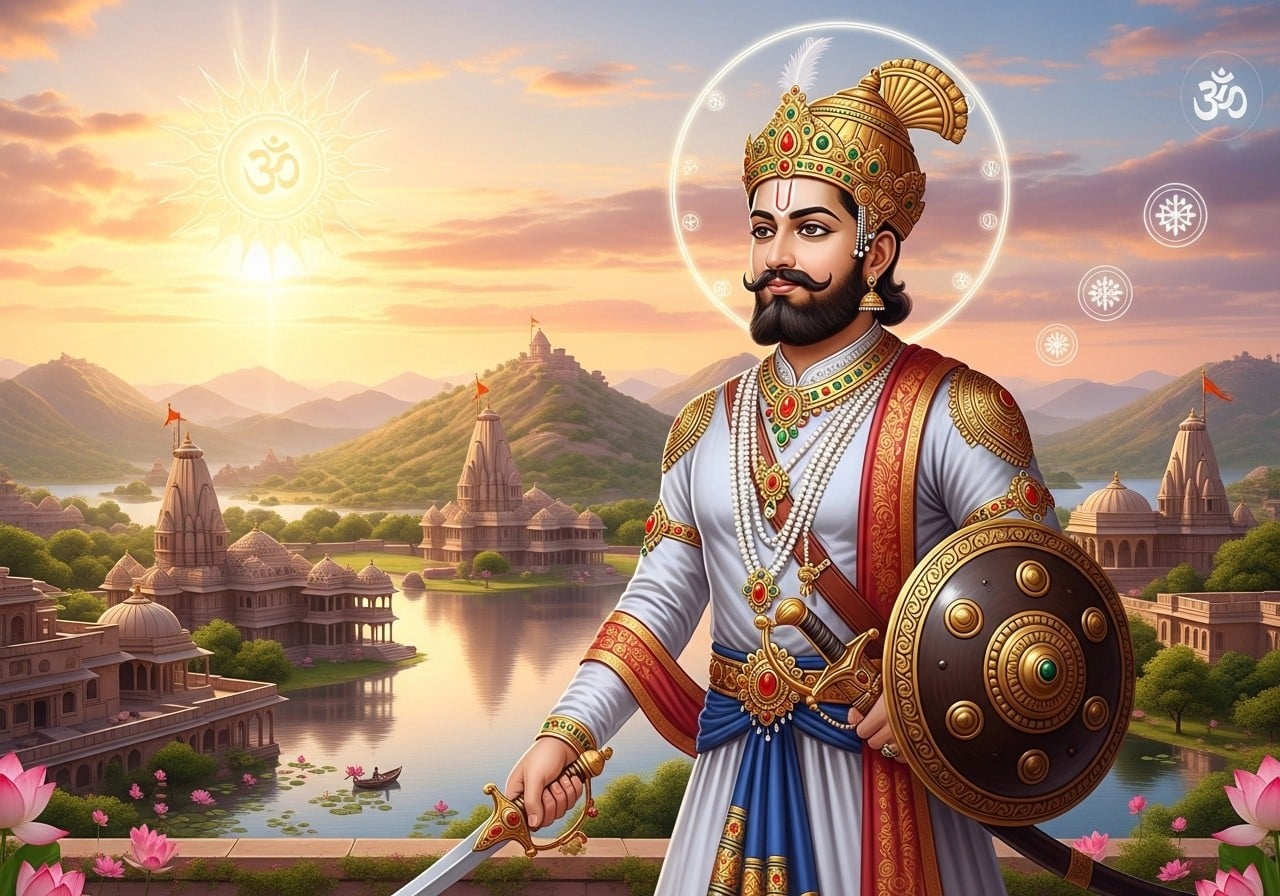
The land of India is dotted with tales of valor, but few regions hold a place in our hearts quite like the Mewar region. It is a land where history is written not just in ink, but in the blood of warriors and the chants of sages. At the center of this glorious legacy stands the towering figure of Bappa Rawal, the legendary founder of the Mewar Dynasty. His story is not merely about a king who ruled; it is about a guardian who protected the sanctity of our culture.
For us at poojn.in, understanding our roots is the first step in preserving them. As India’s leading platform for cultural goods, we believe that the stories of our ancestors, like the great Bappa Rawal, help us keep our traditions alive in our modern homes. This blog takes a deep dive into the geographical vastness, historical might, and spiritual soul of Mewar.
The Rise of a Warrior: Historical Background of Bappa Rawal
Born as Prince Kalbhoj around 713 CE, the early life of Bappa Rawal reads like a divine script. After his father, Rawal Mahendra II, sacrificed his life in battle, young Kalbhoj was raised in secret, protected by a Brahmin lady and the Bhil community. It is said that he spent his childhood tending to sacred cattle in the Vindhya Range near Nagda, a humble beginning for a man destined to be an emperor.
His ascension to the throne was not just a political shift but a restoration of Dharma. Here is how history remembers his rise:
- Establishment of Mewar: In 728 CE, Bappa Rawal took the first decisive steps toward establishing the Mewar Kingdom. By 734 CE, he had seized the strategic fort of Chittor from the Mori rulers, marking the beginning of a dynasty that would last for over 1250 years.
- The Arab Invasion Repelled: The 8th century was a turbulent time, with Arab invasions threatening the fabric of Indian society. Bappa Rawal united the Rajput rulers and played a pivotal role in the Battle of Rajasthan, dealing a crushing defeat to the invaders and protecting the motherland.
- Expansion Beyond Borders: His valor knew no bounds. Historians note that he chased the invader Bin Qasim beyond Sindh. He is believed to have marched as far as Ghazni and Iran, building military posts to ensure that foreign forces would think twice before looking towards India again.
To understand the depth of this era, one must look at how the kingdom rose and fell over centuries. You can read more about the timeline in our detailed article on the Mewar Kingdom: A History of Its Rise and Fall.
The Geographical Footprint: From Mewar to Iran
When we speak of the geography of Mewar today, we think of the beautiful districts of Udaipur, Rajsamand, Bhilwara, and Chittorgarh. However, under Bappa Rawal’s reign (734–753 CE), the boundaries were far more extensive. The rugged Aravalli Range served as a natural fortress, protecting the heart of the kingdom, while the capital shifted from Nagda to the impregnable Chittorgarh Fort.
But Bappa Rawal was not content with just defending his home; he believed in proactive defense. His empire’s influence reportedly stretched into Khorasan, Turan, and Isfahan. He established checkpoints and watchtowers as far as Iran, effectively creating a buffer zone that safeguarded India for centuries. This unique blend of strategic geography and military might is what makes Mewar’s history so fascinating. For a deeper look into the land itself, explore Mewar’s Spiritual Heart: Udaipur’s Sacred History and Geography Explored.
The Diwan of Eklingji: A Spiritual Legacy
In India, a true king is one who bows before the Divine. Bappa Rawal’s life was deeply intertwined with spirituality. His power was never for personal glory but was considered a blessing from his guru, Harit Rishi. It was this sage who initiated him into the Shaivite order and prophesied his kingship.
The most enduring symbol of this devotion is the Eklingji Temple in Nagda. Bappa Rawal built this temple and dedicated the entire kingdom to Lord Shiva. He famously declared that he was merely the “Diwan” (Prime Minister) and that the true ruler of Mewar was Shree Eklingnath ji. This tradition of ruling as a custodian of God was followed by Mewar rulers for generations.
If you wish to understand the spiritual network that connects these ancient sites, we recommend reading Mewar’s Legacy: A Spiritual Journey Through Udaipur’s Historical Sites.
This deep connection to Shiva is something many of us strive for in our daily pujas. To bring a fraction of that purity into your own home rituals, authenticity is key. At poojn.in, we offer the Sapta Jal (Seven Holy Water), perfect for the Mahasnan (great bath) of your Shivling, allowing you to perform Abhishek with the reverence of the ancients.
Keeping the Tradition Alive
After a glorious reign of about 20 years, Bappa Rawal abdicated the throne in 753 AD to pursue the path of asceticism. He left behind not just a kingdom, but a legacy of Hindu resistance and spiritual integrity. He is remembered today as a Warrior-Saint, a protector who proved that devotion and strength go hand in hand.
We at poojn.in are committed to helping you stay connected to these profound traditions. Whether you are looking for authentic ritual items or cultural artifacts that tell a story, our store is your bridge to India’s heritage. Please note, while we love the history of these temples, we strictly sell cultural goods and do not offer travel packages or VIP darshan services.
Frequently Asked Questions about Bappa Rawal and Mewar
What was the true geographical extent of Bappa Rawal’s empire?
Bappa Rawal’s empire went far beyond modern-day Rajasthan. While the heart of Mewar included Udaipur, Chittorgarh, and Rajsamand, historical accounts suggest his military influence and control extended into Sindh, Baluchistan, and even parts of present-day Afghanistan and Iran, where he set up military posts to deter invaders.
How did the bond between Bappa Rawal and Harit Rishi shape Mewar?
The relationship was foundational to the kingdom’s ethos. Harit Rishi was the spiritual guru who guided Bappa Rawal during his early years and blessed him with kingship. It was under his guidance that Bappa Rawal embraced Shaivism and established the Eklingji Temple, embedding spirituality into the governance of the state.
Why is Bappa Rawal considered the ‘Diwan’ of Eklingji?
Bappa Rawal set a unique precedent by not claiming the title of the supreme monarch for himself. Instead, he dedicated the kingdom to Lord Shiva (Eklingji) and ruled as his representative or “Diwan.” This act of humility and devotion signified that the state was governed by divine will, a tradition upheld by his successors.
When did Bappa Rawal rule, and what is his contribution to Indian history?
Bappa Rawal ruled from approximately 734 CE to 753 CE. His greatest contribution was repelling the Arab invasions in the 8th century, a victory that historians believe protected India from foreign domination for nearly 400 years. He is celebrated as the founder of the Mewar Dynasty and a symbol of national pride.