

When we look back at the tapestry of Indian history, certain names shine brighter than gold. Bappa Rawal is one such name that evokes a sense of deep pride and reverence in every Indian heart. He was not just a ruler; he was a phenomenon who redefined the boundaries of our bravery. His legacy is not merely a chapter in a textbook but a living spirit that continues to inspire our traditions and values today.
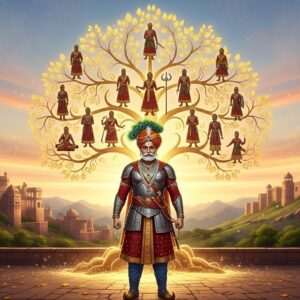
Understanding his life helps us appreciate the cultural soil we stand on. Whether it is the protection of Dharma or the establishment of the illustrious Mewar Dynasty, Bappa Rawal’s contributions are the roots from which the great tree of Rajput valour grew. For us at poojn.in, celebrating such history is akin to worshipping the very essence of our culture.
From Kalbhoj to Bappa Rawal: The Rise of a Warrior
Born in 713 AD as Kalbhoj, his early life was steeped in tragedy and resilience. After his father, Rawal Mahendra, and other male elders fell in battle against the Bheels of Idar, young Kalbhoj was raised by his mother. It is said that loyal Bheel attendants played a crucial role in his upbringing, teaching him the art of warfare and survival in the rugged terrains. This bond between the ruler and the tribal communities became a cornerstone of Mewar’s strength.
By 734 AD, at the young age of 21, the boy had become a formidable warrior. He defeated Man Mori to conquer the legendary Chittor Fort. Instead of continuing his father’s lineage name, he chose to forge a new path, establishing the Guhil dynasty of Mewar in 728 CE. This marked the beginning of an era that would later produce titans like Maharana Pratap and Rana Sanga.
The Shield of India: Military Conquests and Strategy
Bappa Rawal is perhaps best remembered for his role as the protector of the Indian frontier. In the 8th century, when the subcontinent faced the threat of Arab invasions, it was Bappa Rawal who stood like a wall of iron. His military brilliance was displayed in the Battle of Rajasthan in 738 AD.
- The Great Confederacy: Bappa Rawal did not fight alone; he understood the power of unity. He formed a formidable alliance with the Pratihar King Nagbhata I, along with the brave Bhils and Nagas. Together, they decimated the invading Arab forces on the Sindh-Rajasthan border, securing the land’s safety for centuries.
- Expanding Boundaries: Unlike many rulers who were content with defending their borders, Bappa Rawal believed in proactive defense. He chased the invaders far beyond the Indus, expanding the Mewar kingdom’s influence up to Ghazni, Kandahar, and Iran. He constructed massive watchtowers along the route to discourage any future aggression, effectively sealing the gateway to India.
Just as we explore the rise of other great powers in our history, such as in our article on the Gahadavala Dynasty’s rise and rule, Bappa Rawal’s expansionism set a benchmark for sovereignty and strategic depth.
Rawalpindi: A Mark of Dominion
The extent of his influence is etched in geography itself. The city of Rawalpindi (now in Pakistan) derives its name from this great ruler. It was here that Bappa Rawal established a critical military base to fortify the Northwest Frontier. From this strategic point, he launched over 15 attacks into Ghazni, liberating Sindh and administering a vast territory that stretched deep into Central Asia. This historical connection reminds us that the influence of Indian kings once spanned far beyond our modern borders.
Spiritual Devotion and the Eklingji Tradition
Despite his immense military power, Bappa Rawal remained a humble servant of the Divine. A devout Shaivite, he credited his victories to the blessings of Lord Shiva. He constructed the famous Eklingji Temple, initiating the tradition where the Ranas of Mewar ruled not as kings, but as custodians (Diwans) of Eklingji.
In 753 AD, after ruling with an iron fist and a kind heart for about 20 years, he chose the path of renunciation. He abdicated the throne in favor of his son and became an ascetic, devoting the rest of his life to spiritual practices. This transition from a conqueror to a sage is a quintessential Indian ideal, reflecting the balance between Raj Dharma (duty of a king) and Moksha (liberation).
Connecting with Our Heritage Through Poojn.in
Poojn.in is the premier destination for cultural goods in India, bringing you closer to the traditions that men like Bappa Rawal fought to preserve. We understand that history is not just about reading; it is about experiencing the culture that has survived for thousands of years. While we do not offer travel packages to historical sites, we provide the essential items you need to keep these traditions alive in your home.
Embrace the Rituals
Bappa Rawal’s devotion to Lord Shiva inspires us to perform our daily pujas with purity and dedication. To assist you in your spiritual journey, we offer high-quality ritual items. For instance, the vibrancy of our offerings can be enhanced with authentic products like Rakta Jaba Alta, which symbolizes auspiciousness and devotion in many Indian households.
Learn from the Past
Our blog is a treasure trove of information. If you are interested in how other dynasties shaped our culture, you might enjoy reading about the legacy of Kumarapala of the Chaulukya Dynasty. Much like Bappa Rawal, Kumarapala’s rule left an indelible mark on Indian history, and understanding these figures gives us a complete picture of our glorious past.
Common Questions About Bappa Rawal’s Legacy
Why is Bappa Rawal considered the real founder of the Mewar Dynasty?
While the Guhila lineage existed before him, it was Bappa Rawal who truly established the kingdom’s power in 728 CE. By capturing the Chittor Fort and expanding the territory significantly, he transformed a small principality into a sovereign state that would last for centuries. His military success provided the stability needed for the dynasty to flourish.
What was the significance of the Battle of Rajasthan in 738 AD?
This battle is one of the most critical moments in Indian history. Bappa Rawal led a confederacy that crushed the invading Arab armies. The defeat was so severe that it is said the Arabs did not dare to attack India for the next 400 years. This victory preserved the indigenous culture and religion of the region during a time of great geopolitical upheaval.
Did Bappa Rawal really name Rawalpindi?
Yes, historical accounts suggest that Bappa Rawal set up a military cantonment in that region to guard the Northwest Frontier. The city that grew around this base came to be known as Rawalpindi, serving as a testament to his administration that extended all the way to the borders of Iran and Afghanistan.
How did Bappa Rawal spend his final years?
After a life of warfare and administration, Bappa Rawal turned towards spirituality. In 753 AD, he handed over the reigns of his kingdom to his son and embraced the life of an ascetic. He dedicated his remaining time to the worship of Lord Shiva, reinforcing the spiritual foundation of the Mewar royal family.
At poojn.in, we are committed to keeping these stories alive. By integrating our rich past with your daily life through authentic cultural products, we hope to serve your spiritual needs. For any assistance with our products, please visit our website.