
In the vast and colorful tapestry of our Sanatan Dharma, Lord Brahma holds a unique and revered position as ‘The Divine Creator.’ As one-third of the holy Trimurti, alongside Lord Vishnu (the Preserver) and Lord Shiva (the Destroyer), his role is fundamental to the existence of the cosmos. While we see countless temples for Shiva and Vishnu across India, the mythology of Brahma is somewhat more enigmatic, filled with profound symbolism and ancient stories passed down by our elders. Understanding these narratives allows us to connect deeply with the spiritual roots that define our culture.
At Poojn.in, we believe in keeping these traditions alive, not just through stories, but by providing the authentic tools you need for worship. Lord Brahma, the creator deity in Hindu religion, laid the foundation of the universe, and we are here to help you honor that legacy in your daily life.
The Divine Origins: How the Creator Came to Be
The story of how Lord Brahma came into existence is as fascinating as the universe he created. Ancient scriptures offer us vivid glimpses into his birth, often describing him as ‘Swayambhu,’ meaning the self-born one. One of the most popular beliefs, cited in many Puranas, is that he emerged from Hiranyagarbha, the cosmic golden egg, which floated in the primordial void. This golden womb represents the source of all energy and matter before the universe took shape.
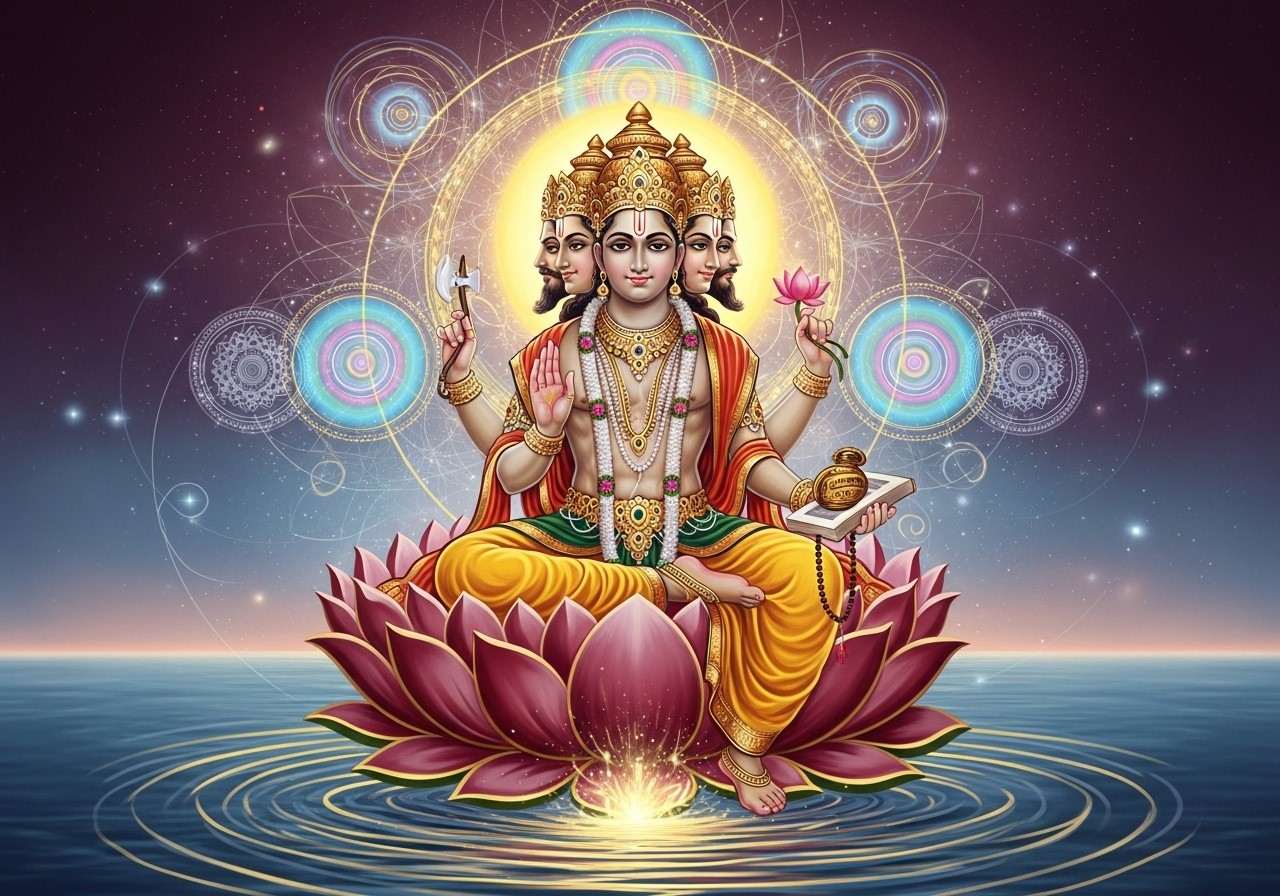
Another deeply held belief connects him intimately with the preserver of the universe. It is said that Brahma was born from a mystical lotus that sprouted from the navel of Lord Vishnu while he was in deep meditative sleep on the cosmic ocean. This imagery highlights the beautiful interdependence of the gods—creation rising from preservation. In the context of Shaktism, the narrative shifts slightly, portraying Brahma as the son of Adi Para Shakti, the supreme energy, emphasizing the feminine power behind creation. To dive deeper into these fascinating origin stories, you can read our detailed guide on understanding Brahma, the Hindu God of Creation explained.
Decoding the Symbolism: Four Heads and the Swan
Have you ever wondered why Lord Brahma is depicted the way he is? Every aspect of his iconography carries a heavy weight of spiritual meaning. He is famously shown with four heads, which represent the four Vedas (Rig, Yajur, Sama, and Atharva). These heads face the four cardinal directions, signifying that his knowledge is comprehensive and all-seeing. Unlike the warrior deities, Brahma is often shown as an elderly sage with a white beard, symbolizing the maturity and eternal wisdom required to craft the universe.
His hands hold items that are essential for a life of piety and discipline:
- The Kamandalu (Water Pot): This contains the water of creation, symbolizing the source from which all life flows. It reminds us that water is the essence of life, a concept deeply rooted in Indian rituals where Kalash worship is mandatory.
- The Akshamala (Rosary) and Vedas: The beads represent the passage of time and the cycle of the universe, while the scriptures in his hand signify that knowledge is the foundation of all creation. Without knowledge (Vidya), creation is impossible.
- The Vahana (Vehicle): Brahma is seated on a Hamsa (Swan) or a lotus. The swan is a powerful symbol in Indian philosophy; it is said to possess Neera-Ksheera Viveka, the ability to separate milk from water. This represents the divine wisdom to distinguish between the real and the unreal, or the good and the bad.
For those who appreciate the beauty of such divine craftsmanship, bringing home a brass idol can be a way to invite positive energy. While Brahma idols are rare, we offer exquisite Lord Vishwakarma Pure Brass Murti Showpiece, honoring the divine architect who works in tandem with the creative principles of Brahma.
Brahma and Saraswati: The Union of Creation and Knowledge
One cannot speak of Brahma without honoring his divine consort, Goddess Saraswati, the deity of wisdom, music, and the arts. Their union is not just a marriage of two deities but a philosophical necessity: creation cannot exist without knowledge. Mythology tells us that Brahma created Saraswati from his own being. He was so enchanted by her wisdom and beauty that he grew extra heads to gaze upon her, a story that metaphorically shows the inseparable bond between the creator and his muse.
However, their relationship is also complex and woven with lessons. Some legends suggest that Saraswati, displeased with Brahma’s infatuation, cursed him, which is one of the reasons cited for his limited worship on Earth. Yet, they remain a powerful duo in the celestial hierarchy. To explore this divine relationship further, we recommend reading our post on Brahma and Saraswati: The Creator and His Muse.
Why are there so few Brahma Temples?
It is a question that puzzles many: if he is the creator, why do we not have a temple for him in every city like we do for Hanuman ji or Shiva? The answer lies in the ancient scriptures. Legends state that Lord Brahma was cursed, leading to a decline in his worship. One prominent myth involves a competition between Brahma and Vishnu to find the end of a massive Shiva Linga. Brahma falsely claimed to have found the top, using a Ketaki flower as a false witness. Angered by this deceit, Lord Shiva, the embodiment of truth, cursed Brahma that he would not be worshipped by mortals.
Another variation attributes the curse to Goddess Saraswati herself. Despite this, he is still revered in key pilgrimage sites like the famous Brahma Temple in Pushkar, Rajasthan. While daily home worship of Brahma is less common, he is always invoked during the beginning of rituals (Yajnas) and marriages, proving that no auspicious work is complete without his blessings.
How Poojn.in Can Help You Connect with the Divine
At Poojn.in, we understand that spirituality is a personal journey, yet it requires the right materials to feel complete. We stand out as the premier destination for cultural goods in India. Our extensive range of products meets all your cultural requirements, ensuring that your connection to the divine is never hindered by a lack of resources. Explore our collection today at poojn.in.
We offer a range of products and resources that can enhance your understanding and appreciation of Hindu traditions:
- Authentic Ritual Items: We offer authentic ritual items related to daily worship that you can purchase online. From pure brass diyas to high-quality incense, we ensure your prayer room has the sanctity it deserves.
- Brahman Bhojan Essentials: Feeding Brahmins is a symbolic offering that honors Lord Brahma, the father of Dharma. Poojn.in provides the necessary items (such as raw grains, cloth, and utensils) for performing this ritual, ensuring you have everything you need for an authentic experience.
- Knowledge & Guidance: Through our blog, we provide detailed articles about Indian deities. We believe that knowing the ‘why’ behind a ritual makes the ‘how’ much more meaningful.
Why should you choose poojn.in for your cultural needs? One reason is that poojn.in offers a unique collection of cultural goods that you won’t find anywhere else. For more information or assistance, contact us at 03369029784 or WhatsApp 9476142738.
Common Questions Devotees Ask About Lord Brahma
What is the story behind Lord Brahma’s birth?
According to sacred texts, Lord Brahma’s origin is mystical. He is often said to have been born from a lotus that bloomed from the navel of Lord Vishnu. In other traditions, he emerged from a golden cosmic egg known as Hiranyagarbha. Both stories signify that he is the beginning of all creation.
Why do we see very few temples for Lord Brahma in India?
Although he is a supreme deity, mythology suggests that Lord Brahma was cursed. One legend says Lord Shiva cursed him for speaking an untruth, while another says Goddess Saraswati cursed him. Because of this, temples dedicated solely to him, like the one in Pushkar, are very rare.
What do the four heads of Lord Brahma signify?
The four heads are not just physical features; they are deeply symbolic. They represent the four Vedas (ancient scriptures of knowledge) and the four cardinal directions (North, South, East, West). This shows that the Creator’s knowledge is complete and omnipresent.
Who are the consorts of Lord Brahma?
Goddess Saraswati is the primary consort of Lord Brahma, representing the knowledge required for creation. In some regional traditions and texts, Goddess Gayatri and Savitri are also mentioned as his consorts, playing vital roles in Vedic rituals.
Is Lord Brahma still worshipped in Hindu rituals today?
Yes, absolutely. While he may not have many dedicated temples, no Vedic ritual or Yajna is considered complete without invoking Lord Brahma. He is revered as the silent witness and the ultimate grandfather (Pitamaha) of the universe during these ceremonies.