


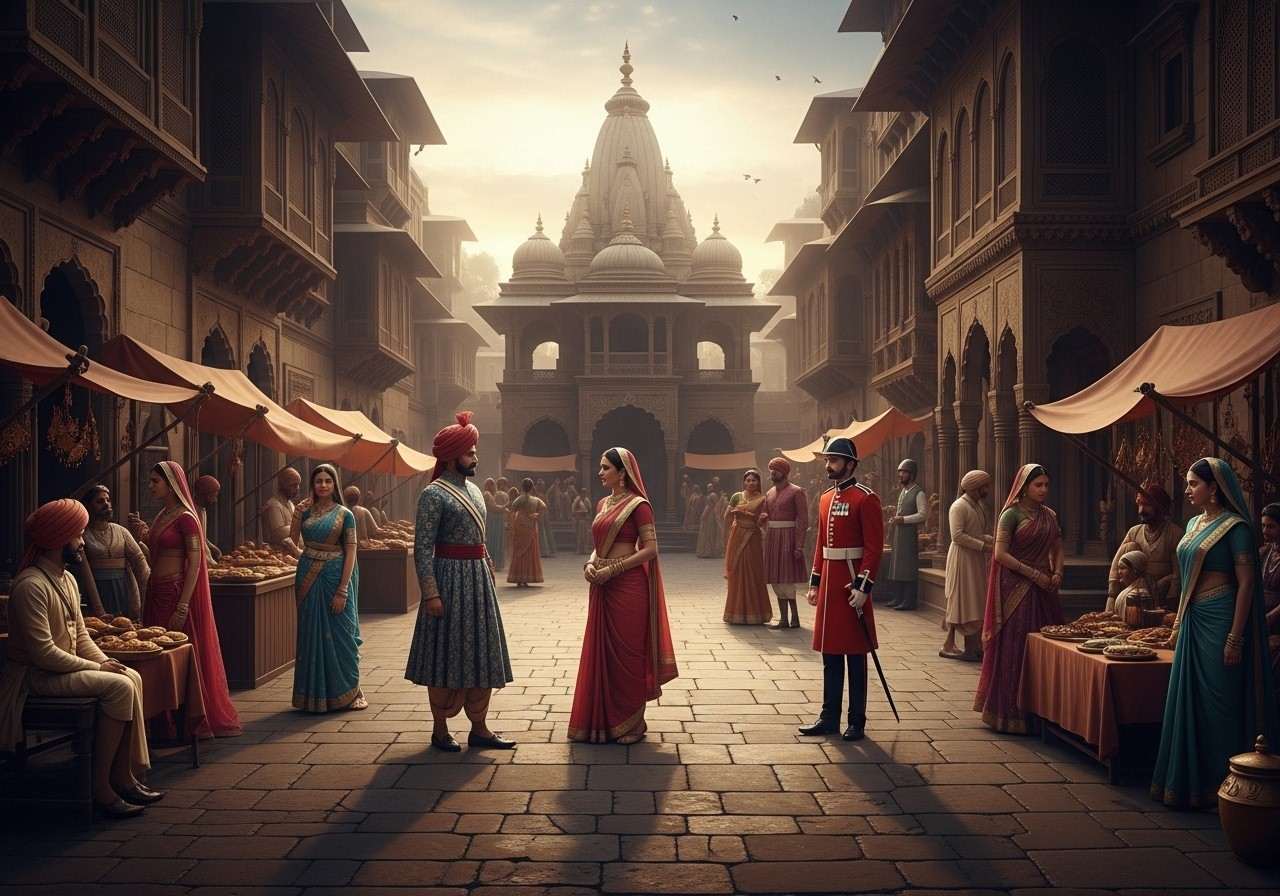
Every family in India has stories, whispers from our grandparents about a time that was vastly different, yet shaped the very world we live in today. This was the British era, a significant period in our history that stretched from 1803 to 1947. It was a time of great upheaval, profound change, and an unyielding struggle for freedom. For those of us who hold our traditions close to our hearts, understanding this journey is not just a history lesson; it’s about connecting with the resilience and spirit of our ancestors.
The Seeds of Control: The Early British Footprint (1803-1857)
In the early 1800s, the British presence, initially through the East India Company, began to tighten its grip over the subcontinent. The Second Anglo-Maratha War was a crucial event that firmly established British power. They introduced clever policies like Lord Wellesley’s ‘Subsidiary Alliance,’ which seemed like an offer of protection but slowly eroded the independence of Indian princely states. It was during this time that the foundations of the British Raj were laid, not just with soldiers and treaties, but through social and economic shifts that changed the fabric of Indian life.
The Charter Act of 1813 opened the doors for Christian missionaries and wider commerce, bringing Western ideas and goods into our society. This sparked a period of great intellectual and cultural churning, especially seen in the Bengal Renaissance. While the East India Company focused on trade and administration, a quiet storm of discontent was brewing among the people, setting the stage for a massive uprising.
The First Roar for Freedom: The 1857 Uprising
The year 1857 is etched in our collective memory as India’s First War of Independence. It wasn’t a sudden event but the culmination of years of economic exploitation, disrespect for our cultural and religious sentiments, and grievances among Indian soldiers. Brave hearts like Rani Lakshmibai of Jhansi, Tantia Tope, and the aged Mughal emperor Bahadur Shah Zafar became symbols of this fierce resistance.
Though the uprising was suppressed with great force, it shook the British Empire to its core. It marked the end of the East India Company’s rule and the beginning of direct governance by the British Crown. This transfer of power brought about significant changes in administration, but it also deepened the racial divide and, ironically, ignited the flames of Indian nationalism like never before.
Life Under the Raj: Policies and a Rising Consciousness (1858-1914)
Under the direct British Raj, India underwent a massive transformation. The administration introduced new systems that touched every aspect of life.
- Economic Overhaul: Land revenue systems like the Permanent Settlement and Ryotwari were implemented. While they were meant to streamline tax collection, they often left farmers in deep debt. Traditional Indian crafts and handloom industries suffered as India was turned into a market for British factory goods.
- Connecting the Country: The British built a vast network of railways, telegraphs, and canals. While this infrastructure connected different parts of India, its primary purpose was to help the British transport raw materials and deploy troops quickly to maintain control.
- A New Wave of Thought: The introduction of English education created a new class of Indians who were exposed to Western ideas of democracy, liberty, and justice. This new-found awareness led to the rise of political consciousness and the formation of organisations like the Indian National Congress in 1885, which started as a platform to voice Indian concerns and eventually became the leading force in the freedom struggle.
The Final Chapters of the Freedom Struggle (1914-1947)
The 20th century saw the freedom movement gain unstoppable momentum. After millions of Indian soldiers contributed bravely to World War I, the desire for self-rule grew stronger. It was the era of Mahatma Gandhi, who transformed the struggle into a nationwide mass movement with his philosophy of non-violent resistance. Movements like the Civil Disobedience and the powerful Quit India Movement of 1942 saw ordinary Indians from all walks of life come together to demand freedom.
The final years were marked by intense negotiations, but also by the deep pain of the Bengal Famine and growing communal tensions, fanned by British policies. Ultimately, the British era in India came to an end on August 15, 1947. The joy of independence was immense, but it was bittersweet, as it came with the tragic partition of the subcontinent.
The Enduring Legacy: Shadows and Light
The British era left behind a complex legacy of both shadows and light. It left us with a system of parliamentary democracy, a unified legal framework, and a vast railway network. The English language, too, became a tool for global communication. However, it also left scars of economic exploitation and social division that took generations to heal.
To understand modern India, it’s crucial to look back at this period. It teaches us about our strength, our ability to unite, and the incredible price our ancestors paid for the freedom we enjoy today. It is a history of pain, but also one of immense pride and resilience.
Connecting with Our Heritage
Reflecting on our history can be a deeply personal experience. Creating a serene atmosphere can help us connect with the spirit of our past. At Poojn, we believe that our traditions are a bridge to our history. Simple rituals can help us feel closer to our roots and the journey of our nation.
As you delve into the stories of our freedom fighters and the complexities of the British Raj, consider bringing a touch of tradition into your space. Lighting a simple brass diya or the calming fragrance of incense sticks can create a peaceful environment for reflection. These are more than just objects; they are a link to centuries of Indian heritage. Explore our collection of authentic ritual items at www.poojn.in and feel the connection to our incredible past.