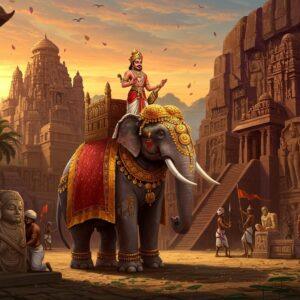



Namaste and welcome to the heart of Karnataka. Mysore is not just a city of palaces and silk; it is a place where history breathes through the streets and legends are etched into stone. While the grandeur of the Mysore Palace leaves visitors spellbound, there is a whisper that travels with the wind—a tale of tragedy, betrayal, and a 400-year-old curse that has haunted the royal Wodeyar dynasty for generations. Join us as we walk through the sands of time to understand this fascinating mystery that blends folklore with history.
The Heartbreaking Tale of Alamelamma
To understand the present, we must look back to the year 1612. The region was witnessing a shift in power. Raja Wodeyar, seeking to expand his dominion, dethroned Sri Rangaraya, the viceroy of Vijayanagar and governor of Srirangapatna. While political conquests were common, what followed was a personal tragedy that changed the fate of the dynasty forever.
Alamelamma, the devout wife of the ousted governor, fled with her precious royal ornaments to escape the new ruler’s soldiers. It is said that these jewels were meant for the deity, Sri Ranganathaswamy. Pursued and cornered, she made a heartbreaking decision. Rather than surrendering her dignity and the sacred jewels, she chose to offer herself to the Cauvery River at a place called Malangi. Before she took her final breath in the swirling waters, she uttered a potent prophecy, known today as the Curse of Alamelamma.
The Threefold Prophecy: Sand, Whirlpools, and Lineage
The legend says that in her final moments, Alamelamma cast a curse that would echo through four centuries. Her words were specific and chilling:
-
“May Talakadu become barren sand.”
She declared that the vibrant town of Talakadu would be buried under dunes of sand, transforming a fertile settlement into a desert-like landscape, a phenomenon that geologists and historians still study with intrigue today. -
“May Malangi turn into a deadly whirlpool.”
The stretch of the Cauvery River where she ended her life was cursed to become turbulent. To this day, the waters at Malangi are known for their treacherous whirlpools, serving as a reminder of her despair. -
“May the Wodeyars of Mysore never have children.”
Perhaps the most haunting part of the curse was directed at the royal lineage itself. She proclaimed that the Rajas of Mysore would struggle to beget direct male heirs, forcing the throne to rely on adoption to continue the legacy.
A Legacy of Struggle and Devotion
For the culturally rooted Indian, these stories are not mere myths; they are reflections of Karma and destiny. The Wodeyar dynasty took this curse very seriously. History bears witness that for generations, the ruling Maharaja often failed to produce a direct male heir, necessitating the adoption of a nephew or a relative to inherit the throne. This cycle of adoption became a unique tradition within the Mysore royal family.
However, the royals did not sit idly by. In a display of immense humility and reverence, Raja Wodeyar installed a statue of Alamelamma within the palace grounds immediately after her death. Even today, she is worshipped as a deity. The royal family performs daily rituals and offers special prayers to appease her spirit, showing that in our culture, repentance and devotion are the ultimate remedies.
Is the Curse Finally Broken?
Time, they say, heals all wounds. In modern times, a glimmer of hope appeared for the royal family. In 2016, the current titular head, King Yaduveer Wadiyar, married Princess Trishika Kumari Devi. The nation watched with bated breath and joy when, a year later, the couple welcomed a baby boy. This joyous event has led many to believe that the intensity of the ancient curse has finally waned, marking a new chapter of prosperity for the custodians of Mysore’s heritage.
Bringing Peace and Tradition to Your Home
Just as the Mysore royal family turned to prayer and ritual to find peace, we too seek harmony in our own lives. At Poojn.in, India’s premier destination for cultural goods, we understand the power of tradition. We provide authentic items to help you perform your daily pujas and keep negative energies at bay.
Here is how our collection can enhance your spiritual journey:
-
Premium Incense Sticks (Agarbatti):
Create a calming atmosphere suitable for deep meditation and prayer. Our natural incense sticks are crafted to purify the air and invite positive vibrations into your living space.
Shop our Incense Collection here. -
Traditional Brass Lamps (Diyas):
Light conquers darkness, both literally and metaphorically. Our handcrafted brass lamps are perfect for your altar, symbolizing the removal of ignorance and the inviting of divine blessings.
View our Brass Lamp designs. -
Complete Puja Thali Sets:
Ensure your rituals are performed without interruption. Our curated Puja Thali sets contain all the essential vessels and items required for a complete and satisfying ceremonial offering.
Explore Puja Thali Sets.
Embrace your roots with poojn.in, where tradition meets convenience.
Modern Interpretations: Myth or Mystery?
Today, Mysore stands as a beautiful blend of the old and the new. While geologists argue that the sand dunes of Talakadu are caused by ecological changes and the shifting course of the river, the locals hold fast to their beliefs. For the people of Karnataka, the Curse of Talakadu is a living history, a reminder of the power of a woman’s grief. Visitors flock to the buried temples of Talakadu and the whirlpools of Malangi, not just for sightseeing, but to feel the energy of a story that has survived 400 years.
Common Questions About the Mysore Royal Curse
Understanding the nature of the Maharaja’s Curse
Many people are curious about what exactly the curse entails. It is essentially a 17th-century vow made by Alamelamma, the wife of a defeated governor. Her grief allegedly caused the town of Talakadu to be buried in sand, the river at Malangi to swirl dangerously, and the Mysore kings to face difficulties in having direct male children.
The impact on the royal lineage today
A frequent topic of discussion is whether the family still suffers from this old prophecy. While the family faced centuries of adoption to maintain the lineage, the birth of a son to King Yaduveer and Queen Trishika in recent years suggests to many that the dark cloud may have finally lifted, bringing relief and joy to the dynasty.
Can tourists visit the cursed sites?
Travelers often ask if they can see the locations mentioned in the legend. Yes, Talakadu is a popular pilgrimage and tourist site where you can see the excavated temples amidst the sand dunes. Similarly, the Mysore Palace, where Alamelamma is worshipped, is open to the public and remains one of India’s most visited monuments.
The scientific view versus local belief
There is often a debate regarding the truth of these claims. While scientists attribute the sand at Talakadu to natural river damming and wind patterns, the cultural sentiment remains deeply tied to the legend. For the faithful, the timing of the events and the specific outcomes serve as proof that some mysteries are beyond scientific explanation.
Rituals performed to counter the bad omens
Readers frequently inquire about how the royals managed the curse. The Wodeyar family has historically performed various Shanti Pujas and installed the idol of Alamelamma to honor her. This reflects the deep-seated Indian tradition of resolving conflicts through spiritual appeasement and respect for the departed.
Mysore continues to be a city of wonder. Whether you view the Maharaja’s Curse as a historical coincidence or a supernatural phenomenon, it undeniably adds a layer of mystical charm to the city’s rich tapestry. It reminds us that our past is never truly gone; it lives on in our stories, our rituals, and our land.