

Languages are much more than mere tools for communication; they are the very heartbeat of our civilization. Exploring the world of native Indian languages offers a fascinating, soulful glimpse into our shared human history and vibrant culture. When we look at the beautiful, artistic forms of various Indian writing systems, we are essentially looking through a window into our ancestors’ legacy. These ancient alphabets have grown and evolved beautifully over time, heavily influenced by generations of scholars, saints, and everyday people, all while maintaining their essential, sacred role in preserving our timeless traditions.
Historical Context and Evolutionary Journey
To truly appreciate our modern vernaculars, we must journey back to their shared roots. Both the Bengali and Hindi writing systems trace their profound origins back to the ancient Brahmi script. Brahmi proudly stands as one of the earliest and most revered writing systems used in India, laying the spiritual and structural foundation for countless modern vernaculars. Over centuries, these regional languages blossomed through intermediate historical stages such as the Gupta and Siddham eras, gently adapting to regional flavors and historical shifts.
- Common Ancestry and Language Family: It is beautiful to note that both of these revered languages belong to the Indo-Aryan branch of the grand Indo-European language family. Because they both originally evolved from the sacred sounds of Sanskrit, they share a deep, spiritual bond that continues to resonate in our daily prayers and literature.
- The Divergence of Styles: While they started from the same Brahmi roots, the structural paths of these two systems eventually separated to form unique identities. Historical records show that the Bengali writing style began to beautifully diverge from the Devanagari system around the 11th century AD, carving out its own unique visual identity.
Structural Comparison: Visual Harmony and Distinctions
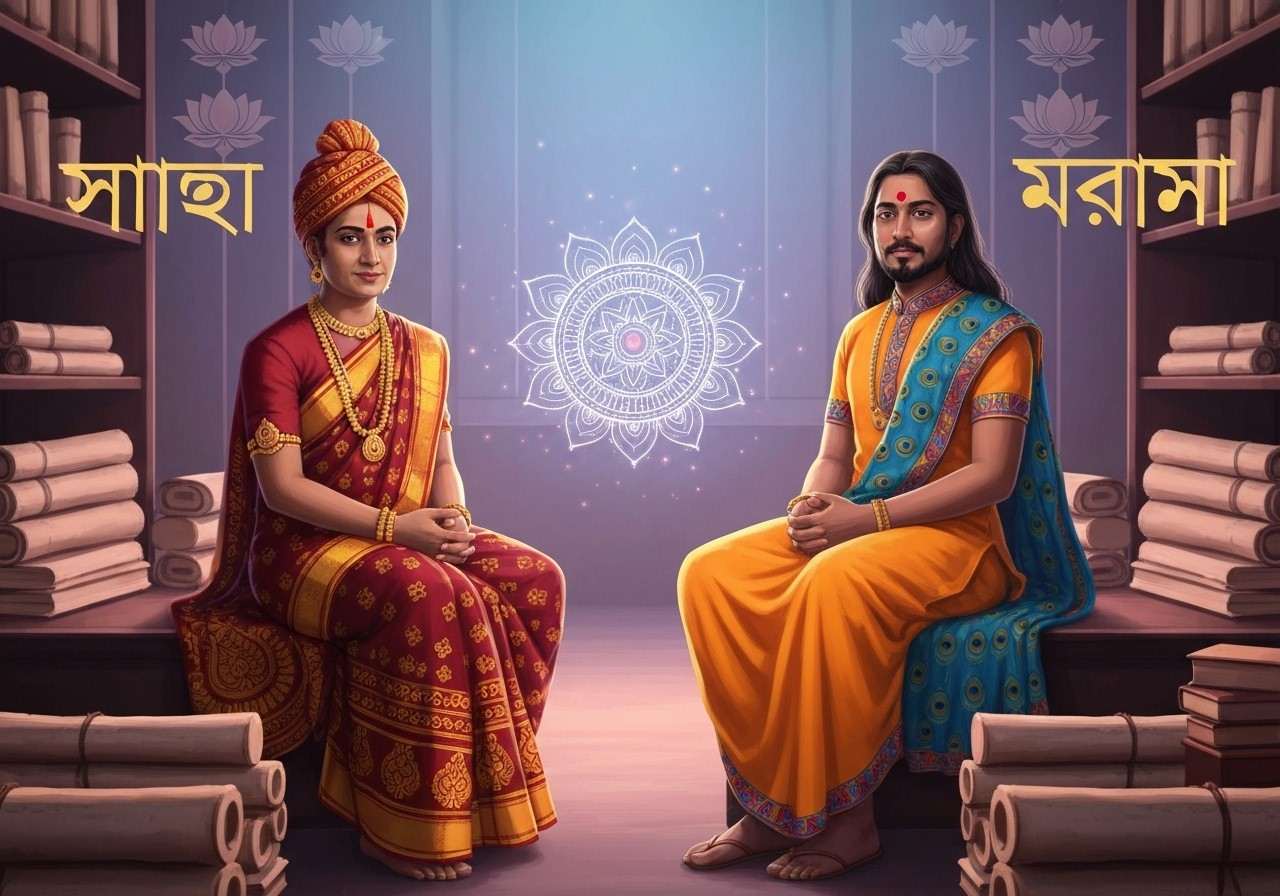
When you place these two historic texts side by side, their visual dance is instantly captivating. While distinct in their modern forms, they share a beautiful, underlying structural symmetry. Both are formally classified as abugidas, which means that a specific diacritic mark intricately modifies or gracefully suppresses an inherent vowel sound.
- Character Composition and Counts: The Devanagari system, beautifully used for Hindi, consists of 47 primary characters, elegantly balanced with 14 vowels and 33 consonants. In contrast, the Bangla alphasyllabary boasts a rich tapestry of 12 vowel characters and 52 consonant characters, generally recognized as having a foundational alphabet of 50 letters.
- Aesthetic Appeal and Lines: Devanagari features a very distinctive, grounding horizontal line—known affectionately as the shirorekhā or mātrā—that runs steadily along the top of the letters. On the other hand, the Bengali symbols captivate the eye with sharper strokes and more diagonally angled lines, often choosing not to use the continuous horizontal top line.
Grammar, Pronunciation, and Linguistic Nuances
The soul of any spoken word lies in its phonetic delivery and grammatical grace. These linguistic characteristics beautifully define the regional identities of both linguistic traditions. The comforting influence of our ancestral Sanskrit deeply enriches the phonetic features of both systems, reflecting our glorious, shared cultural heritage.
- Grammatical Rhythms: Both languages comfortably follow a subject-object-verb (SOV) sentence structure, feeling naturally intuitive to native speakers. However, Hindi delightfully utilizes gendered nouns for everyday objects, whereas Bengali verb conjugations focus more gracefully on the tense of the action and the level of politeness being offered.
- The Melody of Pronunciation: Hindi proudly maintains a very clear, crisp distinction between aspirated and unaspirated consonants. Conversely, Bengali pronunciation is famous for its softer, melodic consonants and the frequent, beautiful use of nasalized vowels, often lovingly dropping the inherent vowel at the very end of spoken words.
- Richness of Vocabulary: Because of their shared roots, both languages are blessed with many cognates—words that sound similar and carry the same heartfelt meanings. Over time, Hindi vocabulary warmly embraced Persian-Urdu influences, while Bengali remained intimately close to its Eastern Aryan ancestry, boasting a distinct vocabulary steeped in sustained Sanskrit influence.
Cultural Significance and Everyday Usage
In our homes, temples, and bustling markets, these alphabets are a testament to our enduring cultural resilience. In states like West Bengal and Tripura, as well as in neighboring Bangladesh, the Bengali script holds immense, emotional cultural value. It is the official language that carries the weight of incredible poetry, soulful music, and deeply rooted literature.
Similarly, Devanagari stands tall as the vital backbone of North India and serves proudly as one of the official languages of the nation. These sacred alphabets are passionately used to script our revered religious texts, our timeless literature, and our modern media. When our children learn to trace these letters in school, they are not just learning to read; they are being handed the beautiful, symbolic keys to heritage preservation.
Nurturing Our Heritage with Poojn.in
Whether you are lovingly reciting a mantra from a Devanagari text or reading a soulful poem written in Bengali, the ambiance of your surroundings plays a vital role in your spiritual connection. Creating the right, pure atmosphere at home is essential for honoring our deep-rooted traditions.
As India’s most trusted online destination for authentic cultural items, we proudly support your devotional journey. We offer an extensive, carefully curated selection of traditional goods that are absolutely essential for your daily rituals, festive ceremonies, and spiritual studies. Please remember, while we do not offer any travel packages, pilgrimage guidance, or VIP temple darshan services, we are entirely dedicated to providing the finest physical items for your home shrines.
If you are setting up a dedicated space to study these ancient, sacred texts, consider enhancing your spiritual corner with our authentic ritual items. These sacred objects help foster a deeply divine atmosphere, perfectly bridging the gap between historical wisdom and your daily life. Experience the unmatched convenience of having premium cultural goods delivered straight to your doorstep by visiting https://www.poojn.in. For any heartfelt inquiries about our beautiful product range, you can warmly reach out to us by calling 03369029784 or simply WhatsApp us at 9476142738.
Modern Usage and Technological Adaptations
As we gracefully step into the digital era, adapting our ancient Indian alphabets to modern technology presents both unique challenges and brilliant solutions. Today, specialized keyboard layouts and advanced software have wonderfully evolved to accommodate our beautiful regional vernaculars.
- Digital Standardization: The implementation of global Unicode standards has been a true blessing, ensuring that our native characters are consistently and accurately represented across all modern digital platforms. This technological leap guarantees that whether you are typing an email or formatting a digital manuscript, the integrity of the original text remains perfectly intact.
- Global Accessibility: Modern technology and the rise of social media have successfully made these historic languages far more accessible to the global Indian diaspora. Younger generations are now seamlessly blending traditional vernaculars with digital communication, ensuring that our linguistic heritage continues to thrive and evolve in a rapidly changing world.
Conclusion
Our regional alphabets offer a profoundly fascinating glimpse into the history, culture, and collective identity of the Indian subcontinent. Both writing systems, deeply rooted in the ancient Brahmi tradition, have blossomed uniquely over the centuries, beautifully showcasing the incredibly rich tapestry of our linguistic traditions. They continue to play an absolutely vital role in preserving our shared heritage, serving as comforting symbols of cultural identity for millions of proud speakers.
In these modern times, the way these alphabets seamlessly adapt to technological advancements ensures their continued, vibrant relevance. From reading centuries-old traditional texts to expressing thoughts on modern digital platforms, these languages beautifully connect our people across diverse generations. As we continue to explore and cherish these ancient writing systems, we joyfully celebrate their enduring significance and warmly embrace their graceful evolution in an ever-changing world.
Frequently Asked Questions About Our Linguistic Heritage
How does the Bengali alphabet structurally compare to the Hindi alphabet?
The Bangla alphasyllabary boasts a rich foundation of 50 primary letters, while the Hindi language, gracefully written in the Devanagari script, contains 47 primary characters. Both systems fundamentally include a beautiful arrangement of vowels and consonants, but they proudly maintain their own distinct pronunciation rules and unique visual writing styles.
Is it possible to seamlessly convert Hindi text to the Bengali writing system?
Yes, you can certainly convert one script to the other using various transliteration tools readily available online today. These advanced digital tools are incredibly helpful for linguistic students and cultural enthusiasts who wish to better understand the phonetic similarities across our regional vernaculars.
What are the most notable, beautiful similarities between these two historic scripts?
Both of these revered writing systems proudly share ancient origins tracing back to the Brahmi script, and both intelligently utilize a system of vowels and consonants. Furthermore, because of their shared Sanskrit ancestry, they beautifully share several phonetic sounds and cognates, despite their varying visual representations.
Why do the Bengali and Hindi writing styles look so visually distinct from one another?
They appear visually different primarily due to centuries of unique regional styling and localized writing rules. The eastern writing style naturally features more gracefully curved, sharper, and diagonal lines, whereas the Devanagari style is distinctly recognized by its strong, linear top bar and more angular structural forms.
Are the vowel sounds and representations identical in both of these languages?
While both linguistic systems absolutely rely on vowels to give life to consonants, their visual representation and exact pronunciation can vary beautifully. Each language has developed its own specific set of vowel markers (matras) and stylistic rules that give the spoken words their unique regional melody.
Can understanding Hindi genuinely help someone learn the Bengali alphabet?
Having a strong foundational knowledge of Hindi can certainly aid in learning the eastern script, as both proudly share underlying phonetic concepts and a familiar grammatical structure. However, a dedicated learner must still take the time to deeply understand the unique visual strokes and specific pronunciation nuances of the new alphabet.
Is comparing these two ancient writing systems a common practice among language learners?
Absolutely, cultural scholars and language learners frequently explore the beautiful similarities and differences between these historic systems. This comparative study not only deeply aids in better linguistic retention but also fosters a much profound appreciation for our diverse, shared Indian heritage.
What modern resources are best suited for learning to cross-read these alphabets?
Today, there is a wonderful abundance of intuitive online platforms, mobile applications, and dedicated language courses focused specifically on script conversion and language learning. These culturally rich resources lovingly provide step-by-step, empathetic guidance for anyone eager to connect deeper with their ancestral roots.