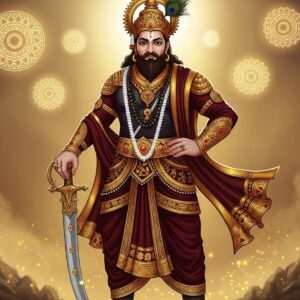


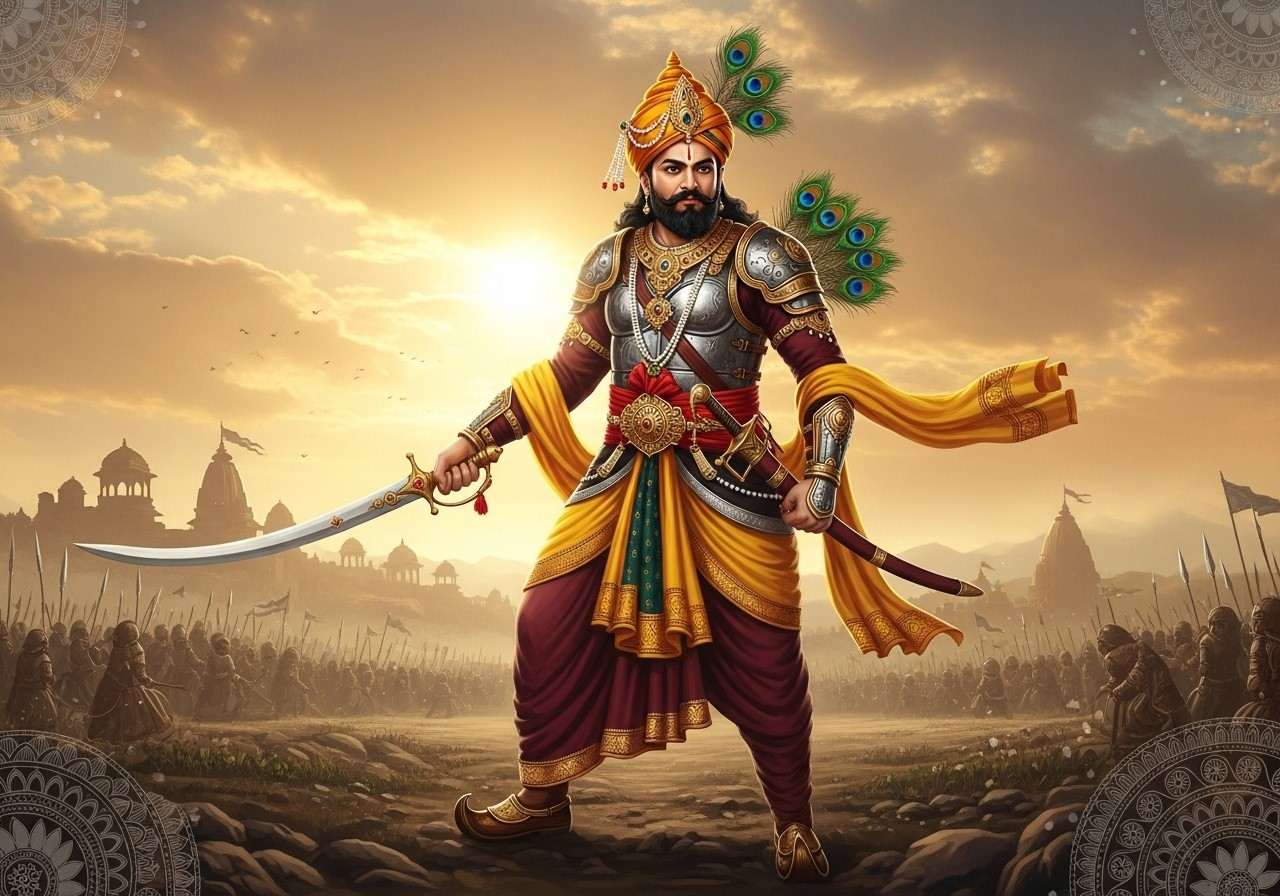
In the vibrant tapestry of Indian history, few names resonate with as much valour and reverence as Bappa Rawal. Particularly in the heart of Rajasthan, his name is spoken not just as a king, but as a guardian deity of independence and dharma. For us Indians, history is not merely dates and battles; it is a collection of stories that define our sanskar (values) and identity. While many know the legends of his bravery, there is often confusion regarding his real name, his birth, and the exact time period he graced this land.
This blog invites you to step back into the 8th century, a golden yet turbulent era, to uncover the truth behind the legend who laid the foundation of the illustrious Mewar Dynasty. We will explore the man behind the title and understand why his legacy still beats in the heart of every Indian who values tradition and courage.
The Man Behind the Title: What Was Bappa Rawal’s Real Name?
It is a fascinating aspect of our history that some of our greatest heroes are known by their titles rather than their birth names. Historically, Bappa Rawal was born as Prince Kalbhoj. The name we revere him by today is actually a combination of affectionate and royal titles bestowed upon him by his people and spiritual mentors.
-
Bappa (Father): In the local dialect and cultural context of Mewar, “Bappa” is an emotional term akin to ‘Father.’ It signifies his role not just as a ruler, but as a paternal protector who shielded his subjects from foreign threats and internal chaos.
The people looked up to him with the same reverence one holds for a family elder, trusting him to guide and guard their honour against all odds. -
Rawal (King): This title denotes royalty and sovereign power. It marked his transition from a prince in exile to the supreme ruler of the region.
Together, “Bappa Rawal” symbolizes a “Royal Father,” perfectly capturing the essence of a King who ruled with both might and compassion.
This transformation from Kalbhoj to Bappa Rawal is a testament to how he was perceived—a blend of a warrior’s strength and a father’s care. To understand the lineage of such great dynasties further, you might be interested in reading about the Gahadavala Dynasty, which also played a significant role in India’s historical landscape.
The Early Life of Prince Kalbhoj: A Destiny Written in Struggle
The early life of Bappa Rawal reads like a gripping epic. Born around 713 AD, his childhood was anything but luxurious. Tragedy struck early when his father, Rawal Mahendra, was assassinated in battle. To protect the young prince from enemies, his mother took him into hiding.
It was here, in the wild terrains of the Vindhya Range near Nagda, that the future king was forged. He was raised with the help of Bheel attendants, the indigenous tribal community known for their fierce loyalty and unmatched knowledge of the forests. Under their mentorship, young Kalbhoj learned the art of guerrilla warfare, survival, and military strategy. Legends often speak of his mischievous childhood adventures in these hills, which were merely the training ground for the great responsibilities that lay ahead.
Preserving History with Poojn.in
Just as ancient scriptures were preserved on natural materials, understanding our history requires connecting with our roots. For those interested in traditional writing materials used by our ancestors, explore our authentic Original Bhoj Patra. It is a symbol of the ancient wisdom that has been passed down through generations.
Historical Time Period and Reign (734–753 CE)
Bappa Rawal’s rise to power occurred during a critical juncture in Indian history. He ruled approximately between 734 CE and 753 CE. This was the 8th century, a time when India was facing relentless invasions from the west. The political stability of the region was fragile, with local kingdoms constantly at war.
At the young age of 21, in 734 AD, Bappa Rawal achieved a monumental victory by defeating Man Mori and conquering the formidable Chittor Fort. This victory was not just a territorial gain; it marked the establishment of the Mewar Dynasty (Guhila Rajput dynasty), which would go on to become the longest-serving dynasty in the world.
During this same era, other great rulers were also defending the motherland. For instance, the contributions of Nagabhata I, the founder of the Pratihara dynasty, were crucial in the collective resistance against foreign incursions, paralleling Bappa Rawal’s efforts.
Achievements that Defined an Era
Bappa Rawal is not merely remembered for being a king; he is celebrated for being a saviour of Indian culture and sovereignty. His achievements extend far beyond the battlefield.
1. The Guardian of the Frontier
Bappa Rawal is credited with repelling the Arab invasions that were sweeping across Asia. In the historic Battle of Rajasthan, he united smaller states and inflicted a crushing defeat on the invading forces. Historians note that his military prowess was so feared that he effectively prevented major Arab attacks on India for approximately 400 years.
2. Expansion Beyond Borders
His vision was not limited to defence. Accounts suggest that Bappa Rawal pursued the retreating forces of Bin Qasim all the way to the western banks of the Sindhu River. Some historical narratives even claim that he expanded his influence into regions like Kandahar, Khorasan, Turan, and Iran, establishing a buffer zone to protect the Indian heartland.
3. Spiritual and Architectural Legacy
A devout Shiva devotee, Bappa Rawal understood that a kingdom needs spiritual strength as much as military might. He established the famous Eklingji Temple near Udaipur. He ruled not as the owner of the land, but as the Diwan (Prime Minister) of Lord Eklingji, setting a tradition of humility and service for all future Ranas of Mewar.
Exploring the lives of spiritual leaders helps us understand the backbone of Indian resilience. You can read about Guru Har Rai’s life and history to see how spirituality and leadership have always been intertwined in our culture.
Common Questions About Bappa Rawal’s History
There are often many curiosities surrounding such a legendary figure. Let us address some of the most common thoughts people have regarding his life and times.
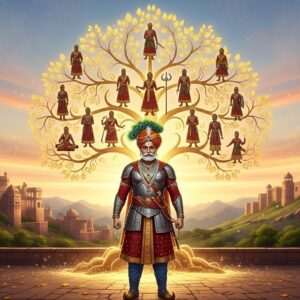
Many people often ask what Bappa Rawal’s real name was. As mentioned, he was born Prince Kalbhoj, and “Bappa Rawal” was the honorific title he earned through his deeds. Another frequent query is regarding his exact birth date. While records from that era can be scarce, historical consensus estimates his birth around 713 AD. When discussing why he is so significant, the answer lies in his establishment of the Mewar dynasty and his role in the Battle of Rajasthan, which safeguarded the region from Arab invasions for centuries. Finally, his legacy lives on through his descendants, including legendary warriors like Rana Sanga, Maharana Pratap, and Rana Uday Singh, who continued his tradition of resistance and valour.
Conclusion: A Legacy Etched in Stone and Spirit
Bappa Rawal was more than just a ruler of the 8th century; he was a phenomenon who taught us that the defence of one’s culture and motherland is the highest duty. From his upbringing among the Bheels to his conquest of Chittor and his construction of the Eklingji Temple, every chapter of his life inspires us.
At Poojn.in, we believe in keeping these traditions alive. Whether it is through the stories we share or the ritual items we use in our daily worship, the spirit of our ancestors continues to guide us. We hope this deep dive into the life of Kalbhoj—our beloved Bappa Rawal—has brought you closer to the rich heritage of India.
Bring Tradition Home with Poojn.in
Poojn.in is India’s most trusted destination for authentic cultural goods. From essential puja samagri to rare spiritual items, we ensure that your connection to tradition remains unbroken. Visit Poojn.in today to explore our vast collection. For any assistance, feel free to contact us at 03369029784 or WhatsApp us at 9476142738.