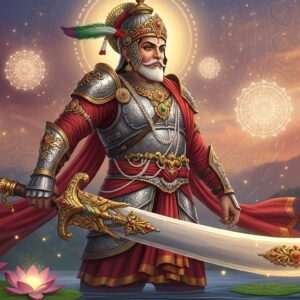


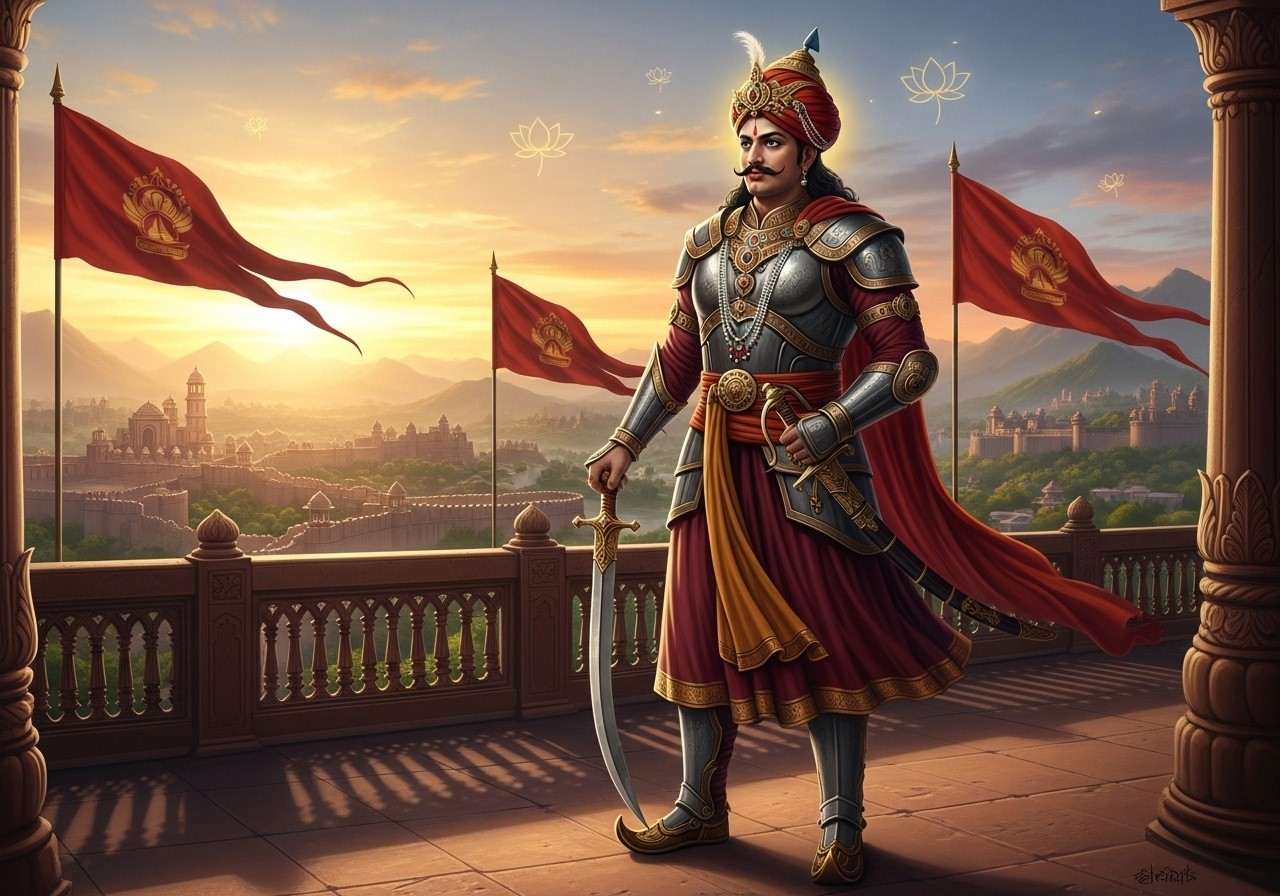
In the vast tapestry of Indian history, few names resonate with as much power and reverence as Bappa Rawal. For us, he is not merely a historical figure from the 8th century; he is the embodiment of resilience, valor, and the undying spirit of Swaraj. His life story, from a humble upbringing to establishing a massive empire that stretched up to Iran, appeals deeply to every Indian who values our rich tradition and heritage. At poojn.in, we believe in celebrating these roots, helping you stay connected to the culture that shaped such legendary leaders.
The Early Life: A Childhood Forged in Adversity (713 AD)
Born as Kalbhoj in 713 AD, the man who would become Bappa Rawal faced tragedy very early. Destiny had a difficult path written for him initially, as his father, Rawal Mahendra, along with other male members of the family, sacrificed their lives in a fierce battle against the Bheels of Idar. This loss could have ended the lineage, but fate had other plans.
His upbringing was a unique blend of different cultures, which contributed to his greatness:
- The Guidance of Mother and Bheels: Protected by his mother and loyal Bheel attendants, young Kalbhoj was not raised in a palace but in the rugged terrain. It was the Bheel tribe who imparted critical military warfare skills to him, teaching him how to survive and fight in the harshest conditions, a skill set that would later help him conquer vast lands.
- The Spiritual Grounding: To keep him safe, he was raised by a compassionate Brahmin lady in Nagda. Here, he worked as a caretaker of cows, learning humility and service. It was during this phase that he met the great sage Harit Rashi. The sage initiated him into the Shaivite order, instilling a deep spiritual foundation that guided his future rule as a Diwan of Eklingji.
Understanding the lives of such complex historical figures often reminds us of the meticulous records kept by later historians. Much like the works discussed in Kalhana: A Biography Exploring His Life, Works, and Legacy, the oral traditions and bardic tales have kept Bappa Rawal’s story alive for us today.
The Rise of a Warrior: Reign and Military Brilliance
The transformation from a cowherd to a King occurred when Bappa Rawal was just a young man. In 734 AD, at the age of 21, he displayed the courage of a tiger. He defeated Man Mori, the ruler of Chittor, and conquered the majestic Chittor Fort. This victory was not just about territory; it was about reclaiming honor.
History tells us that Bappa was a commander in the Mori army. When the Arab forces, led by generals like Bin Qasim, threatened the integrity of India, Bappa Rawal rose to the occasion. He didn’t just defend; he pursued the invaders back through Saurashtra and to the western banks of the Sindhu river. This aggressive defense established the Mewar Kingdom in 728 CE, a dynasty that would stand the test of time.
Expanding the Boundaries of Aryavarta
Bappa Rawal’s vision was of a united front against foreign aggression. He successfully unified the smaller states of Ajmer and Jaisalmer, creating a formidable confederacy of warriors. His military campaigns were legendary:
- The Afghan Campaign: He led a coalition of Hindu kings that not only decimated Arab invaders but chased their armies deep into their own territories. He launched more than 15 attacks into Ghazni, Afghanistan, effectively expanding the boundaries of the Mewar kingdom all the way to Iran, turning the hunter into the hunted.
- Strategic Bases: Understanding the need for forward operating bases, he built a city which is known as Rawalpindi today (located in modern-day Pakistan). This city served as his military base to keep a check on the frontiers, showcasing his foresight in military planning and border security.
His vast empire spanned from Mewar to Sindh, Baluchistan, Kandahar, Khorasan, Turan, and Iran. His pivotal role in the Battle of Rajasthan saw regional Indian rulers inflicting such a resounding defeat on the invaders that it secured the land for centuries.
Poojn.in stands out as the premier destination for cultural goods in India. Just as Bappa Rawal preserved the sanctity of our traditions, we strive to bring you the most authentic spiritual items. Our extensive range of products meets all your cultural requirements. Explore our collection today at poojn.in to keep your traditions alive.
Legacy: The Shield of India
The impact of Bappa Rawal’s reign is felt even today. His bravery was so astounding that historical records suggest Arabs did not dare to attack prosperous India for the next 400 years. This period of peace allowed Indian culture, art, and philosophy to flourish without fear.
He is the forefather of some of the greatest warriors India has ever produced. Legendary figures like Prithviraj Chauhan and later Rana Sanga, Maharana Pratap, and Rana Uday Singh, all share the bloodline or the martial spiritual lineage that Bappa Rawal established. He founded the Sisodia Dynasty, which holds the distinction of ruling Mewar for more than 1300 years—one of the longest-serving dynasties in the world.
Just as the bards sang the praises of later kings in works like the Prithviraj Raso, Bappa Rawal’s name became synonymous with courage, leadership, and honor. He is remembered for saving India, preserving Hindu culture, and uniting the Rajput community when it mattered most.
Spiritual Devotion and Final Years
Despite his immense power and vast empire, Bappa Rawal never forgot the spiritual lessons taught by Sage Harit Rashi. He considered himself not the owner, but the custodian of the kingdom under the grace of Lord Shiva. He is credited with building the famous Eklingji Temple, which became the spiritual heart of Mewar.
In 753 AD, proving that true strength lies in detachment, he took to a spiritual path. He submitted himself entirely to the devotion of God Shiva, leaving behind a legacy that was as pious as it was powerful. In our rituals today, the color red often symbolizes this energy and strength, much like the Rakta Jaba Alta used in traditional ceremonies to invoke auspiciousness and power.
Celebrating the Legacy with Poojn
Why should you choose poojn.in for your cultural needs? One reason is that poojn.in offers a unique collection of cultural goods that you won’t find anywhere else. We understand the emotion behind every ritual.
- Puja Essentials: From premium incense to pure ghee wicks, we have everything you need to perform your daily worship with the same devotion Bappa Rawal showed to Eklingji.
- Cultural Books: Our collection helps you pass on the stories of great Indian kings and sages to the next generation, ensuring our history is never forgotten.
- Traditional Items: We bring you authentic items that help you stay rooted in your traditions while enjoying the convenience of modern online shopping.
Celebrate the spirit of India and the legacy of its great kings. Shop online at Poojn.in today.
Common Questions About Bappa Rawal’s Era
What are the details surrounding his birth and lineage?
Bappa Rawal was born in 713 AD. He belonged to the Guhilot dynasty. His early life was marked by struggle as his father, Rawal Mahendra, was killed in battle, leading Bappa to be raised in secrecy by his mother with the help of the Bheel community.
How did he contribute to the geography of the region?
He significantly expanded the Indian borders. By defeating the Arab invaders, he pushed the boundaries of his kingdom up to Iran and Turan. He also established the city of Rawalpindi (now in Pakistan) as a strategic military base.
What is his significance in religious history?
Apart from being a warrior, he was a devout Shaivite. He built the Eklingji temple and ruled Mewar as a representative of the deity. In 753 AD, he retired from royal duties to pursue a completely spiritual path dedicated to Lord Shiva.
Did he really stop foreign invasions?
Yes, his military campaigns were so effective that they halted major Arab invasions into India for nearly four centuries. His unification of Rajput warriors in the Battle of Rajasthan was a turning point in resisting foreign conquest.