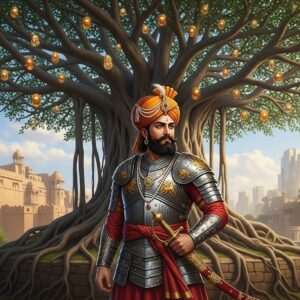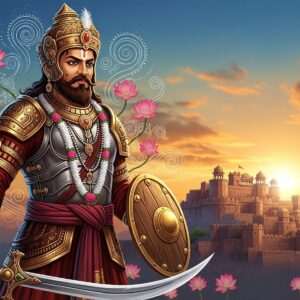


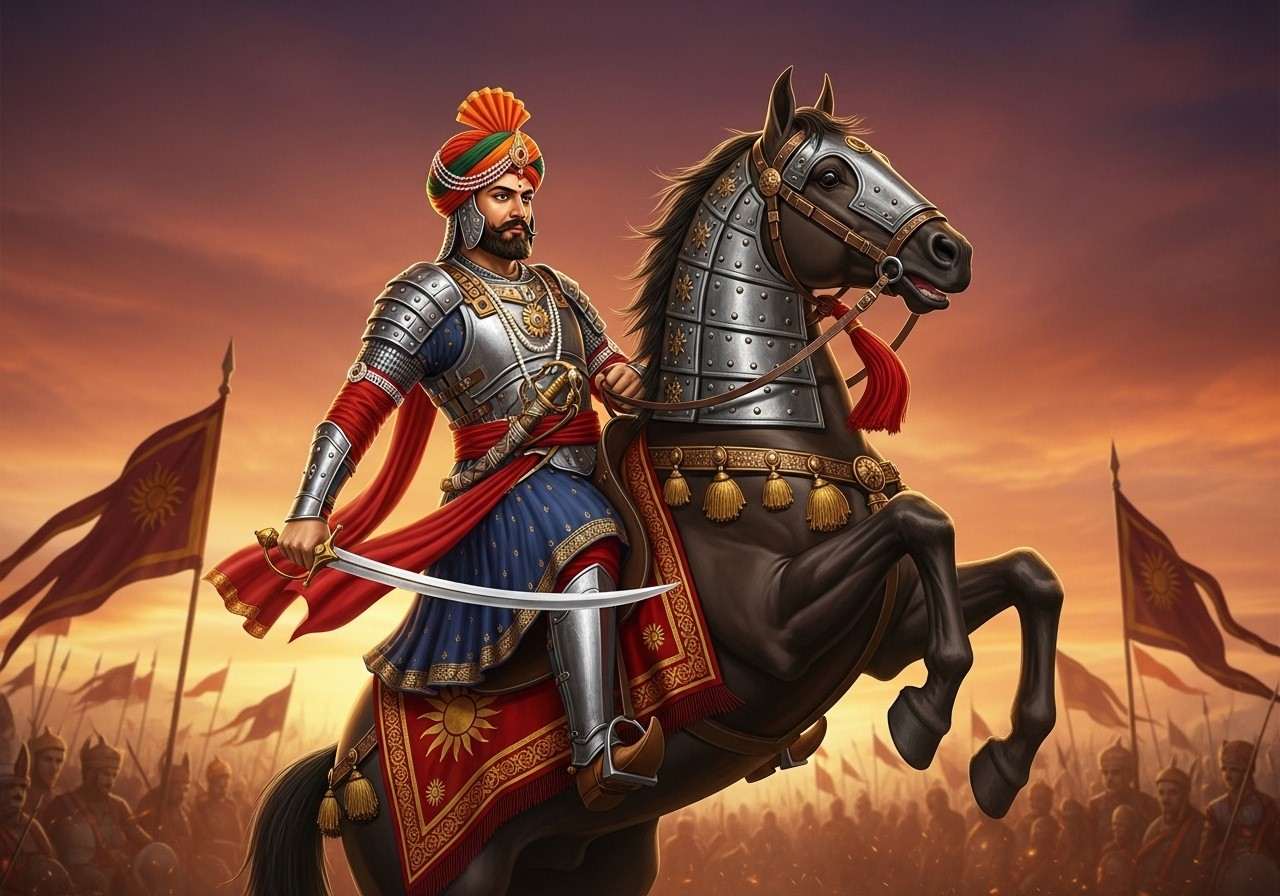
When we turn the pages of our glorious history, few names shine as brightly as Bappa Rawal. He was not just a king; he was a phenomenon—a warrior whose sword protected the sanctity of our land and whose vision laid the foundation of the Mewar Dynasty. For us culturally rooted Indians, Bappa Rawal is more than a historical figure; he is a symbol of valor, resilience, and unyielding Dharma. His story, filled with legendary battles and strategic brilliance, continues to inspire us today.
At poojn.in, we cherish these stories that define our identity. As India’s premier destination for cultural goods, we understand that our traditions are the threads that bind us to our past. Just as Bappa Rawal preserved the culture of Mewar, we strive to bring authentic ritual items and cultural artifacts to your doorstep, helping you keep those traditions alive in your modern homes.
The Rise of a Warrior: Understanding 8th-Century India
To truly appreciate the magnitude of Bappa Rawal’s achievements, we must look at the chaotic landscape of 8th-century India. It was a time of great turmoil. The land was fragmented, and the threat of foreign invasion loomed large over the horizon. The Guhila dynasty, to which Bappa Rawal (also known as Kalbhoj) belonged, was navigating these dangerous waters.
Young Bappa was raised in the cradle of Rajput culture, which instilled in him a deep sense of duty towards his motherland. It wasn’t just about ruling a kingdom; it was about protecting the Hindu Dharma against the relentless onslaught of the “Mlechchhas” (invaders). If you are interested in how other great dynasties rose to power during challenging times, you might find the story of Dantidurga’s rise to power equally fascinating.
The Battle of Rajasthan (738 AD): A Victory for the Ages
History is often defined by decisive moments, and for India, that moment was the Battle of Rajasthan in 738 AD. This was not a minor skirmish; it was a battle for survival. Bappa Rawal, displaying immense strategic foresight, understood that a divided India could not stand.
He accomplished something remarkable: Alliance Building. He united the Rajput and Gurjar forces, forming a confederacy with powerful kings like Nagabhata I of the Gurjara-Pratihara dynasty and Jaysimha Varman of the Rashtrakuta Empire. Together, they faced a massive Arab army led by Emir Junaid.
The result was a crushing defeat for the invaders. Bappa Rawal and his allies didn’t just stop the enemy; they decimated the Arab forces, killing Emir Junaid. This victory was so absolute that it halted Arab expansion into India for the next 400 years. It is a testament to the power of unity—a lesson that resonates even today.
Conquering Chittor and Establishing Mewar
Before his great defense of the borders, Bappa Rawal solidified his home base. In 726 CE, he seized the majestic fortress of Chittor from the Mori rulers. Historical accounts suggest that he may have captured it from foreigners who had temporarily defeated the Moris, reclaiming it for his people. By 728 CE, according to the Ekalinga Mahatmya, he had formally established the Mewar Kingdom, marking the beginning of a lineage that would produce heroes like Rana Pratap centuries later.
Similar to the strategic governance seen in other historical accounts, such as Rudradaman’s reign, Bappa Rawal knew that a kingdom needs strong fortifications and spiritual grounding to survive.
Expansion Beyond Borders: From Mewar to Iran
What makes Bappa Rawal truly legendary is that he did not believe in merely defending; he believed in proactive action. After defeating the Arabs in Rajasthan, he did the unthinkable—he pursued them beyond the borders of India.
- Chasing the Invaders: He led his armies deep into foreign lands, chasing the retreating forces all the way to Iran.
- Conquest of Ghazni: He defeated Salim, a local vassal, in Ghazni and boldly appointed his own nephew as the ruler there.
- The City of Rawalpindi: To secure the frontiers, he established a military base which is known today as Rawalpindi.
- Strategic Watchtowers: Understanding the need for vigilance, he constructed a series of watchtowers extending towards Iran to monitor and prevent future attacks.
His military prowess reminds us of the dedication seen in later warriors. For a deeper look into the lives of such dedicated figures, you can read about Chimaji Appa’s family life and battles.
Spiritual Legacy: The Eklingji Temple
Bappa Rawal was as pious as he was fierce. He credited his victories not to his own strength, but to the blessings of the divine. He constructed the famous Eklingji Temple, dedicating his kingdom to Lord Shiva. He ruled not as a King, but as the Dewan (prime minister) of Eklingji, a tradition that the Maharanas of Mewar followed for a thousand years.
This deep connection to the divine is something we at poojn.in cherish deeply. We know that for you, a home temple is the heart of the household. If you are looking to bring that divine energy into your home, we invite you to explore our collection. Specifically, our Asthadhatu Brass Ganpati Bappa Murti is a perfect addition for those who value purity and tradition in their worship.
Common Questions About Bappa Rawal
Curious minds often ask us about the specifics of Bappa Rawal’s life and impact. One of the most common topics of interest is his identity. Bappa Rawal was the legendary founder of the Mewar dynasty, a ruler who combined martial skill with spiritual devotion. People also frequently ask about the significance of his battles. It is important to understand that his victory in the Battle of Rajasthan was a pivotal moment in world history, as it effectively saved Indian civilization from being overrun in the 8th century.
Another area of interest is his contribution to infrastructure. Beyond battles, he was a builder. He established the city of Rawalpindi as a military garrison and built the Eklingji temple, which remains a spiritual center for Hindus. Finally, when discussing his legacy, it is widely acknowledged that his courage instilled a sense of Rajput pride that allowed the kingdom of Mewar to withstand foreign pressure for over a millennium.
A Legacy Etched in Time
Bappa Rawal’s life teaches us that Dharma is protected not by silence, but by strength and unity. His legacy is not just in the forts he built or the battles he won, but in the spirit of resilience he left behind. He showed us that when we stand together, rooted in our culture, we can overcome any adversary.
At poojn.in, we are honored to serve a community that values this rich heritage. While we do not offer travel packages or VIP darshan services, we take immense pride in providing you with the finest cultural goods to celebrate your faith. Visit our online store today to find items that resonate with your spirit and history.