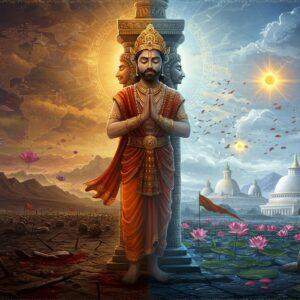



Imagine standing before a stone pillar that has witnessed the rise and fall of empires, a silent guardian of history that has stood firm for over 1,500 years. This is the essence of the Talagunda Inscription, an extraordinary artifact located in the Shivamogga district of Karnataka. For us, as Indians who cherish our roots, this isn’t just a piece of rock; it is a bridge to the glorious Kadamba dynasty and a testament to the sophistication of our ancestors. It tells the story of how our languages, culture, and governance evolved in the southern part of our divine land.
Deepening our connection to our heritage often begins with understanding these historical markers. The Talagunda pillar is pivotal because it decodes the secrets of the past, offering a glimpse into the cultural richness of the 5th century CE. Let us embark on this journey to understand how a single inscription contributes so massively to the narrative of Karnataka and India as a whole.
The Talagunda Inscription: A Historical Treasure
Dating back to the mid-5th century CE, the Talagunda Inscription is more than just text; it is a masterpiece of classical art and literature. It serves as one of the earliest and most significant Sanskrit inscriptions found in South India. What makes it truly fascinating is its connection to the Kadamba lineage, revealing the political heartbeat of that era. The inscription does not merely list names; it paints a vivid picture of governance, society, and the values held dear by the people of that time.
Composed by Kubja, the court poet of King Santivarman, the text consists of 34 poetic verses. These verses are not just administrative records but are written in beautiful meter, adhering to the strict rules of Sanskrit prosody, showing that art and authority walked hand in hand in ancient India.
Decoding the Language: A Linguistic Marvel
For language enthusiasts and history buffs alike, the script of the Talagunda Inscription is a marvel. It represents a fascinating transition period in our linguistic history.
- Classical Sanskrit in Kannada Script: While the language used is excellent classical Sanskrit, the script itself is Kannada. Specifically, it uses a unique “box-headed” southern alphabet with a floral box-type font. This artistic detail shows the aesthetic sensibilities of the scribes of that era.
- Rewriting Kannada History: Perhaps the most exciting aspect is that this site pushes back the timeline of the Kannada language. While the Halmidi inscription (450–500 CE) was long thought to be the oldest, evidence from Talagunda suggests the presence of Kannada words dating between 370 and 450 CE. This potentially makes it the earliest evidence of the Kannada language, a point of immense pride for the region.
Unveiling the Legacy: The Story of Mayurasharman
The inscription gives us the foundational story of the Kadamba dynasty, starting with its founder, Mayurasharman. The text describes him as a learned Brahmin scholar who traveled to Kanchipuram, a major center of learning (or ghatika), to study the Vedas. However, following a conflict with the Pallava overlords, he tapped into his warrior spirit.
Mayurasharman’s rebellion established the kingdom around 345 CE, proving that the lines between the scholarly and the martial were often crossed when dharma and dignity were at stake. Talagunda itself, known then as Sthanakunduru, was an important agrahara—a prestigious place of learning. This highlights how education and spiritual knowledge were the bedrock of ancient Karnataka’s society.
Spiritual Roots: Religious Significance of Talagunda
Our land has always been one of devotion, and the Talagunda inscription confirms this deep-seated spirituality. It provides the earliest epigraphical evidence in Karnataka of a Hindu temple dedicated to Lord Shiva. The inscription mentions a temple water tank and the worship of the Shiva Linga existing well before 450 CE.
The Pranaveshwara Temple in Talagunda is believed to have been worshipped even by the Satakarnis, linking different dynasties through a shared thread of devotion. The text also reflects the cultural values of the time, referencing music, the virtues of a King, and invoking Goddess Lakshmi as the deity of wealth. It portrays an era where religion, culture, and daily life were seamlessly interwoven.
Bring Authentic Tradition Home with Poojn.in
Poojn.in stands out as the premier destination for cultural goods in India. Our extensive range of products meets all your cultural requirements, helping you stay connected to the traditions mentioned in our history. Explore our collection today at poojn.in.
Why should you choose poojn.in for your cultural needs? One reason is that we offer a unique collection of cultural goods that you won’t find anywhere else, ensuring your rituals are performed with the utmost authenticity.
Poojn.in is your go-to source for authentic ritual items and cultural insights. If you are interested in understanding the spiritual depth behind artifacts like the Talagunda Inscription, we offer resources and products that connect you to India’s rich heritage. Our collection includes traditional items that are part of ancient rituals and practices, helping you explore historical contexts like those surrounding the Talagunda Inscription.
For those who wish to perform rituals or ceremonies inspired by ancient traditions, our online store provides a wide range of products. From puja kits to sacred texts, we ensure you have everything you need for an authentic experience.
Visit Poojn.in to explore our offerings or contact us at 03369029784. You can also reach us via WhatsApp at 9476142738 for more information on how our products can enhance your understanding of India’s linguistic and cultural legacy.
Discovery and Preservation: Keeping History Alive
This historical gem was brought to light in 1894 by the historian B. L. Rice. Since then, scholars like Buhler and Kielhorn have worked to translate and interpret the verses, ensuring that the legacy of the Kadambas is not lost to time. However, preserving such ancient stone inscriptions is a challenge against nature and time. It requires the collective effort of archaeologists and citizens who value their heritage to ensure these stories remain accessible for our children.
Common Questions About the Talagunda Inscription
Understanding the Essence of the Inscription
Many people ask what exactly the Talagunda Inscription is. Simply put, it is an ancient stone record found in Karnataka that serves as a window into the 5th-century socio-political life. It is crucial because it bridges the gap between myth and history, offering concrete proof of the Kadamba dynasty’s origins and the early use of the Kannada language.
Language and Script Details
A frequent topic of curiosity is the language used on the pillar. The text is written in high-quality Sanskrit, which was the language of the learned, but it uses the Kannada script in a unique box-headed style. This blend signifies the cultural exchange and the evolving identity of the region during that period.
What Secrets Have Been Revealed?
Historians have decoded fascinating details from the text, including the genealogy of the Kadamba kings and their administrative structure. It reveals the transition of Mayurasharman from a peaceful student in Kanchipuram to a powerful King, and it highlights the existence of Shiva worship practices that are still prevalent in India today.
Visiting the Site
For those inspired to see this marvel in person, the inscription is located in Talagunda village, Shivamogga district, Karnataka. It stands near the Pranaveshwara Temple, making it a spiritually and historically enriching destination for any traveler.
Embracing Our Shared Legacy
The Talagunda Inscription is more than just a subject for history books; it is a symbol of our civilization’s continuity. It reminds us of a time when education, valor, and devotion defined our society. As we learn about the Kadamba dynasty and the early strides of the Kannada language, we feel a deeper sense of pride in our Indian identity. By preserving and understanding these inscriptions, we ensure that the wisdom of our ancestors continues to guide us. Let us celebrate this shared history with reverence and keep the flame of our traditions alive.