


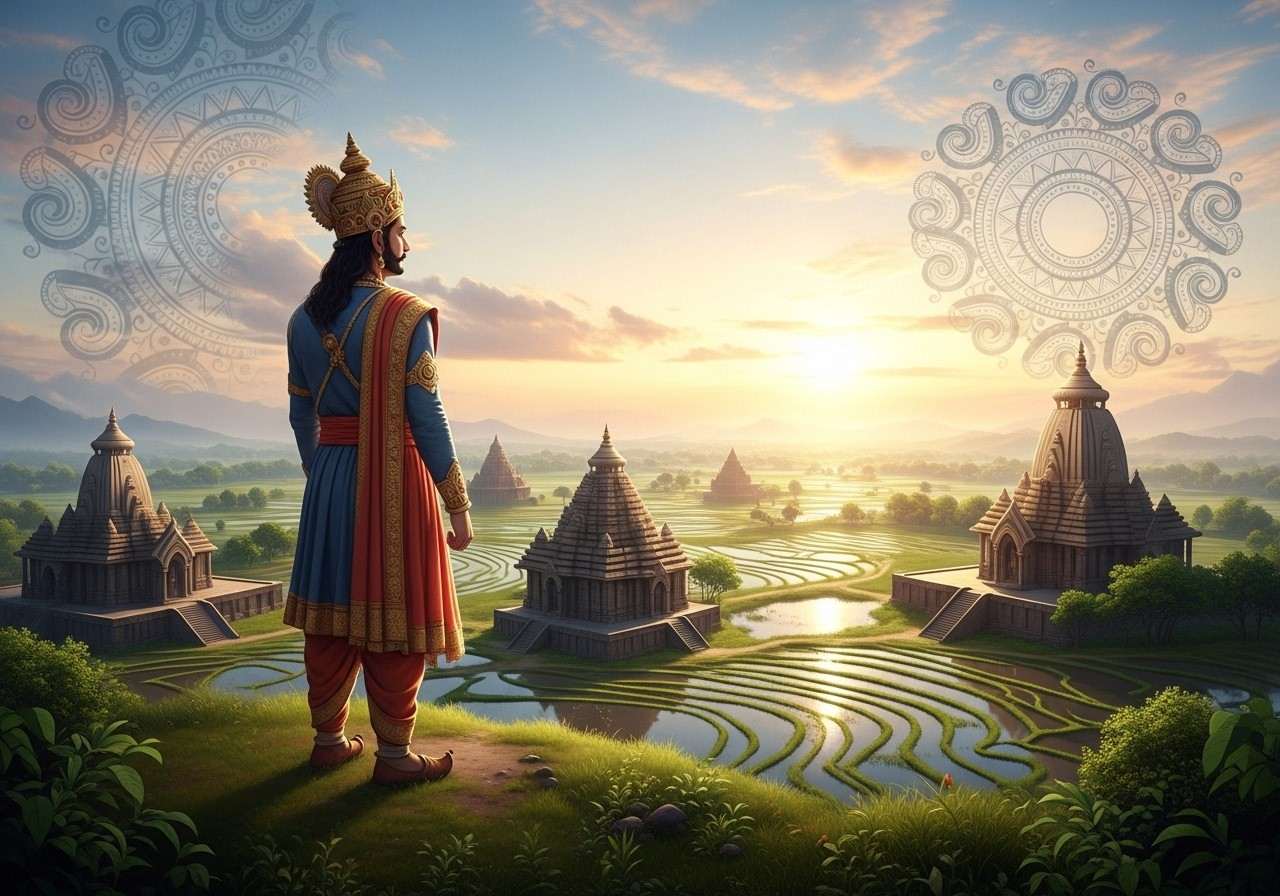
Our beloved India is a land of countless stories, where every region echoes with tales of valor, spirituality, and rich cultural heritage. Among these, the grand saga of the Ahom dynasty stands out as a deeply inspiring chapter in our history. Evolving from a small group of Tai migrants into a formidable imperial power, the Ahom rulers gracefully transformed the northeastern landscape of India. Spanning an incredible 598 years, from 1228 to 1826, their reign in the Brahmaputra Valley is a brilliant example of strategic brilliance, cultural harmony, and unwavering resilience.
The Sacred Founding of a New Homeland
The fascinating journey of this empire began with Sukaphaa, a visionary Tai prince from Mong Mao (present-day Dehong, China). In the year 1228, he bravely crossed the rugged Patkai mountains to enter the fertile Brahmaputra valley. Establishing a new kingdom in an unfamiliar land was no small feat, but Sukaphaa brought with him advanced wet rice agriculture technologies, which brought prosperity to the region. He affectionately named his new realm Mong Dun Shun Kham, a kingdom full of gold.
With deep wisdom and respect for local traditions, Sukaphaa chose Charaideo as his first capital, a decision that held immense strategic and spiritual significance. Rather than ruling by force alone, he gently befriended indigenous communities like the Borahi and Marans. Through a beautifully inclusive system called Ahomisation, which incorporated stateless people into their clans, he wove diverse groups into a united family. To honor this great founder, Assam proudly celebrates Sukaphaa Divas (Assam Day) every year on December 2, a testament to his enduring legacy.
Expansion, Unity, and Cultural Blending
As generations passed, the kingdom blossomed into a multi-ethnic powerhouse. Under the dynamic leadership of Suhungmung in the 16th century, the realm saw massive territorial and social expansion. A key milestone in this era was the absorption of the Chutia kingdom in 1523, where the Ahoms respectfully integrated Chutia nobility, skilled commanders, and technological advancements into their own fold.
This inclusive approach sparked a beautiful cultural ethnogenesis. It was a time when diverse ethnic interactions enriched the society, seamlessly blending Tai roots with local Assamese traditions to create a vibrant, harmonious culture that we still revere today.
Society, Spirituality, and the Ahom Way of Life
To govern and protect their expanding homeland, the rulers relied on the ingenious Paik system, a well-organized method of decentralized administration. This system required able-bodied men to serve the state, functioning as both an economic engine and a defensive shield. The society itself was respectfully hierarchical, deeply rooted in duty and community service.
Spirituality was the heartbeat of Ahom daily life. While they practiced profound ancestor worship and maintained close political ties with other Tai states like Möng Kawng (Nara), they also gracefully embraced local deities, particularly Lord Siva. The air was filled with devotion, and the temples resonated with chants that brought peace to the community.
Nurturing Our Spiritual Roots with Poojn.in
Just as the Ahoms held their rituals and ancestral worship close to their hearts, we understand how vital it is for you to maintain a sacred, pure atmosphere in your own homes. Preserving our timeless Indian traditions gives us immense peace and emotional strength. At Poojn.in, India’s most trusted online cultural goods store, we are dedicated to bringing the sanctity of these ancient rituals straight to your doorstep.
Our carefully curated selection of authentic ritual items is designed to help you honor your heritage with complete devotion and convenience:
- Authentic Brass Diyas: Perfect for your daily traditional ceremonies, these heavy, beautifully crafted brass diyas are designed to bring divine light, warmth, and a deep sense of positivity into your household.
- Natural Incense Sticks: Thoughtfully made from pure, organic ingredients, our incense sticks help create a deeply serene atmosphere, allowing you to focus completely during your meditation and evening prayers.
- Traditional Puja Thalis: Complete your sacred rituals with our exquisitely designed puja thalis, which not only add an element of elegance to your home altar but also honor the timeless Indian traditions we all hold so dear.
We deeply respect your busy lifestyle, which is why we offer a seamless online shopping experience. You can confidently trust Poojn.in to deliver genuine, high-quality spiritual items safely to your home. For any assistance in finding the perfect items for your family’s rituals, warmly reach out to us at 03369029784 or WhatsApp us at 9476142738.
Fierce Resistance and the Defense of the Motherland
A true mark of the Ahom legacy is their breathtaking courage against foreign invasions. The kingdom faced repeated, fierce attacks from the Turkic and Afghan rulers of Bengal but stood strong like a mountain. Their first major encounter with an imperial power took place against the Mughal Empire in 1615.
The pinnacle of their military glory is undoubtedly the legendary Battle of Saraighat in 1671. Led by the brilliant and courageous Lachit Borphukan, the Ahoms utilized masterful naval strategies and guerrilla warfare to completely repel a massive Mughal invasion, significantly extending their boundaries westward. Thanks to their unyielding bravery, by 1682, the Mughal presence in the region was permanently eradicated.
The Twilight of the Empire
History teaches us that even the mightiest empires face the passage of time. By the mid-18th century, the once-flawless administrative framework began to show its age. The beloved Paik system, which had successfully thwarted massive invasions, slowly became outdated in a changing world. Furthermore, the kingdom was burdened by a rigid hierarchical structure and a weakening institutional base.
Internal social conflicts, most notably the tragic Moamoria rebellion, significantly drained the kingdom’s strength. The final chapter of Ahom rule was written during the devastating Burmese invasion of Assam, which ultimately led to the annexation of the region by the British East India Company following the Treaty of Yandabo in 1826.
An Enduring Legacy of Pride and Unity
Though the political reign ended, the spiritual and cultural legacy of the Ahom empire continues to flow through the heart of Assam like the mighty Brahmaputra. They gifted us advanced agricultural practices, mesmerizing art forms, historic chronicles known as Buranjis, and vibrant festivals like Bihu, which continue to fill our lives with joy today. Remembering the glorious 598 years of Ahom rule reminds us of the strength we find in unity, faith, and the proud embrace of our shared cultural identity.
Frequently Asked Questions About the Ahom Dynasty
How the Rulers Built Such a Vast State
The rulers expanded their glorious territory through a brilliant mix of strategic alliances, advanced warfare, and compassionate diplomacy. They heavily focused on strengthening their centralized administration to peacefully integrate and uplift the diverse regions they brought under their protective umbrella.
Where the Empire Was Established
The foundation of this majestic empire was beautifully laid in the fertile Brahmaputra Valley of present-day Assam, India. This blessed region provided them with abundant natural resources and strategic geographical advantages, enabling their culture and agriculture to deeply flourish.
The Visionary First King
Sukaphaa, a noble Tai prince who arrived from Mong Mao in 1228, was the founding father of the kingdom. He is still deeply celebrated across Assam for his extraordinary leadership, immense foresight, and his loving approach to unifying local communities under one harmonious rule.
Uniqueness of Their Administration
Their governance was uniquely characterized by the highly effective Paik system. This well-organized approach involved a mandatory rotation of labor and military service among the common people, ensuring that the state was always protected and economically productive without relying on a standing mercenary army.
How They Maintained Their Autonomy
Power was sustained through a powerful combination of unmatched military strength, deeply empathetic governance, and brilliant cultural assimilation. By graciously adopting local Assamese traditions and promoting the practice of Ahomisation, they unified countless diverse communities into a single, loyal family.
Their Most Notable Achievements
The kingdom is famously revered for its legendary resistance against repeated Mughal invasions, maintaining complete independence for nearly six centuries. Beyond their military might, they made monumental contributions to the spiritual, architectural, and cultural evolution of Northeast India.
The Impact on Regional Culture
The royal lineage left an indelible mark on the culture by lovingly blending their native Tai traditions with the indigenous practices of the valley. Their patronage profoundly influenced local art, architecture, beautiful languages, and the sacred rituals that continue to be celebrated with deep devotion today.