
Namaskara! Welcome to a journey through the profoundly spiritual and historically rich landscape of one of South India’s most beloved states. Karnataka is an awe-inspiring tapestry of ancient traditions, magnificent temples, and deeply rooted local customs. As we embrace the year 2026, understanding the intricate web of its administrative and geographical boundaries helps us appreciate how local heritage has been safeguarded for generations. The division of this sacred land into carefully structured zones ensures that every unique dialect, ritual, and community festival receives the reverence it deserves.
Tracing the Divine Across 31 Districts and 4 Administrative Divisions
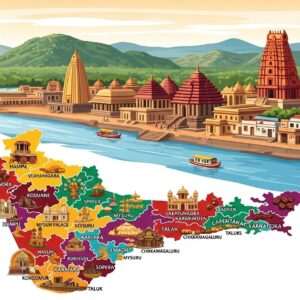
The state’s geography is not merely a matter of borders on a map; it is the very framework that sustains its glorious cultural legacy. As of April 2026, Karnataka proudly encompasses 31 unique districts, systematically organized under 4 primary administrative divisions: Bangalore, Belgaum, Kalaburagi, and Mysore. Each of these regions radiates its own spiritual and historical aura, nurturing timeless arts, crafts, and philosophical teachings. From the modern yet culturally grounded streets of Bengaluru Urban to the royal, festival-rich corridors of Mysuru, every region contributes a vital thread to the state’s vibrant social fabric.
To improve local governance and service delivery, the administration constantly evaluates the state’s vast geography. The state government has proactively initiated the process of dividing expansive districts like Belagavi (Belgaum) and Tumakuru (Tumkur) for improved governance. Notably, recent discussions and commitments have highlighted the creation of a newly bifurcated Chikkodi district out of Belagavi, ensuring that localized cultural identities and community needs are better served.
The Vital Role of Taluks in Preserving Grassroots Traditions
If districts are the grand pillars of the state, then taluks are the intricate carvings that give it distinct character. As of March 2026, Karnataka comprises approximately 237 taluks, which are smaller subdivisions crucial for local administration and revenue collection. These local blocks are the true custodians of folklore, ancestral worship, and community bonding. Interestingly, the Belagavi district currently holds the distinction of having the highest number of taluks in the entire state.
To ensure balanced growth without losing cultural essence, these taluks are carefully classified based on their developmental progress. This categorization allows the government to focus on areas that need the most socio-economic support:
- Administrative Focus on Backward Regions: Currently, 93 taluks are classified as “extremely backward,” with another 36 noted as “highly backward” and 43 as “backward.” By officially recognizing these categories, the government can channel dedicated resources to uplift these deeply traditional yet economically vulnerable communities, preserving their heritage while improving living standards.
- Steady Progress in Developed Subdivisions: On the other end of the spectrum, 64 taluks have successfully achieved the “developed” status. This positive growth highlights that progressive, modern governance can beautifully coexist alongside the region’s localized cultural heritage and age-old traditional practices.
Honoring Your Ancestral Roots from Home
While physically visiting the sacred shrines scattered across these 31 districts is a deeply moving experience, we understand that busy modern lives can make frequent travel challenging. You can still seamlessly integrate the purity of these geographical traditions into your daily household worship through our extensive online collection. At poojn.in, we are devoted to supporting your spiritual journey by delivering high-quality, authentic items straight to your doorstep.
- Complete Traditional Puja Kits: Our meticulously curated puja kits contain all the essential elements required for performing time-honored ceremonies. Whether you are seeking to honor a local deity from your ancestral village or conduct a special family homa, these comprehensive kits ensure you never miss a vital offering.
- Premium Aromatic Incense and Dhoop: Elevate the spiritual ambiance of your home altar with our carefully crafted agarbattis and pure dhoop sticks. Blended from natural, pure ingredients, these soothing fragrances will instantly transport your senses to the serene, stone-carved corridors of ancient southern temples.
- Authentic Brass and Copper Utensils: Incorporate the enduring purity of traditional metals into your daily worship with our beautifully polished brass and copper items. These timeless pieces are perfect for presenting holy water, fresh flowers, and radiant deepam offerings to the divine, exactly as our ancestors did for countless generations.
Please remember that Poojn does not provide any travel packages, nor do we offer VIP darshan arrangements or temple guidance services. Our sole dedication lies in providing you with the finest cultural goods through our online store, allowing you to honor your ancestral roots right from the comfort of your own home.
For any personalized assistance in selecting your ritual items, please feel free to contact our dedicated support team at 03369029784 or simply WhatsApp us at 9476142738. Let poojn.in be your trusted companion in preserving the sacred essence of India’s glorious heritage.
Frequently Asked Questions About Our Sacred Landscape
Many devotees naturally wonder about the exact structure and administrative breakdown of this beautiful state. Currently, Karnataka is home to 31 distinct districts, each boasting its own unique cultural identity, historical landmarks, and sacred geography. To understand the local governance better, people often ask about the specific role of a taluk. A taluk functions as an essential administrative sub-division within a district, often encompassing multiple villages and towns where deep-rooted local customs and community rituals thrive on a daily basis.
If you are curious about which region holds the most subdivisions, Belagavi district proudly claims the highest number of taluks in the entire state. For those seeking culturally significant areas to study or revere from afar, districts like Mysuru and Vijayanagara (famous for Hampi) stand out as true cultural gems. These taluks contribute immensely to the state’s spiritual landscape by housing ancient shrines, sustaining local artisans, and serving as the focal points for traditional community festivals.
Finding a comprehensive list of these regions is quite simple, as various state government publications and reliable cultural platforms offer detailed insights into the state’s mapping. Regarding recent changes expected in the administrative map by the end of 2026, the state has been actively exploring strategic restructuring to ensure better governance. This includes the highly anticipated bifurcation of large districts like Belagavi and Tumakuru, which will ultimately help in offering closer support to local communities and better preservation of their cherished grassroots heritage.