

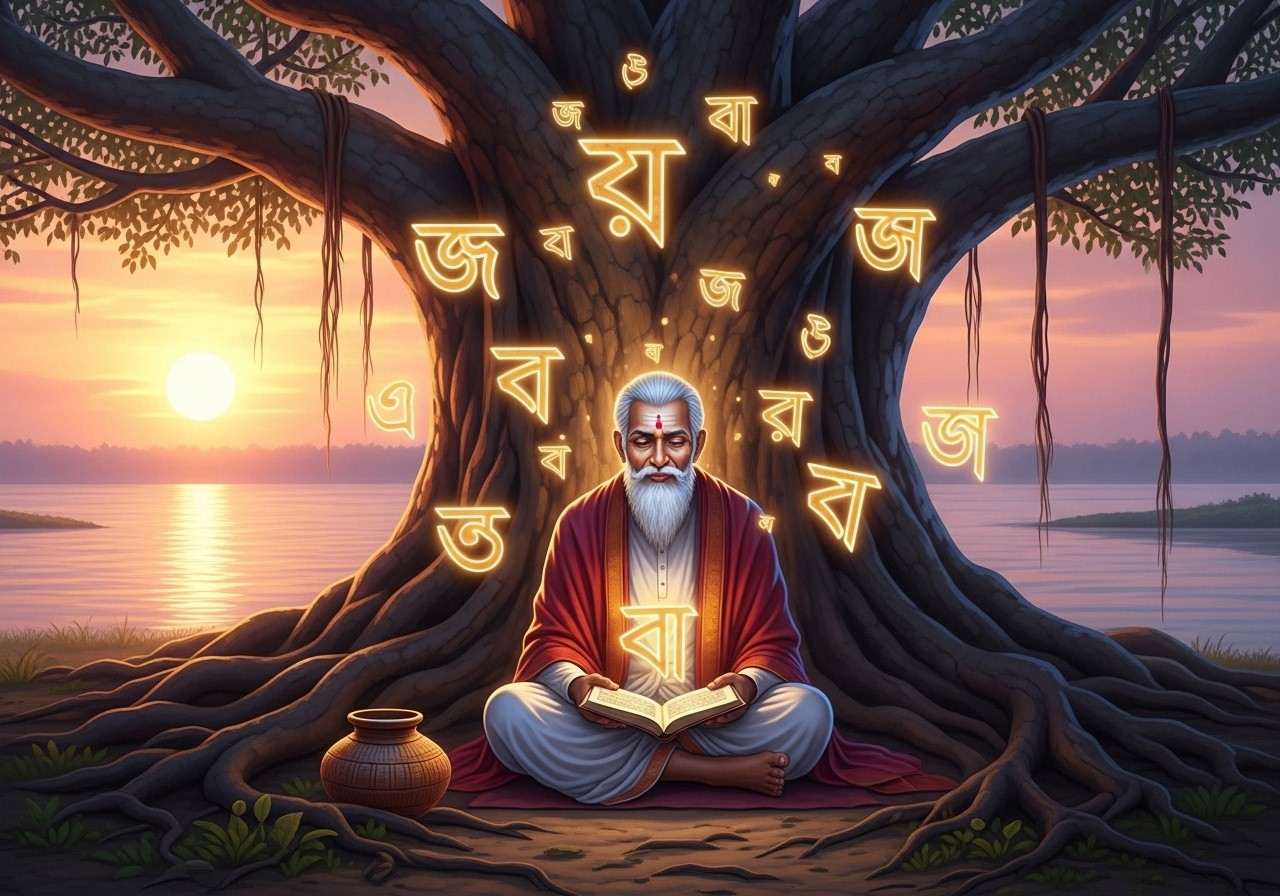
There is a profound sense of pride that comes with tracing the roots of our mother tongues. The Bangla script, known affectionately as the Bengali alphabet, is not just a writing system; it is a vital heartbeat of Bengal’s incredibly rich cultural heritage. Admired for its beautifully rounded, curvilinear shapes and the melodic sweetness it brings to spoken words, understanding these letters is a beautiful stepping stone toward appreciating a literary tradition that has moved millions. As we navigate through 2026, preserving and passing down these linguistic treasures to the next generation remains as important as ever for families who deeply cherish their cultural roots.
Tracing Its Historical and Cultural Roots
To truly respect the Bangla writing system, one must look back at its remarkable historical evolution. The script gracefully evolved from the ancient Bengali-Assamese script, which itself is a proud descendant of the revered Brahmi script that birthed many prominent Indian languages.
- A legacy of empires and scholars: During the grand reign of the Pala and Sena dynasties, the region saw an incredible fostering of linguistic and cultural growth. The heavy influence of Sanskrit eventually added a beautiful complexity to the phonetic structure, ensuring the language could handle profound philosophical, spiritual, and literary texts.
- The touch of a visionary reformer: The colonial era and the subsequent Bengal Renaissance brought much-needed modernization to how the language was taught. It was the legendary scholar Ishwar Chandra Vidyasagar who played an instrumental role in standardizing the letters, bringing the consistency and clarity that makes it accessible for us to learn and teach even today.
Origin, Usage, and Global Footprint
Today, the Bangla letters hold a cherished spot in homes across borders, proudly serving as the 5th most used writing system in the entire world. Around 300 million people use these characters daily to express their deepest thoughts, sing soulful Rabindra Sangeet, and preserve age-old household traditions.
- Widespread official and national presence: It stands tall as the proud national script of our neighboring Bangladesh. Within India, it rightfully holds official status in West Bengal, Tripura, and Assam’s lush Barak Valley, binding diverse communities together through a deeply shared linguistic thread.
- Cross-cultural adaptability and regional embrace: Interestingly, the versatile nature of these letters allows them to be seamlessly used for the Meitei language in Manipur, beautifully showcasing how fluidly Indian scripts adapt to regional linguistic needs over centuries.
Distinctive Architectural Features of the Script
When you observe a beautifully written Bangla manuscript, a few distinctive structural features immediately catch the eye. The script is an abugida, meaning the vowel sounds are primarily realized as distinct diacritics that seamlessly modify the inherent vowel of a base consonant.
- The elegant horizontal foundation: Just like several other Indic scripts, the text is written gracefully from left to right across the page. Every single letter appears to hang securely from a defining horizontal line placed at the top, which is traditionally and affectionately referred to as the matra.
- A beautifully unicameral phonetic system: The script closely aligns with a purely phonetic alphabet where almost every spoken sound has a dedicated, distinct character. Moreover, it is an entirely unicameral script, meaning it delightfully lacks any uppercase and lowercase distinctions, offering a unique spiritual simplicity compared to Western languages.
The Core Components: Swarabarna and Byanjanbarna
The foundation of this deeply melodic language is built upon a well-structured set of vowels and consonants that blend together to create an infinite array of phonetic possibilities.
- The Vowels (Swarabarna): There are exactly 11 essential vowel letters in the system. Vowels can stand beautifully independent when used at the very beginning of a syllable, or they can be dependent. In their dependent form, they become যোগ চিহ্ন (diacritical marks, kars, or matras) such as া, ি, ী, ◌ু, ◌ূ, ৃ, ৄ, ে, ৈ, ো, and ৌ that attach themselves to consonants. The very first letter, অ, acts as the inherent vowel sound /ɔ/ that resides naturally within consonants. The independent vowels include অ, আ, ই, ঈ, উ, ঊ, ঋ, ঌ, এ, ঐ, ও, and ঔ.
- The Consonants (Byanjanbarna): The robust structure boasts 32 fundamental consonant letters, including familiar traditional sounds like ক, খ, গ, ঘ, ঙ, চ, ছ, জ, ঝ, ঞ, ট, ঠ, ড, ঢ, ণ, ত, থ, দ, ধ, ন, প, ফ, ব, ভ, ম, য, র, ল, শ, ষ, স, and হ. Every single one of these letters inherently carries that foundational vowel sound of “ɔ”, patiently waiting to be modified by a corresponding kar.
- Conjunct Letters and Numerical Identity: The linguistic magic truly happens with যুক্তাক্ষর (conjunct letters), where two or more consonants elegantly merge to form completely new visual and phonetic clusters. In these combinations, all but the final consonant represent their base sounds, and only the final consonant is followed by a vowel sound. Additionally, the language boasts its own native numerical symbols and special contextual characters, adding deep cultural texture to written mathematics and literature.
Nurturing Cultural Roots with Poojn.in
Passing down the profound knowledge of our mother tongue to the next generation is a sacred family duty. We understand that finding authentic, high-quality resources to teach children—or even to relearn the basics yourself—can sometimes be a challenge in today’s fast-paced world. Poojn.in stands as your trusted partner for authentic cultural goods that can beautifully support the learning and understanding of these traditional scripts.
Our lovingly curated online store offers a wide variety of educational materials designed specifically to help you seamlessly grasp the structure of the Bangla script. These premium materials include engaging books, beautifully illustrated wall charts, and handy flashcards tailored carefully for learners across different age groups and proficiency levels.
We take immense pride in ensuring that our products are authentic and strictly tailored to meet our rich traditional standards. Whether your little ones are starting from scratch or you are looking to deepen your own existing knowledge, our heartfelt selection caters to all your cultural learning needs. Please note that we exclusively sell tangible cultural goods and educational resources through our online store; we do not engage in offering travel packages, nor do we provide VIP darshan arrangements. Our sole devotion is to bringing the essence of tradition directly into your home.
For more personalized information or specific inquiries about our educational and cultural items, please feel free to reach out to our supportive team at 03369029784, or simply drop us a warm message on WhatsApp at 9476142738. Visit our online store at Poojn.in today to explore our authentic, root-connected educational materials.
Common Curiosities About the Bangla Writing System
Many individuals eager to reconnect with their linguistic heritage often wonder about the core structure of the language. To put it simply, the system functions elegantly as an abugida. This means that every foundational letter is essentially a consonant that carries an inherent vowel sound, which can then be beautifully modified using specific diacritical marks to change the tone and rhythm.
Language enthusiasts frequently ask about the total number of letters they need to lovingly memorize. The standard writing system consists of 50 primary characters, thoughtfully and logically divided into 11 independent vowels and 39 base consonants, giving earnest learners a wonderfully structured path to conversational fluency.
People also frequently inquire about the specific vowels used to shape their daily words. The primary 11 vowels are deeply phonetic and beautifully pronounced, starting from অ (A) and moving fluidly through আ (Aa), ই (I), ঈ (Ii), উ (U), ঊ (Uu), ঋ (Ri), এ (E), ঐ (Oi), ও (O), and concluding gracefully with ঔ (Ou).
For those familiar with other regional languages, there is often a natural curiosity about how this script compares to others across our diverse country. It shares a wonderful historic kinship with fellow Indic scripts like Devanagari. Both share the left-to-right reading flow and the top hanging line, yet the Bangla script retains entirely unique, visually softer symbols and a rounded phonetic characteristic perfectly tailored to Bengali pronunciation.
A very practical concern for new learners is whether they have to worry about silent letters, a common hurdle in Western languages. Thankfully, the script is incredibly straightforward and honest in this regard—there are absolutely no silent letters. Every beautifully drawn character you see on the page corresponds to a specific, proudly pronounced sound.
Interestingly, some wonder if these letters are strictly confined to just one spoken tongue. Because of its highly versatile and phonetic structure, while it is primarily the vessel for Bangla, the exact same script is successfully adapted for writing other languages spoken within Bangladesh and various northeastern parts of India.
Finally, parents actively teaching their children often look for the best way to explain how this differs from the English alphabet. The differences are beautifully profound; our regional script relies heavily on inherent vowel sounds and interconnected syllable blocks. It entirely lacks the uppercase and lowercase mechanics of English, making the act of writing a uniquely artistic and spiritually grounded endeavor.
Embracing the rich tapestry of this script is a beautiful journey of cultural rediscovery. Approach it with the utmost respect, warmth, and curiosity, and watch as it seamlessly brings your family closer to the enduring, golden heart of Bengal.