
Maharashtrian nuptials are globally admired for their perfect balance of simplicity, sheer elegance, and deeply rooted traditional customs. They represent far more than just a legal union; they are a vibrant celebration of culture, devotion, and the unbreakable bonds of family. Every single ritual in these celebrations carries profound spiritual significance, seamlessly weaving together the ancient heritage of Maharashtra with the heartfelt emotions of the modern Indian family. As we navigate through fast-paced modern lives, honoring these age-old traditions helps us stay beautifully connected to our cultural roots and ancestral blessings.
The Auspicious Beginnings: Pre-Wedding Ceremonies
The journey to a holy matrimony in Maharashtrian culture begins long before the actual wedding day. These preliminary ceremonies are designed to prepare the couple spiritually, emotionally, and physically for their lifelong partnership, surrounded by the warmth and blessings of their loved ones.
- Sakhar Puda: This beautiful pre-wedding ceremony serves as the official engagement, where the groom’s mother lovingly applies Haldi-Kumkum to the bride’s forehead. It is a moment of deep emotional connection, complete with the gifting of a vibrant saree, traditional jewelry, and sweets, followed by an exchange of engagement rings between the couple to signify the joyous blending of two families.
- Muhurt Karane: In this deeply communal ritual, five married women, respectfully known as Suhasanies, come together to grind turmeric, aromatic spices, and pulses in preparation for the big day. They also spend time rolling traditional papads and joyfully displaying the bridal trousseau, utensils, and sweets, bringing an atmosphere of true festive preparation to the household.
- Halad Chadavane: This is a highly anticipated and delightful custom where a purifying turmeric paste is applied to the groom by five Suhasanies, using auspicious mango leaves on his forehead, shoulders, hands, and feet. Once completed, this exact same sacred paste is affectionately carried to the bride’s home, where she undergoes the same radiant ritual to cleanse and prepare her for the marital vows.
The Sacred Union: Heart of the Wedding Rituals
The actual wedding day is a serene sequence of Vedic rituals, each step carefully designed to invoke divine blessings and seal the couple’s commitment. From seeking the grace of the Almighty to making lifelong vows around the holy fire, these traditions form the spiritual core of the marriage.
- Ganpati Puja and Gaurihar Puja: The highly auspicious day begins with Ganpati Puja, invoking Lord Ganesha to ensure a smooth, obstacle-free, and blissful married life. Following this, the bride, radiating grace in a yellow saree and vibrant green bangles, performs the Gaurihar Puja, wholeheartedly worshiping Goddess Parvati to seek her divine blessings for eternal marital harmony.
- Antarpat and Kanyadaan: The groom arrives at the mandap adorned with a ‘mundavalya’—a holy ornamental thread gracefully tied across the forehead. A sacred curtain, the Antarpat, initially separates the couple while priests chant the powerful Mangalashtaka verses. This leads to the deeply moving Kanyadaan, where the bride’s parents officially and lovingly entrust their precious daughter to the groom’s lifelong care.
- Mangalsutra, Sindoor, and Lajahoma: In a moment that brings tears to many eyes, the groom ties the sacred thread around the bride’s neck and delicately applies vermillion to her forehead, officially signifying her married identity. Following this, a holy fire is lit for the Lajahoma, where the bride offers life-sustaining grains to the flames while the groom chants powerful Vedic mantras.
- Saptapadi and Kama Samapti: The couple takes seven symbolic, deeply meaningful steps around the sacred fire, making heartfelt vows for their shared future, with each round honoring Dharma, Artha, Kama, and Moksha. The ceremonies gracefully conclude with the Kama Samapti, where the couple performs Laxmi Puja until the holy fire naturally subsides, after which the groom lovingly bestows a new name upon his bride.
Welcoming the New Era: Post-Wedding Traditions
Once the sacred vows are complete, the celebrations shift towards welcoming the new daughter-in-law into her permanent home. These traditions are characterized by warmth, acceptance, and the joyful merging of extended families.
- Grihapravesh: This is the highly emotional moment when the bride steps into her new home, greeted by her mother-in-law performing a loving aarti and washing the couple’s feet with milk and water. As a symbol of bringing immense prosperity, the bride gently knocks over a traditional kalash filled with rice using her right foot before making her auspicious entry.
- Mooh Dikhai and Reception: During the Mooh Dikhai, the groom’s family presents beautiful gifts to the bride, giving her a wonderful opportunity to interact intimately with her new relatives. A grand reception traditionally follows, where the newlyweds are formally introduced to a wider circle of extended family members, friends, and society, marking the beginning of their public life together.
Elegance Woven in Threads: Traditional Bridal and Groom Attire
The visual splendor of a Maharashtrian celebration is heavily defined by its distinct, deeply culturally rooted attire. The garments chosen for this day are not just beautiful; they carry generations of historical weight and regional pride.
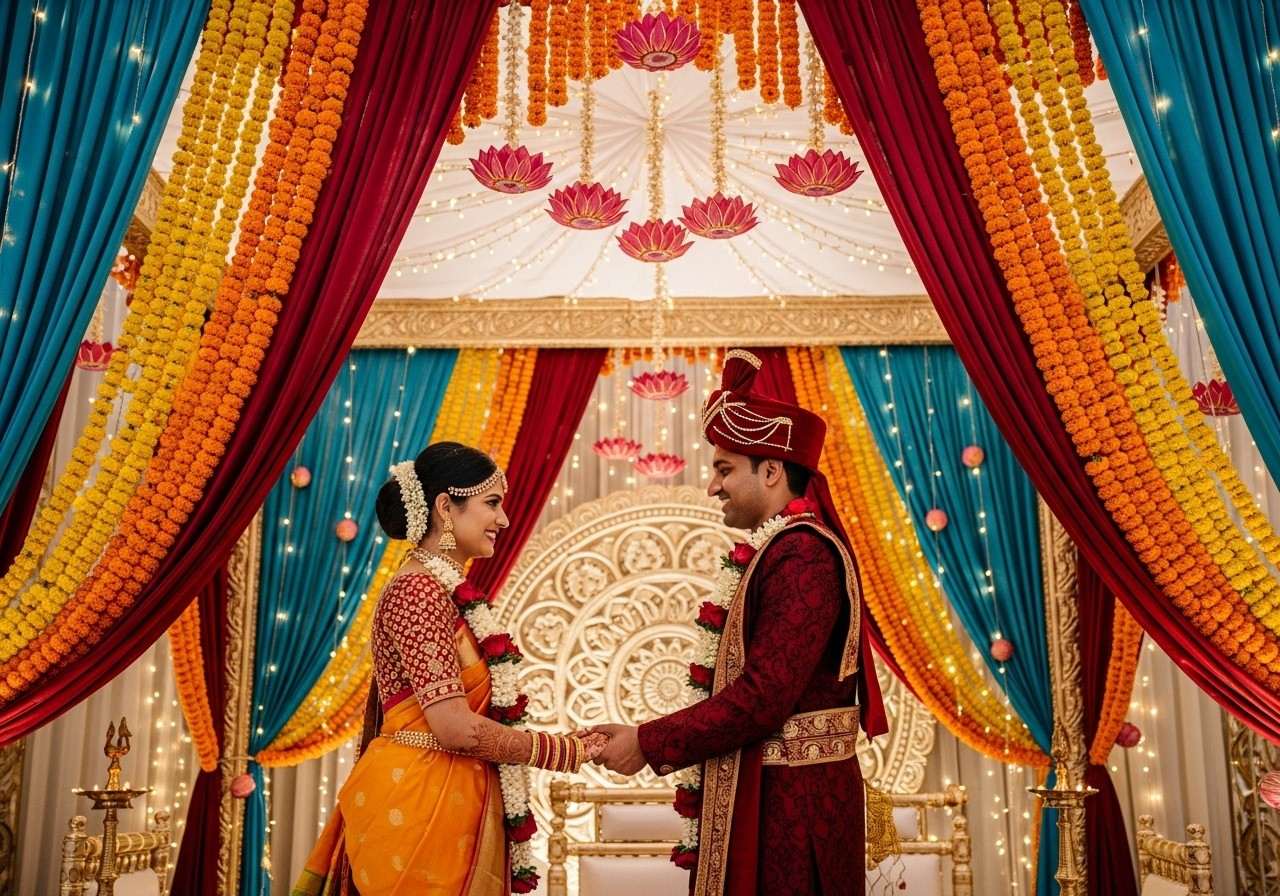
- The Radiant Bride: A Maharashtrian bride is a vision of unmatched elegance, traditionally draped in a colorful six-yard Paithani or a nine-yard Navari silk saree featuring exquisite gold borders, worn in the classic Marathi Dhoti style in shades like yellow, purple, or green. Her divine look is completed with green glass bangles, a traditional Thusi necklace, Maharashtrian armlets, a classic moon-shaped Bindi, and the iconic string of pearls known as the ‘Mundavalya’ across her forehead.
- The Dignified Groom: Complementing his bride’s radiance, the groom wears a simple yet incredibly elegant off-white, cream, or beige kurta, perfectly paired with a white kanche or dhoti featuring a subtle thin border. To add a touch of regal festivity, he drapes a vibrant red or gold-colored stole over his shoulders and crowns his look with a traditional Gandhi-style hat or a culturally rich pheta (turban).
Setting the Tone: Crafting Meaningful Invitations
Long before the guests arrive, the marriage invitation sets the emotional and cultural tone of the upcoming celebration. Crafting these announcements in the native language not only preserves heritage but also warmly conveys the deep respect the host family has for their invitees.
- Authentic Wording and Design: Invitations are traditionally adorned with the beautiful Marathi and Hindi calligraphy text “Shubh Vivah,” directly translating to “Happy Wedding”, which immediately invokes a sense of divine blessing. You can easily find countless customizable templates online that use authentic phrasing, seamlessly blending profound traditional respect with the modern convenience of digital e-invites for eco-friendly sharing.
Supporting Your Cultural Journey with Poojn.in
We deeply understand that planning such a detailed and culturally rich ceremony requires the finest, most authentic ritual items. As families strive to keep these age-old traditions alive in today’s fast-paced world, finding genuine, high-quality spiritual goods can sometimes feel overwhelming. Poojn.in stands tall as India’s premier destination for cultural goods, dedicated exclusively to enriching your spiritual practices without engaging in travel packages or VIP temple darshan services. We purely focus on providing the physical items that make your sacred home ceremonies feel complete and deeply blessed.
- Sacred Thread of Matrimony: The tying of the sacred thread is arguably the most emotional moment of the entire ceremony, representing an unbreakable bond. You can confidently explore our exquisite collection of authentic traditional Mangalsutras, carefully crafted to honor Maharashtrian heritage while bringing a touch of lasting elegance to the bride’s everyday life.
- Perfect Offerings for the Divine: Absolutely no Vedic ceremony or traditional Puja is complete without the proper arrangement of offerings for the deities. Our beautifully crafted Pooja Thalis come fully equipped with every essential item you could possibly need, including high-quality incense sticks, auspicious diyas, and pure kumkum, ensuring your rituals are performed flawlessly.
- Purity for Joyous Beginnings: The highly anticipated Halad Chadavane requires ingredients that are as pure as the couple’s intentions for their new life together. Our carefully curated, unadulterated Haldi Ceremony Essentials provide the finest turmeric powder and traditional accessories, ensuring the bride and groom are blessed with genuine, skin-safe, and spiritually untainted ingredients.
If you require any personalized assistance in selecting the perfect authentic items for your upcoming holy matrimony, our dedicated team is always here to guide you. Please feel free to reach out to us by calling 03369029784 or by connecting comfortably with us on WhatsApp at 9476142738. It is our immense privilege to be a small part of your family’s biggest celebrations.
Addressing Common Curiosities About Maharashtrian Matrimonial Traditions
What are some common Maharashtrian marriage rituals?
Many individuals embarking on the beautiful journey of holy matrimony often wonder about the essential customs that define these cultural celebrations. The foundation of these ceremonies includes the Sakhar Puda, which officially marks the sweet engagement of the couple, and the highly joyful Halad Chadavane, where a purifying turmeric paste is lovingly applied to both the bride and the groom to ward off evil and invite immense prosperity.
How can I create an authentic marriage announcement card in the regional language?
To craft a truly memorable and culturally resonant announcement, you should start by meticulously detailing the names, auspicious dates, specific times, and venue locations. Incorporating traditional phrases, such as the widely respected “Shubh Vivah,” alongside classic motifs like the sacred Swastika or beautiful peacocks, adds an irreplaceable cultural warmth that guests will deeply appreciate.
What vital information should be highlighted in a regional language matrimonial biodata?
A comprehensive and respectful biodata serves as the very first impression in the matchmaking process, so it must include accurate personal details like age, educational achievements, and current occupation. Furthermore, providing transparent family background information, personal hobbies, and clear future expectations—while writing in the native language—helps establish a profound sense of cultural authenticity and undeniable trustworthiness between families.
What is the core significance of invoking Lord Ganesha before the ceremonies?
Invoking Lord Ganesha at the very beginning of the festivities is an absolute cornerstone of Hindu traditions, particularly in Maharashtra. This vital ritual is performed with pure devotion to seek the Lord’s divine blessings, ensuring that the entire course of the matrimonial ceremonies proceeds flawlessly, free from any unforeseen obstacles, and brings lifelong prosperity to the couple.
How is regional heritage reflected in the traditional attire of the couple?
The cultural pride of the region is magnificently displayed through the couple’s wardrobe choices on their special day. The bride elegantly drapes herself in an authentic silk Paithani saree and adorns traditional jewelry like the Nath and Mundavalya, while the groom looks dignified in a classic silk dhoti and kurta, perfectly symbolizing simplicity, purity, and deep respect for ancestral roots.
Why is the application of turmeric considered so vital before the wedding day?
The pre-wedding application of turmeric is much more than a festive activity; it holds deep Ayurvedic and spiritual significance for the couple. It is firmly believed to effectively purify the mind, body, and soul, acting as a divine shield to ward off negative energies while simultaneously bestowing a radiant, natural wedding glow upon the bride and groom.
What specific design elements truly capture the essence of a traditional Marathi invitation?
An authentic cultural invitation is distinguished by its respectful tone, elegant simplicity, and the inclusion of meaningful religious symbols. To ensure your announcement perfectly reflects Maharashtrian culture, you should prioritize respectful linguistic etiquette, incorporate verses from local poetry, and utilize auspicious colors like deep red, vibrant yellow, and golden hues that resonate deeply with traditional values.