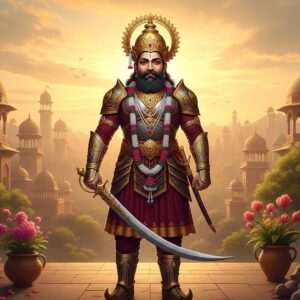


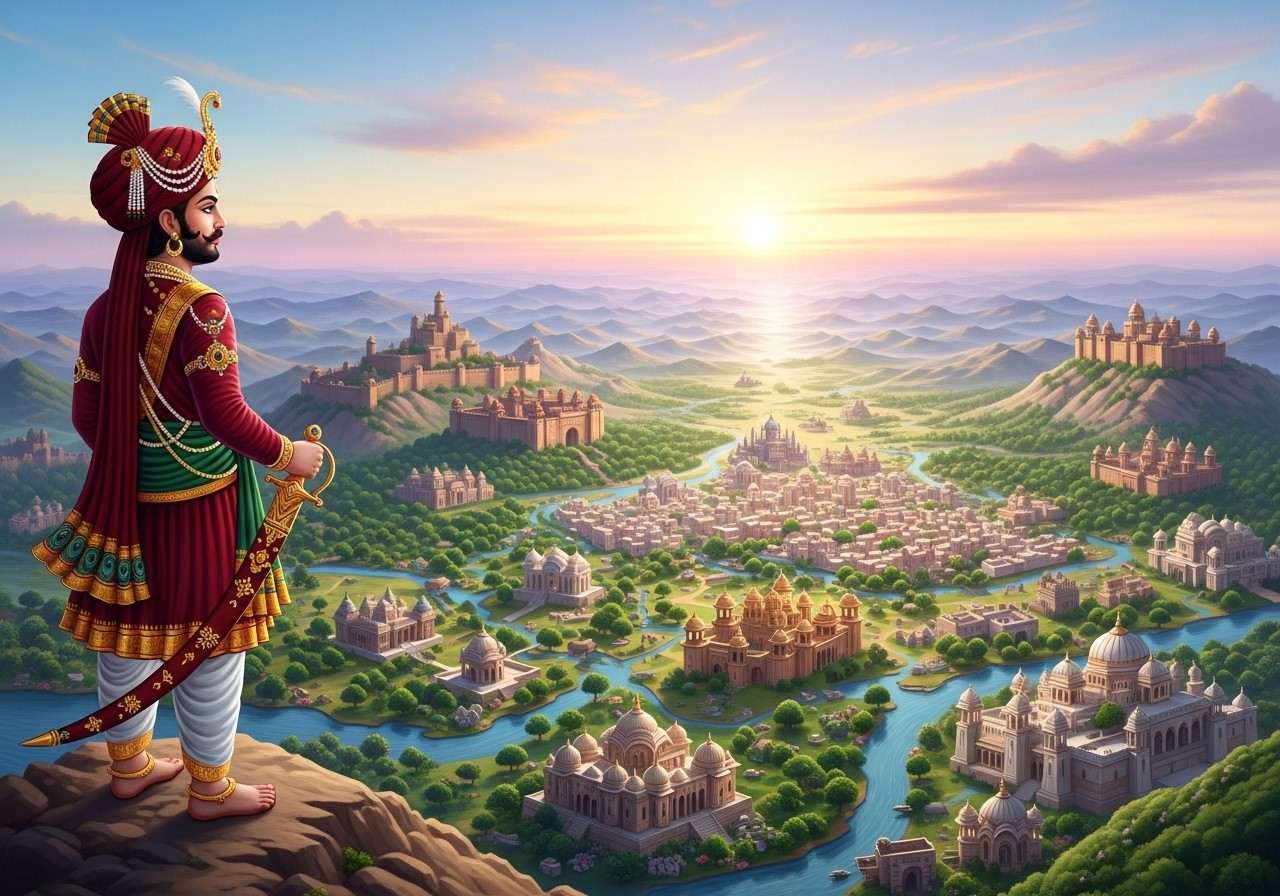
Deep within the golden sands and rugged hills of Rajasthan lies the inspiring saga of Bappa Rawal, a legendary Rajput king whose valor and devotion continue to echo through the corridors of time. Born as Kalbhoj around 713 CE, this visionary leader emerged in the 8th century to shape the cultural, spiritual, and political landscape of medieval India. As the proud founder of the Mewar dynasty in 728 CE, his extraordinary life was a beautiful confluence of battlefield brilliance and unwavering devotion to the divine. Exploring the vast geographical footprint of his reign gives us a profound understanding of how he protected our sacred lands and established a legacy that modern Indians still deeply revere.
The Vast Territories and Unyielding Dominance
To truly appreciate the magnitude of his rule, one must look at the expansive dominion he successfully consolidated. His sovereign lands stretched far beyond the heartlands of Rajasthan, showcasing an unmatched level of strategic foresight and military acumen. Instead of merely defending his local borders, he redefined the geographical limits of his kingdom.
- Establishing the Mewar Stronghold: After gaining control of the legendary Chittorgarh Fort, he firmly established his dominion in the south-central parts of Rajasthan. This central hub was geographically blessed, flanked by the formidable Aravalli Range to the northwest, and bordered by regions like Ajmer, Gujarat, Vagad, Malwa, and the eastern Hadoti region, making it an impenetrable fortress.
- Expansive Global Footprint: Going far beyond the traditional boundaries of the Indian subcontinent, his victorious armies are recorded to have marched into parts of modern-day Iran and Central Asia. He successfully captured territories like Kandahar, Khorasan, and Ghazni, establishing them as vassal states while forcefully pushing Muhammad bin Qasim’s retreating Arab armies all the way to the western banks of the Sindhu River.
- Founding Pivotal Cities: His strategic vision was not just limited to battlefield victories but also included significant urban expansion. The city of Nagda served as the majestic initial capital of his flourishing kingdom, while the modern-day city of Rawalpindi in Punjab, Pakistan, is historically believed to have been founded by and named after this very warrior king.
Strategic Alliances and the Defense of the Motherland
Bappa Rawal was not just a fierce warrior; he was a master diplomat who understood the incredible power of unity. During a time when the subcontinent faced relentless foreign incursions, his brilliant leadership united the Rajput clans to repel Arab armies in the historic Battle of Rajasthan. He forged crucial strategic alliances with neighboring Hindu rulers, most notably Nagabhata I of the Gurjara-Pratihara dynasty and Jaysimha Varman of the Rashtrakuta Empire. By successfully uniting smaller states like Ajmer and Jaisalmer, his military brilliance effectively halted major foreign invasions into North-West India for centuries.
Spiritual Devotion and Righteous Governance
At the very heart of his majestic reign was an unbreakable spiritual foundation. Bappa Rawal was a devout Shiv-bhakt who believed that his authority was merely a blessing from the divine. Around 734 CE, he built the magnificent Eklingji Temple, formally dedicating his entire kingdom to Lord Shiva. In a profound display of humility and devotion, he declared Eklingji as the true, eternal ruler of Mewar, choosing to govern simply as the deity’s Diwan or Prime Minister. This unique governance model, seamlessly blending spirituality with statecraft, became the enduring soul of Rajasthan’s cultural identity.
As we reflect upon his deep-rooted devotion, it reminds us of the sacred practices we lovingly uphold in our own homes today. Nurturing this timeless parampara requires pure, authentic ritual items, which is exactly what we strive to provide. For families seeking to enrich their daily spiritual routines and honor our rich traditions, you can seamlessly explore our curated collection of premium cultural goods by visiting https://www.poojn.in. We are fully committed to bringing the essence of authenticity right to your doorstep through our online store, ensuring your prayers resonate with true traditional purity.
The Cultural Impact and Lasting Inspiration
The golden era of the Guhila dynasty under his leadership was not solely about military conquests; it was a flourishing period for arts, culture, and dharma. He generously patronized scholars and poets, fostering a highly vibrant court culture. He promoted Sanskrit literature and traditional music, ensuring that the intellectual heritage of the land thrived alongside its military might. Bappa Rawal essentially became the ultimate archetype of the Rajput warrior, directly inspiring future generations of iconic heroes like Maharana Pratap and Chhatrapati Shivaji Maharaj. Today, his enduring legacy is beautifully commemorated at monuments like the Shri Bappa Rawal Temple in Mathatha, Rajasthan, located near the revered Eklingji temple.
The Continuity of the Guhila Lineage
Maintaining such an expansive and culturally rich kingdom required equally capable successors who shared his grand vision. His brave successors, including his son Khuman Singh, faced the immense challenge of preserving these vast territories. Through a combination of strategic consolidation and cultural preservation, they ensured that the glorious foundation laid in 728 CE lasted for centuries. Historical inscriptions and folklore meticulously record these leadership transitions, showing how the subsequent rulers kept the flame of Mewar burning brightly against all odds.
Frequently Asked Questions About the Great King and His Reign
Many history enthusiasts often wonder about the true extent of this great king’s reign and the lands he governed. His sovereign dominion was incredibly expansive, stretching across the rugged terrains of present-day Rajasthan and Gujarat, while his military influence reached as far as Central Asia and Iran. This vast territorial control secured a highly vital position in India’s medieval landscape.
Another common curiosity surrounds his true identity and his royal origins. Born as Kalbhoj, he was the monumental force who laid the foundation of the Mewar dynasty, shaping the destiny of the Rajputana with his courage and devout faith.
History lovers also seek to understand why his reign holds such immense significance even in contemporary times. The answer lies in his extraordinary ability to halt foreign invasions, protect indigenous Sanatan culture, and build enduring architectural marvels that stand tall to this very day.
Those wondering about the specifics of his territorial boundaries will find that historical records beautifully illustrate his strategic conquests. The geographical mappings of his era highlight heavily fortified strongholds, crucial trade routes, and the natural borders that protected his prosperous subjects.
Understanding the royal lineage, many inquire about who carried the torch forward after his glorious era. His brave son, Khuman Singh, along with subsequent generations of the Guhila dynasty, fiercely protected the kingdom and maintained the proud, unbroken legacy of Mewar.
Finally, people often marvel at how he managed to expand and secure his borders so effectively against formidable enemies. It was a brilliant combination of unmatched battlefield valor, relentless pursuit of invading forces, and strategic political alliances with neighboring Hindu empires that cemented his legacy as a true protector of the subcontinent.