
Namaste, dear readers. Have you ever paused while reading a beautiful poem by Gurudev Rabindranath Tagore or while writing a heartfelt letter home, and wondered about the very letters forming those words? Our regional scripts are far more than just tools for communication; they are the living breath of our ancestors, preserving centuries of tradition, emotion, and identity. Today, let us embark on a culturally enriching journey to explore the profound history and origin of the writing system cherished by millions across Bengal and beyond.
The Ancient Roots: From Brahmi to Early Formations
The story of this beautiful writing system begins in the deep antiquity of ancient India. The script is proudly derived from Brahmi, one of the oldest and most revered writing systems in our history. Historically used to document sacred texts in Sanskrit, Prakrit, and Pali, the Brahmi script laid the foundation for numerous regional languages. Some learned scholars even suggest that Brahmi might carry the echoes of the enigmatic Indus Valley civilization, though it remains a beautiful mystery yet to be conclusively proven.
As centuries flowed, the script evolved organically. Linguistic historians trace the early origins of this language to the 10th century AD, branching out from Magahi Prakrit through Magahi Apabhramsha. Another fascinating historical view suggests its earliest spoken and written roots sprouted in the 7th century AD from the ancient Gauda region. By the time of the illustrious Gupta period between the 4th and 6th centuries, the foundational shapes of these eastern characters had already begun to distinctively form.
Development and Divergence Through the Ages
The medieval era was a golden period of refinement for our heritage. It was around the 11th century AD that this eastern writing system began to distinctly diverge from its close relative, the Devanagari script. While Devanagari went on to beautifully serve languages like Hindi, Marathi, and Nepali, the eastern offshoot blossomed under the patronage of the mighty Pala Empire.
Later, the 15th-century Bhakti movement, led by the divine Sri Chaitanya Mahaprabhu, brought a spiritual and literary renaissance. Devotional literature poured out in the local tongue, making the script a household medium for spiritual expression. Through the subsequent eras, including the Mughal period, interactions with various cultures infused the script with subtle stylistic influences from Arabic and Persian traditions, enriching our written heritage even further.
Modernization, Printing, and Standardization
The transition into the modern era brought revolutionary changes to how our ancestors preserved knowledge. The year 1778 marks a monumental milestone, as this was when the current printed form of the characters first appeared. A visionary named Charles Wilkins pioneered the use of movable type for the language, meticulously crafting separate metal blocks for each elegant curve and line of the alphabet.
In the 19th and 20th centuries, the legendary Bengal Renaissance championed the use of the mother tongue in mass education. Visionaries like Ishwar Chandra Vidyasagar took it upon themselves to simplify and organize the characters, making learning accessible to every child. To ensure uniformity in our modern age, the spelling and phonetic rules were formally standardized through comprehensive reforms initiated by the University of Calcutta in 1936. These noble efforts continue today, seamlessly transitioning our ancestral script into the digital age.
Distinctive Linguistic and Cultural Characteristics
What makes this writing system so visually and phonetically unique? Let us look at the beautiful mechanics that govern it:
- It functions as an elegant abugida: In this system, consonants carry an inherent vowel sound, while other vowels are gracefully added as diacritics modifying the base letter. This creates a rhythmic and deeply phonetic flow, making the spoken and written word intimately connected in everyday use.
- A continuous horizontal flow: Written from left to right, the script is characterized by a distinctive horizontal line running across the top of the characters, known as the ‘matra’. Furthermore, there is no concept of capital letters, allowing sentences to visually flow like a serene, uninterrupted river.
- A beautiful confluence of language families: Although firmly rooted as an Indo-European language, our vocabulary and expressions have been remarkably enriched over centuries by Dravidian, Austroasiatic, and Tibeto-Burman language families. This blend stands as a testament to the inclusive and diverse nature of our beloved India.
How Poojn.in Supports Your Cultural Journey
At Poojn.in, we understand that deeply connecting with your roots goes beyond just reading about history. As India’s most trusted online store for authentic cultural goods, we offer a thoughtfully curated range of products to help you celebrate our rich Indian heritage right in your home. While we do not offer travel packages or temple darshan services, our passion lies in bringing authentic, physical pieces of our tradition straight to your doorstep.
- Literature on Indian Heritage: Deepen your appreciation for our motherland’s diverse history with our collection of insightful literature. These carefully selected readings provide a much deeper context regarding the evolution of our regional traditions, rituals, and languages. Explore our collection at .
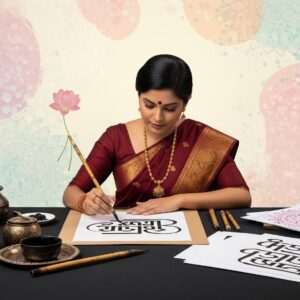
- Authentic Traditional Writing Materials: Experience the nostalgic joy of writing exactly as our ancestors did. We proudly offer premium handmade paper, natural ink sets, and beautifully crafted accessories that evoke the spiritual ambiance of ancient gurukuls. Bring home this experience from .
- Sacred Cultural Artifacts for Your Home: Discover our exquisite range of traditional artifacts and ritual items that reflect the unparalleled artistry of Bengal and beyond. These authentic goods serve as beautiful daily reminders of our enduring faith and timeless traditions. View our authentic collection at .
For more information or to find the perfect ritual items for your family, please visit our website or lovingly reach out to us at 03369029784. You can also easily connect with our dedicated support team via WhatsApp at 9476142738 for any inquiries.
Embracing and Preserving Our Timeless Heritage
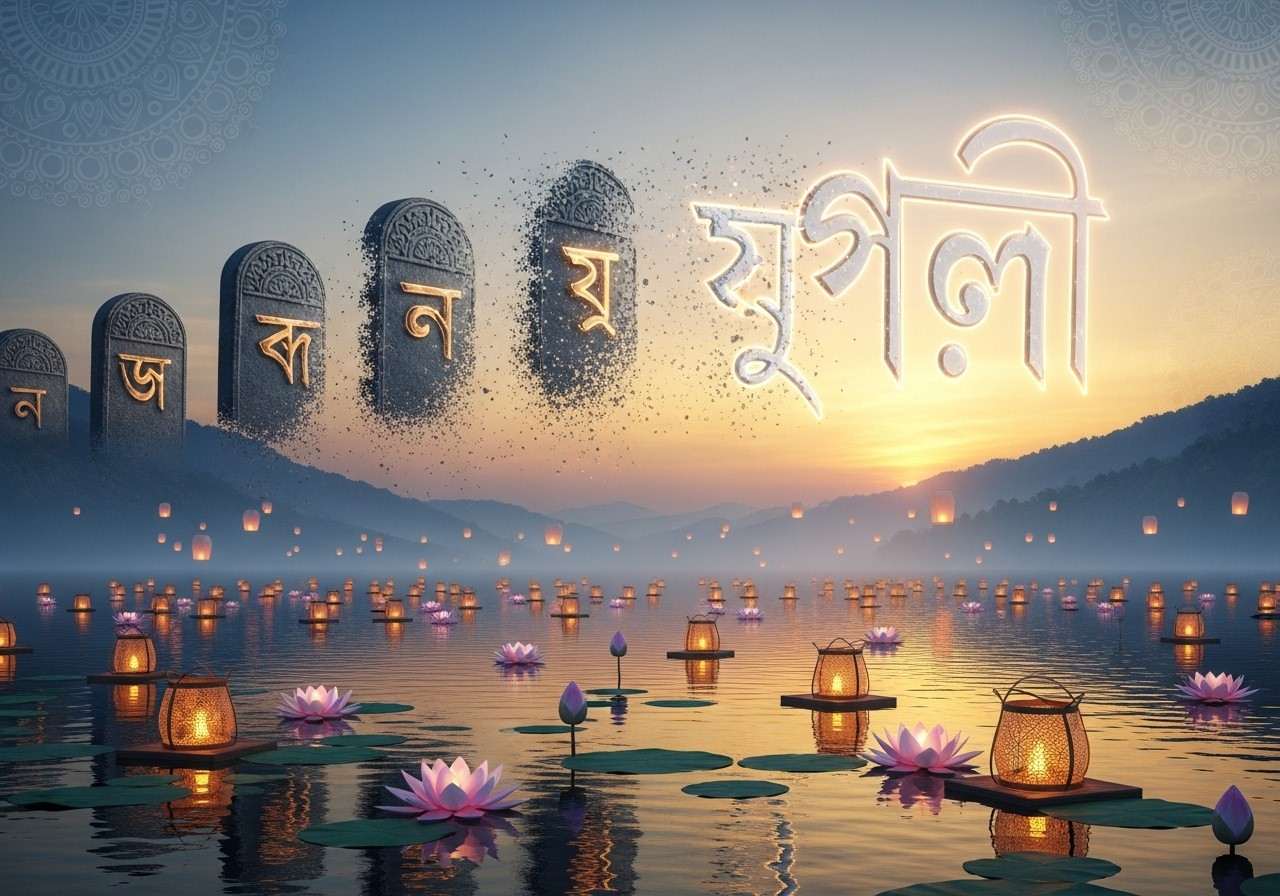
As we conclude this exploration, we are reminded that every curve and stroke of our script carries stories of resilience, deep devotion, and undeniable cultural pride. Our writing systems are not mere instruments of daily chores; they are the sacred vessels holding our folklore, our devotional songs, and our shared identity.
In our rapidly globalizing world, taking the time to understand and pass down these linguistic treasures is a beautiful duty we owe to the next generation. Let us proudly embrace our roots, nurture our mother tongues, and ensure that the legacy of our ancestors continues to inspire, unite, and guide us toward a culturally vibrant future.
Common Queries About Our Regional Script’s History
Who Invented the Eastern Indian Script?
This magnificent writing system was not the sudden invention of a single individual. Rather, it is the result of centuries of organic evolution, blossoming gradually from the ancient Brahmi script, standing as a true testament to the collective intellectual heritage of ancient India.
What is the Historical Journey of these Characters?
The historical lineage stretches back over a millennium. It gracefully developed from the Eastern Nagari script, diverging beautifully from other Indic scripts around the 11th century AD. Along the way, it absorbed the wisdom and linguistic nuances of numerous eras, passing through the Pala and Mughal empires.
When Did the Writing System Take Its Current Form?
While its earliest spoken and written roots can be traced to the Gauda region in the 7th century and Magahi Prakrit in the 10th century, the recognizable foundation of the script took solid shape around the 11th century. Its modern printed format was later crystallized in 1778, with formal standardization occurring in 1936.
How Has the Language Evolved Over Time?
The evolution is a beautiful story of cultural synthesis. Over the centuries, it was deeply influenced by Sanskrit, gracefully touched by Arabic and Persian during the Mughal era, and uniquely enriched by Dravidian, Austroasiatic, and Tibeto-Burman language families.
What Makes These Characters So Visually Unique?
The distinctiveness lies in its continuous horizontal line (matra) connecting the letters, its beautifully curved strokes, and its lack of capital letters. Operating as an abugida, its highly phonetic nature directly mirrors the rhythmic, melodic tone of the spoken language.
Is the Language Used Beyond the Borders of India?
Absolutely. It serves as a powerful bridge of cultural identity, being widely used not only in Indian states like West Bengal, Tripura, and Assam but also serving as the official national script of neighboring Bangladesh.
How Many Characters Make Up the Foundation?
The foundational structure consists of 50 letters, thoughtfully divided into distinct vowels and consonants. Each character is specifically designed to represent precise phonetic sounds, requiring careful enunciation that has been passed down through generations.
What Role Does the Script Play in Cultural Preservation?
The characters are the very soul of the region’s cultural preservation. They permanently safeguard timeless literature, soul-stirring devotional music, and revolutionary historical movements, ensuring that the vibrant identity of the community remains unshaken through the passage of time.